





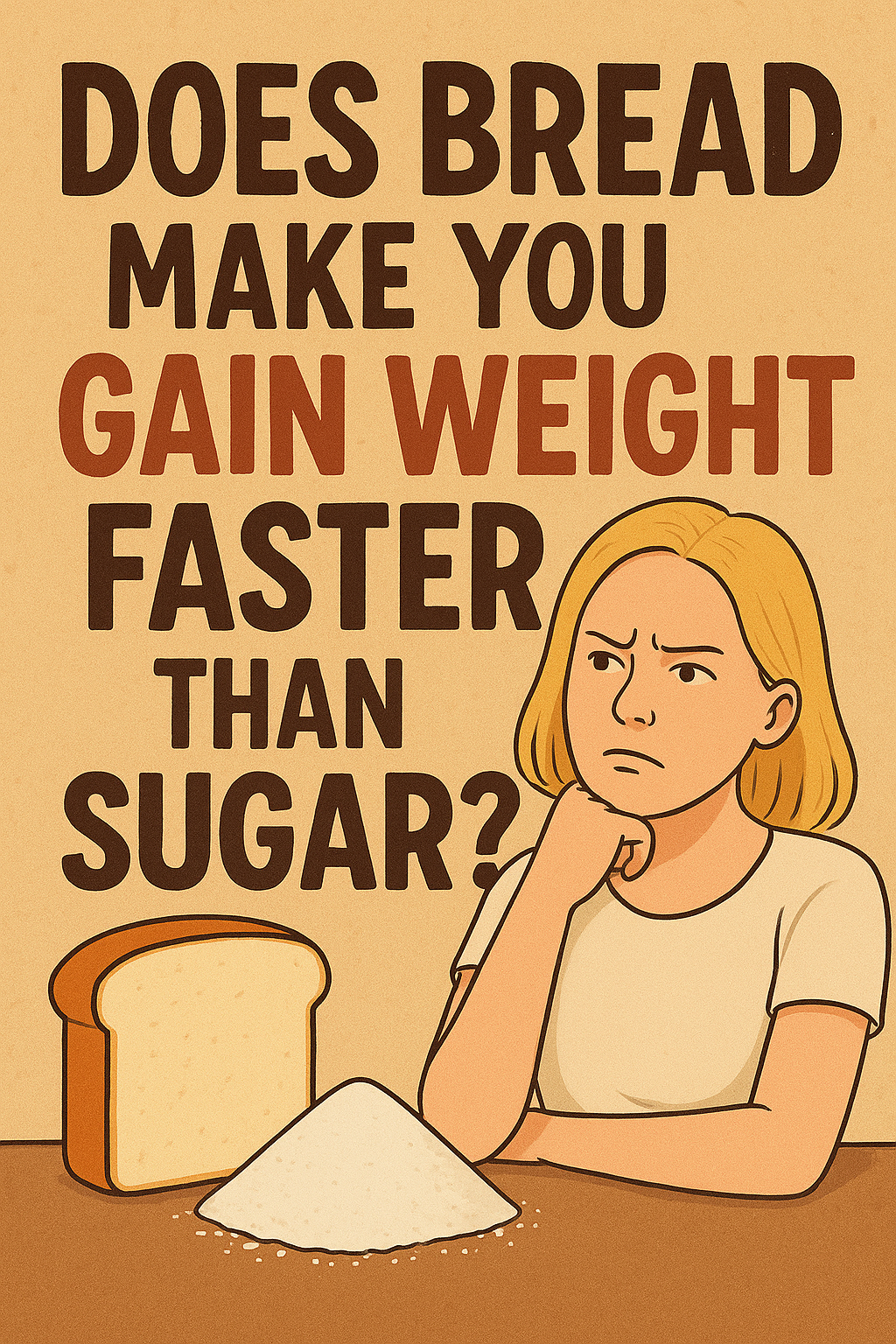
Does Bread Make You Gain Weight Faster Than Sugar? The Surprising Truth About Fruit, Flour and Sugar
expert, nutritionist
Here is a fact that surprises almost everyone: a slice of ordinary white bread can raise your blood sugar faster than a spoonful of table sugar. In the widely used International Tables of Glycemic Index and Glycemic Load Values (Atkinson, Foster-Powell and Brand-Miller, Diabetes Care, 2008), white wheat bread scores around 75, cornflakes around 81, while plain sucrose sits at roughly 65. So does that mean sugar is the "healthier" choice? Not at all. But it does mean that the usual "sugar bad, bread fine" story is far too simple.
Actor Tom Hanks learned this lesson the hard way. He revealed his type 2 diabetes diagnosis in 2013 after years of elevated blood sugar readings, and he later admitted he had once believed that simply removing the bun from his cheeseburger was enough to stay healthy. In a 2022 interview highlighted by Diabetes Australia, he described how he now watches what he eats "to the point of boredom." His story is a reminder that it is not only the sugar bowl that matters, but the whole pattern of carbohydrates on our plates, from bread and breakfast cereals to juices and sweets.
Fruit, bread and sugar are often described as foods to be wary of. Since they are not all the same, it is worth taking a closer look at what actually happens in the body when we eat them. That way we can better understand the processes in our organism and make calmer, smarter choices instead of fearing entire food groups.
We know that fruit contains fructose. Bread is rich in carbohydrates, and some people need to avoid gluten. Added sugar hides in a surprising number of everyday foods, and eating too much of it over a long period is associated with a higher risk of several chronic conditions. The good news is that the dose, the form and the overall diet make a big difference.
Sugar
Many manufacturers add high-fructose corn syrup (HFCS) to foods and drinks. The most common version used in soft drinks, HFCS 55, contains about 55% fructose and 45% glucose, as explained by the U.S. Food and Drug Administration. Unlike glucose, fructose is processed mainly in the liver. When large amounts arrive at once, especially from sweetened drinks, the liver can convert part of it into fat. Researchers have linked a long-term, high intake of added sugars to weight gain and to fat accumulation in the liver, which is why health organizations encourage moderation.
The World Health Organization guideline on sugars intake recommends keeping "free sugars" below 10% of daily energy, and suggests that going below 5% (around 25 grams, or six teaspoons, a day for an adult) may offer additional benefits. Free sugars include table sugar, syrups, honey and fruit juices, but not the sugar naturally found inside whole fruit.
Another word of caution: various substitutes such as agave syrup, maple syrup and coconut sugar are often marketed as healthier, but nutritionally they are still mostly sugar. They may bring a hint of minerals or a different flavor, yet the body treats them much like ordinary sugar. If you want to do something good for yourself, the most effective step is not to find a "better" sweetener, but to gradually get used to less sweetness overall. The same thinking applies to artificial sweeteners, which can keep the craving for very sweet tastes alive.
Sugar also hides where we least expect it. As we wrote in Sugary Breakfast Cereal: The Wolf in Sheep's Clothing That Might Be Draining Your Morning Energy, a single bowl of sweetened cereal can carry a surprisingly large share of the recommended daily limit. Analyses by the UK campaign group Action on Sugar have repeatedly shown how much added sugar is found in products marketed to children.
One more thing: when you start cutting back on sugar, be patient. Many people notice that their taste buds adjust within a couple of weeks and that foods they once found normal suddenly taste too sweet. Small, steady reductions tend to be easier to maintain than dramatic changes, so do not be discouraged if results are not visible right away.
Fruit
Fruit is healthy. We have been taught this our whole lives, and for the most part it is true. Fruit is rich in vitamins, minerals, antioxidants and especially plant fiber. The sugar in fruit is the part people worry about, but there is an important difference: in whole fruit, the sugar is locked inside plant cells surrounded by fiber, so it is absorbed more slowly than the "free" sugar in sweets or soft drinks, as Medical News Today explains.
Research largely supports this distinction. A large study of nearly 190,000 adults published in The BMJ (Muraki et al., 2013) found that a higher intake of certain whole fruits, especially blueberries, grapes and apples, was associated with a lower risk of type 2 diabetes, while a higher intake of fruit juice was associated with a higher risk. A summary of the evidence by NutritionFacts.org points in the same direction: the concerns about fructose apply mainly to added "industrial" sugars, not to fructose eaten as part of whole fruit.
The fiber in fruit is also excellent food for the beneficial bacteria in our gut. These microbes ferment fiber into compounds that support the health of the intestinal lining. The real problem arises when we strip the fiber away and drink large amounts of fruit sugar in liquid form.
We should also keep in mind that some fruit contains starch, as is the case with bananas (especially less ripe ones), which adds even more carbohydrates. Some of the biggest enemies of a balanced meal can be juicers and oversized smoothies. A recent study in Frontiers in Nutrition looked specifically at how solid fruit, juices and smoothies differ in their associations with health. If you enjoy smoothies, blend whole fruit with vegetables, kefir or yogurt rather than relying on juice alone, like in our recipes Smoothie of Eternal Youth for the Tired and Three Ingredients, One Smoothie: Why Passion Fruit, Banana, and Turmeric Are Such a Powerhouse Combination, and keep the portion reasonable.
It is true that fruit is healthy, but vegetables offer a very similar range of beneficial nutrients. A salad of bell peppers, cabbage and apple is a much better everyday choice than a fruit salad made only of bananas and grapes. The main difference is simply the amount of sugar!
Many people who are trying to manage their weight are surprised to learn how quickly "healthy" fruit snacks, dried fruit and juices can add up. Fruit is not the enemy, but large portions of very sweet fruit, especially in liquid form, can tip the balance.
Just to illustrate: 200 ml of freshly squeezed orange juice contains roughly 18 to 20 grams of sugar, and 100 grams of cake or pastry can contain 30 grams of sugar or more (counting not only the sugar added according to the recipe, but also the sugar coming from the other ingredients).
Flour
It is true that flour contains very little sugar, but it does contain a lot of starch, which the body breaks down into glucose molecules. Wheat starch is made of two components: roughly 25% amylose and 75% amylopectin.
Amylose has a more compact, linear structure that is digested more slowly. Part of it can even escape digestion and become so-called resistant starch, which reaches the large intestine and feeds our beneficial gut bacteria, a genuinely positive effect.
Amylopectin, on the other hand, has a highly branched structure that digestive enzymes, starting with those in saliva, can break down very quickly. The glucose enters the bloodstream fast, the body responds by releasing insulin, and many people then experience the familiar drop in energy and a renewed feeling of hunger soon after the meal.
This is why refined white bread has a high glycemic index of around 75, and cornflakes around 81, while table sugar scores about 65. The glycemic index concept itself was introduced by David Jenkins and colleagues at the University of Toronto in a landmark paper, Glycemic index of foods: a physiological basis for carbohydrate exchange (The American Journal of Clinical Nutrition, 1981). Commercial "whole wheat" bread made from finely milled flour can score surprisingly close to white bread, while genuinely coarse, grainy breads, dense rye and traditional sourdough tend to score lower. You can compare common foods in the Harvard Health Publishing list of glycemic index and glycemic load values for 100 foods.
Keep in mind that the glycemic index tells only part of the story. As the Linus Pauling Institute at Oregon State University explains, the glycemic load, which also considers how much carbohydrate a portion actually contains, is often more useful in everyday life. Personal responses also vary: research from the nutrition science company ZOE suggests that white bread causes large blood sugar spikes in just over half of people, while others handle moderate amounts better.
Long-term habits matter too. An Australian study of more than 36,000 adults, Hodge et al., published in Diabetes Care (2004), found that white bread was the food most strongly associated with the development of type 2 diabetes in that population. The researchers suggested that simply switching to lower-GI bread could be an easier change for many people than overhauling their entire diet.
And what about gluten? For people with celiac disease or diagnosed gluten sensitivity, avoiding gluten is essential, and the Celiac Disease Foundation offers reliable guidance. For most other people, the bigger issue with bread is not gluten itself, but the amount of refined flour and how quickly it is digested.
A few simple tricks can soften the impact of bread: choose dense, wholegrain or sourdough loaves, eat bread together with protein, healthy fats and vegetables (for example eggs, cheese, avocado or a salad), and watch portion sizes. For more everyday traps, see Hello, and Fattening: Foods that Sabotage Your Diet and Foods We Use Incorrectly.
Conclusion: What Is Good for Us?
There is no single magic formula, but most nutrition experts agree on the overall direction, and the Healthy Eating Plate from the Harvard T.H. Chan School of Public Health is a good visual guide. A practical way to think about your daily menu:
- Vegetables first: let vegetables make up the largest part of your meals, ideally around half of your plate.
- Fruit in moderation: a few portions of whole fruit a day fit well into a balanced diet. Many adults actually eat too little fruit, while some children get a large share of their energy from juices and sweet fruit snacks. Too much is not healthy, and neither is too little.
- Smart carbohydrates: choose wholegrain, coarse and minimally processed sources of starch, and keep refined white bread, pastries and sweetened cereals as occasional foods.
- Sweets as a treat: try to keep calories from sweets and added sugars to around 5% of your daily intake, in line with the stricter WHO suggestion.
- Dairy and protein: plain yogurt, kefir and other fermented dairy products, along with legumes, fish, eggs and nuts, help round out the plate and keep you full for longer.
Small, consistent changes, such as swapping juice for whole fruit, white bread for a dense wholegrain loaf, and a sugary breakfast for something with more protein and fiber, are often more sustainable than strict bans. For more ideas on everyday habits worth reconsidering, read 5 Foods That Shorten Your Lifespan.
It is not easy, but it is worth it!
Information on this website is for educational purposes only and is not medical advice.
expert, nutritionist
 Would you like to be informed about news on the website?














|

