




What Your Pimples Might - and Might Not - Be Telling You About Your Health
expert, nutritionist
Imagine waking up with a pimple on your chin, and an ancient chart confidently declaring your kidneys are struggling. It's a compelling idea - and one that sells millions of skincare products every year. But before you overhaul your diet to "detox your liver" over a spot between your eyebrows, it's worth knowing what the science actually says. You Believed Them Your Whole Life, but They're Lies: 5 Health Myths It's Time to Bury touches on exactly this territory: acne is a genuinely complex skin condition, and the folk maps attached to it regularly outrun the evidence.
What Is Face Mapping?
The concept of face mapping has its roots in ancient Chinese and Ayurvedic medicine. It is a holistic approach that views the face as a reflection of the body's overall health, with different zones thought to be energetically linked to specific internal organs. The idea is intuitive and satisfying: a breakout on the forehead means your digestion is off; one between the brows signals the liver; pimples along the chin and jaw point to hormones or the kidneys. The problem is the evidence.
There is little scientific evidence to support the theory that health issues with organs in the body relate to where acne breaks out on the face. Dermatology research shows that breakouts are primarily driven by oil production, clogged pores, bacteria, and hormones - not internal organ issues. Acne location is often better explained by exposure and friction: comedogenic hair products can affect the forehead, occlusive makeup can worsen acne, and mask friction can aggravate acne mechanica. These patterns are more plausible than organ-based face mapping.
The Face Map: What the Original Chart Says (and Where It Goes Wrong)
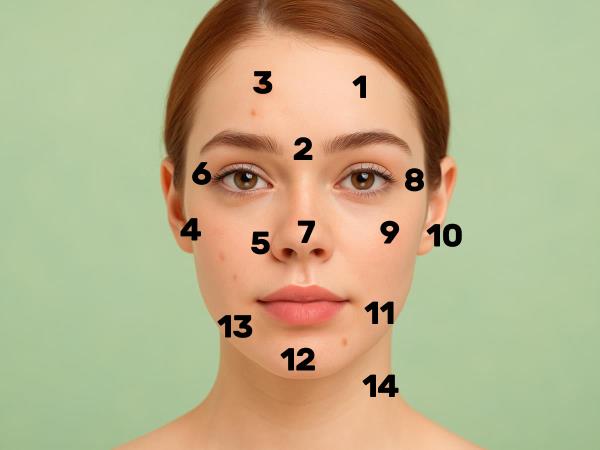
The Slovenian source this article is based on outlines 14 face zones, grouping them into bladder/digestion, liver, kidneys, respiratory, heart, hormones, and intestines. It's a classic face map presentation. Here's how each cluster holds up:
Zones 1 & 3 - Forehead: Digestion and Bladder
The map links forehead breakouts to irregular eating habits, poor sleep, and late-night overeating - and suggests switching up shampoos and conditioners. Stress can indeed lead to an increase in cortisol, a hormone that can trigger acne, but dermatologists also point to more direct external causes for forehead acne - sweat and oil trapped under hats, headbands, or a fringe, a condition known as acne mechanica. The recommendation to get more sleep, eat more vegetables, and change your hair products is sensible advice regardless, even if it has nothing to do with your bladder.
Zone 2 - Between the Eyebrows: Liver
This zone is classically assigned to the liver in Chinese face mapping. In that tradition, the T-zone points to something happening with your liver or heart. Forehead acne is not your liver. What the original advice gets right on its own merits: stopping eating two to three hours before bed is a sound habit. The body is most prepared for digesting food in the first half of the day; in the evening the circadian rhythm begins to calm down, digestion slows, and insulin no longer works as effectively. That's a real reason to avoid heavy late-night meals - it just has nothing to do with predicting a pimple between your brows.
Zones 4, 6, 8 & 10 - Under the Eyes and Cheekbones: Kidneys
Dark circles under the eyes linked to a late night or dehydration? That part is entirely plausible - dehydration affects skin appearance and overall energy. Cheek acne is often caused by touching your face, using dirty phone screens, or sleeping on dirty pillowcases. While poor hygiene can contribute to breakouts, acne in this area has no proven connection to respiratory or kidney health. The original article's tip to change your pillowcase and clean your phone screen is excellent practical advice - just not because of a kidney connection.
Zones 5 & 9 - Cheeks: Respiratory System
The map claims that people who smoke or have asthma frequently develop acne on the cheeks. Smoking does increase inflammation throughout the body and can worsen skin conditions generally, but organ-based face mapping has no scientific support; no study has been found linking pimple location to liver, kidney, or digestive health. The same applies to the lungs. That said, the practical upshot - clean your skin more carefully if you smoke - is harmless and reasonable.
Zone 7 - Nose: Heart
The original text flags nose-area acne as one of the most alarming signs, suggesting high blood pressure or heart trouble, while also admitting makeup allergies could be responsible. The nose is part of the T-zone, an area that produces more oil - which is the actual reason it's prone to breakouts. If you have genuine concerns about blood pressure, please speak to a doctor rather than reading your nose. The advice to cut salt, get fresh air, and exercise more is excellent for cardiovascular health in its own right, as we've covered in Food That Makes You Age Faster.
Zones 11 & 13 - Jawline and Chin: Hormones
This is the one area where the face map accidentally lands on something real - though the mechanism is biological, not energetic. Hormonal acne concentrates in the lower third of the face along the chin and jawlines. The jawline, chin, and mandibular area appear to have a higher concentration of androgen-sensitive follicles than other facial zones. For people who menstruate, chin acne is strongly correlated with cyclical hormonal fluctuations; research shows that up to 63% of people who menstruate experience premenstrual acne flares, predominantly along the chin and jawline.
However, even here the face map oversimplifies. Jawline acne does not by itself prove a hormonal disorder. In one study of 374 women, only 11.2% had acne limited to the mandibular area, and most did not fit the familiar "hormonal jawline" stereotype. If your chin and jaw keep breaking out in a cyclical pattern and nothing topical helps, that is a genuine reason to visit a doctor - clinically, patients with hormone-related acne can be recognised by the concentration of lesions along the jawline and chin, and more than 50% of adult female patients with persistent acne have at least one abnormal hormonal level.
Zone 12 - Chin Area: Intestines
The original text flags this zone as a warning sign for digestive irregularity - either too frequent or too infrequent - and suggests a day of fruit juices or water to "cleanse" the body. There is no evidence that acne in this specific zone signals bowel trouble. What is well supported is the connection between diet and skin more broadly: high glycemic foods trigger spikes in blood sugar and contribute to acne, and research also suggests cow's milk specifically may worsen acne. Eating more fiber and drinking water are genuinely good for digestion - just don't expect one day of juicing to clear your skin.
Zone 14 - Neck: Immune System
The original text describes neck breakouts as a near-certain sign that the body is fighting bacteria, possibly ahead of a cold or flu, and recommends loading up on lemons, bell peppers, green smoothies, and onions. There is no peer-reviewed evidence linking neck acne specifically to impending illness. What is true is that the immune-boosting foods listed here are genuinely good choices. Spinach contains vitamins A, C, E, and K, which act as antioxidants and help maintain healthy skin and strengthen the immune system. For more on maximising the nutrition you get from greens, see Boil the Tomato, Leave the Spinach Raw: What Heat Really Does to Your Food.
What Actually Causes Acne?
Acne is driven by a mix of factors - hormonal fluctuations, genetics, clogged pores, and overactive oil glands. Scientific studies suggest that acne on certain areas of the face may be due to bacteria, excess oil production, hormonal changes, or external factors such as the use of waxy hair products. Diet plays a supporting role for some people: hormones and genetics are primary drivers, with diet links being conditional - high-glycemic patterns and some dairy intake can worsen breakouts for some people, not everyone. For a detailed look at how what you eat shows up on your skin, the Foodwhisper article Food That Makes You Age Faster is a good starting point, and 5 worst foods for your skin breaks down specific culprits.
The Advice Worth Keeping
Strip away the organ-mapping mythology and several of the original recommendations are simply good general health habits:
- Eat more vegetables and drink more water. Both support skin health, digestion, and energy regardless of where on your face you happen to be breaking out.
- Get enough sleep. Sleep deprivation raises cortisol, which can worsen acne and dull skin.
- Stop eating 2{-15230}{-13416}{-15454}‚{-15700}{-15454}€{-14949}3 hours before bed. This supports digestion and metabolic health, as explained in Do late meals affect women's heart health?
- Change your pillowcase regularly and clean your phone screen. Both are genuine sources of bacteria that can transfer to your skin.
- Switch shampoos or conditioners if you notice forehead breakouts coinciding with product use - comedogenic hair products are a well-documented cause.
- Cut back on excess salt and highly processed food. Excessive salt consumption, especially of iodized salt, can cause inflammatory reactions in some individuals, manifesting as acne.
- Include immune-supportive foods - lemons, bell peppers, spinach, onions - as part of a balanced diet. For the best way to combine them, see The Kitchen Trick Your Body Is Begging You to Learn.
When Should You Actually See a Doctor?
Face maps were never designed to replace medical advice, and they cannot diagnose anything. See a healthcare professional if:
- Acne is persistent, scarring, or causing psychological distress - these are the clearest thresholds identified by the American Academy of Dermatology for seeking treatment.
- Chin and jawline breakouts follow a clear hormonal cycle and do not respond to topical care. When that pattern suggests a hormonal imbalance, clinicians may investigate polycystic ovary syndrome with blood tests and an ultrasound.
- You notice sudden, unexplained changes in your skin alongside other symptoms - fatigue, unusual hair loss, or cycle irregularities. Those are worth a check-up for reasons entirely unrelated to face mapping.
The organ version of face mapping is a myth, so do not detox your liver over a forehead spot. Read a breakout as a possible hint about a local trigger, treat the skin where the acne is, and ignore the organ chart entirely. The lifestyle habits the old chart quietly recommends - good food, good sleep, good hydration - are well worth keeping. The mystical geography, less so.
Information on this website is for educational purposes only and is not medical advice.
expert, nutritionist
 Would you like to be informed about news on the website?














|

