





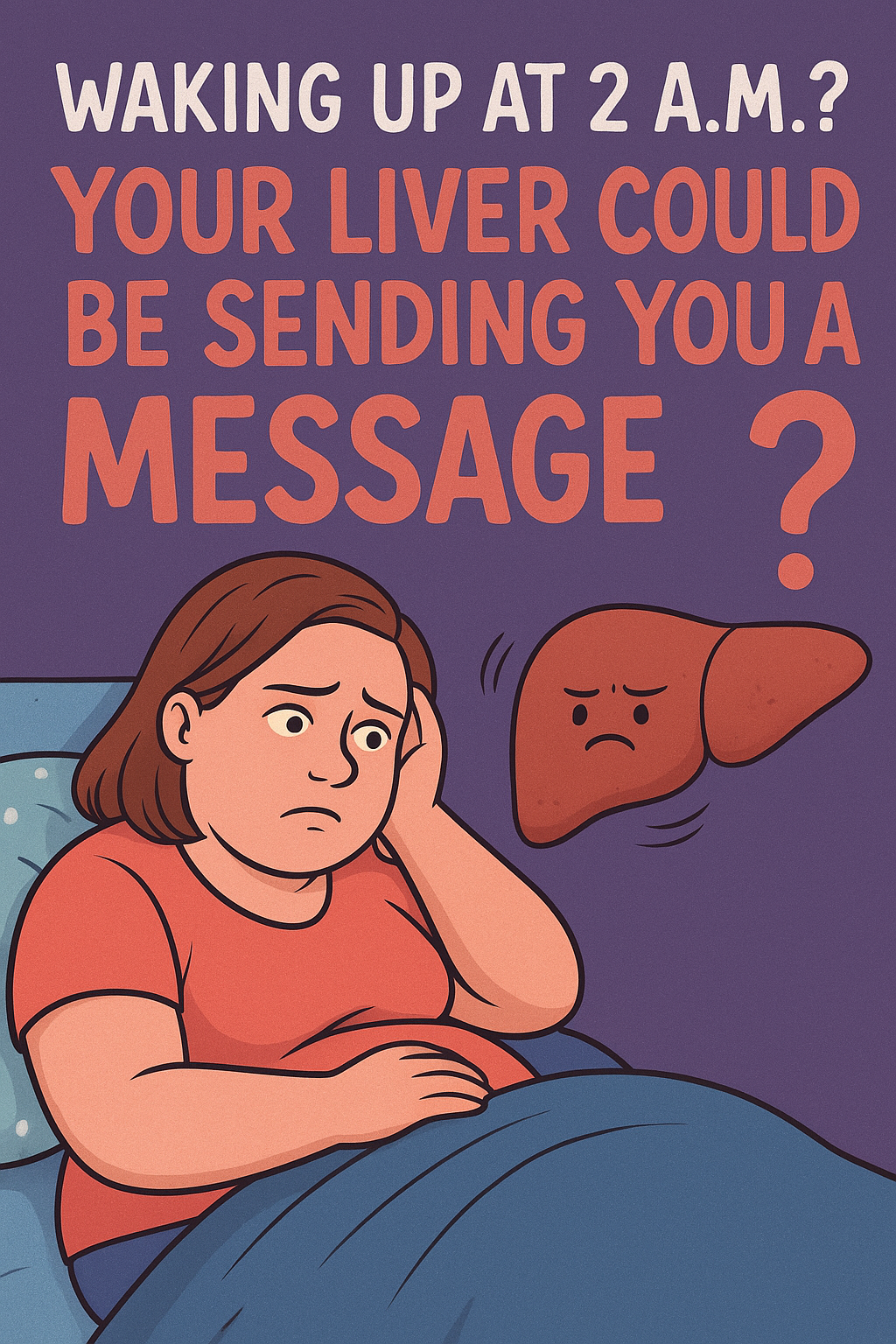
Waking Up at 2 a.m.? Your Liver Could Be Sending You a Message
expert, nutritionist
You set your alarm, fall asleep without trouble {-15454}€” and then, somewhere between 2 and 3 a.m., you're suddenly wide awake for no obvious reason. Most people blame stress, age, or a vivid dream. But a growing body of research suggests there is another, far more common culprit hiding in plain sight: a tired, overburdened liver.
The Surprising Link Between Your Liver and Your Sleep
Researchers at the University of Basel's Center for Gastrointestinal and Liver Diseases found that people with fatty liver disease show "significant fragmentation of their nightly sleep due to frequent awakenings and increased wakefulness" {-15454}€” and that they wake up 55% more often during the night than healthy volunteers, lying awake 113% longer before falling back asleep. The study was led by postdoctoral researcher Dr. Sofia Schaeffer and published in Frontiers in Network Physiology (2024). The researchers recruited 46 adults with fatty liver disease and a further eight patients with alcohol-related liver disease; all those in the fatty liver group were obese, and 80% also had metabolic syndrome.
Despite the striking numbers, the researchers were careful to note they could not yet say whether fatty liver causes poor sleep or whether poor sleep accelerates fatty liver {-15454}€” the direction of the relationship remains an open question. What is clear is that the connection is real and measurable. Earlier work adds to the picture: a 2020 U.S. study of 11,000 people found that individuals with fatty liver are 2.3 times more likely to suffer from insomnia, and in 2022 Japanese researchers confirmed that declining sleep quality correlates with rising liver enzyme levels.
What Is Fatty Liver, and Why Is It So Common?
Fatty liver, or steatosis, develops when more than 5{-15454}€“10% of the liver's total weight consists of fat accumulated inside liver cells. That doesn't mean the liver is completely diseased {-15454}€” but it is no longer in optimal shape. The condition is far more widespread than most people realise. A large 2024 meta-analysis of 479 studies covering more than 78 million participants across 38 countries estimated global NAFLD prevalence at 30.2% {-15454}€” roughly one in three adults. Prevalence is projected to keep rising, driven by the ongoing epidemics of obesity and type 2 diabetes.
The condition is also notoriously silent. Some people feel mild fatigue, others notice bloating or a dull ache under the right ribcage, and many feel nothing at all {-15454}€” until sleep starts to suffer. Increasingly, research from 2023, 2024 and 2025 confirms that fatty liver affects sleep quality much more than most people would expect.
You can find more on how fatty liver forms and what drives it in the Foodwhisper articles Is a lower carbohydrate intake suitable for fatty liver? and How do 2 weeks without bread and pasta bring your liver to its senses?
Why the Liver Disrupts Sleep
Think of the liver as a 24-hour workshop. It is the body's largest detoxification organ, with more than 500 different functions {-15454}€” from cleansing the blood to metabolising food. When fat accumulates, that workshop becomes less efficient. The liver then struggles to regulate blood sugar and certain hormones that govern the body's circadian rhythm, creating a low-level internal restlessness that surfaces as unexplained night-time waking {-15454}€” often at the same hour, most commonly between 2 and 3 a.m.
People with fatty liver disease also tend to sleep more frequently and for longer periods during the day {-15454}€” a sign that the body is trying, and failing, to make up the sleep it lost overnight. Subjectively, patients often describe their sleep as shorter and slow to start; in sleep diaries, 32% of fatty liver patients reported disturbances linked to psychological stress, compared with only 6% of healthy participants.
What You Can Do at Home {-15454}€” No Expensive Supplements, No Strict Diets
The good news is that the liver is remarkably good at healing itself when given a chance. Here are six simple, evidence-informed steps worth trying.
-
Warm water before bed
In many cultures, grandmothers have long recommended a cup of warm water to settle the liver before sleep. Today we know that a warm drink can genuinely improve circulation and support the liver's nighttime cleansing work. The original article cites studies showing warm water may reduce night-time awakenings by up to 18%, though this specific figure is difficult to trace to a single peer-reviewed source {-15454}€” treat it as preliminary rather than established.
-
A teaspoon of olive oil in the evening
Many Dalmatian families still use a spoonful of olive oil before bed. It helps bile to flow more easily and reduces liver bloating. Olive oil contains more than 70% oleic acid, which has been shown to reduce liver inflammation. The U.S. National Institutes of Health (NIH) has published studies showing that olive oil reduces inflammation and protects the liver. See also the Foodwhisper deep-dive: Olive oil on an empty stomach: healthy habit or myth?
-
Milk thistle tea
Milk thistle (Silybum marianum) is one of the most studied herbs for liver health. It contains a compound called silybin {-15454}€” a natural plant substance that helps liver cells regenerate. A 2023 meta-analysis found that milk thistle improved liver markers by 25{-15454}€“35% over three months. Medical research has led to mixed overall results, but studies do suggest silymarin may ease inflammation and promote cell repair, potentially helping with symptoms of fatty liver disease. Note that silymarin is poorly soluble in plain water, so an oil-based supplement enriched with vitamin E and unsaturated fats may deliver more of the active compound than a simple tea. The Foodwhisper article How do 2 weeks without bread and pasta bring your liver to its senses? discusses milk thistle alongside other traditional remedies.
-
Liver-friendly fruits
Three fruits stand out in the research:
- Grapefruit {-15454}€” contains naringenin, a natural plant compound associated with reducing inflammation. Important practical note: grapefruit is known to interact with a number of common medications, including some statins and blood-pressure drugs, so check with your pharmacist before making it a daily habit.
- Blueberries {-15454}€” research suggests they increase antioxidant activity in the liver.
- Pears {-15454}€” traditionally used in folk medicine to cool and calm the liver; some studies link them to lower inflammatory markers, though the human evidence remains limited.
For more on how inulin-rich vegetables (onions, garlic, chicory) also protect the liver by preventing excess fructose from reaching it, see Vegetables that protect the body from too much sugar.
-
A 12-minute walk after dinner
The original article cites a 2024 Indian study suggesting that a short post-dinner walk can reduce fat accumulation in the liver by 10{-15454}€“14% because the body burns blood sugar before it can be stored. This is consistent with broader evidence that light post-meal movement blunts the glucose spike that feeds hepatic fat storage {-15454}€” though the specific percentage figure should be treated as indicative rather than definitive until replicated in larger trials. The American Association for the Study of Liver Diseases (AASLD) 2023 guidelines recommend that people with NAFLD aim to lose at least 7{-15454}€“10% of body weight, which significantly reduces liver fat.
-
Stop eating before 10 p.m.
The liver's metabolic activity follows a circadian rhythm. Late-night eating {-15454}€” particularly of carbohydrates and sugary foods {-15454}€” gives the liver less time to process what arrives and more opportunity for fat to accumulate. Stopping food intake at least two hours before bedtime is one of the simplest ways to avoid stressing the liver further.
How Quickly Can the Liver Recover?
The liver's regenerative capacity is extraordinary. The original article summarises averages from three studies conducted between 2021 and 2024:
- ~5% reduction in liver fat within two weeks
- ~20% reduction within six weeks
- ~45% reduction within three months
These figures align with what a Swedish study published in Cell Metabolism observed when participants reduced their carbohydrate intake: after just two weeks, liver fat dropped by an average of 30% and other health markers also improved {-15454}€” the liver literally started to "breathe" easier.
German media reporting from 2025 also noted that just a 7{-15454}€“10% loss of body weight was enough to noticeably improve sleep quality in people with fatty liver. You do not need a dramatic programme to get there. The habits most consistently linked to meaningful improvement are simple: eat less sugar, drink more water, add more vegetables, take more short walks, and avoid food after 8 p.m.
Fatty Liver and the Rest of Your Body
It is worth remembering that fatty liver is not an isolated problem. When the liver is under strain it also affects skin, energy levels, inflammation and the speed of daily recovery. Research has even linked regular left-side sleeping to a lower likelihood of fatty liver {-15454}€” something explored in the Foodwhisper article 7 health benefits of sleeping on the left side. And because too much dietary fructose is one of the fastest routes to hepatic fat accumulation, if gut bacteria are well-fed with fibre, they break down fructose before it reaches the liver; without fibre, fructose arrives intact and begins causing fat to build up there.
The Bottom Line
If you have been waking up in the middle of the night for months {-15454}€” without obvious cause {-15454}€” it is worth considering your liver. Not to alarm you, but because this is one of those signals you can act on cheaply and gently, starting tonight. Multiple large meta-analyses covering tens of millions of participants confirm that roughly 30% of adults globally are living with fatty liver {-15454}€” most of them without knowing it.
- Night-time waking is one of the earliest, most overlooked signs of fatty liver.
- The 2024 University of Basel study confirmed 55% more night-time awakenings in people with the condition {-15454}€” measured objectively with wrist-worn actigraph devices.
- The remedies are low-cost and gentle: warm water, a little olive oil, milk thistle, liver-friendly fruits, a short evening walk, and an earlier kitchen curfew.
- The liver can reduce its fat load meaningfully within just a few weeks given the right conditions.
You don't need to change everything at once. Every small step produces a noticeable difference {-15454}€” and so does every good night's sleep.
Information on this website is for educational purposes only and is not medical advice.
expert, nutritionist
 Would you like to be informed about news on the website?















|

