




Can the Food That Causes Cancer Also Help Fight It? Science Has a Surprising Answer
expert, nutritionist
Men who eat two or more servings of tomato products a week may cut their prostate cancer risk by roughly 35% {-15454}€” not through any drug or supplement, but through something most of us already keep in the kitchen. That single statistic, drawn from Harvard research, captures the central tension explored here: the same dietary world that contributes to cancer may hold some of our most powerful tools against it.
How much does diet actually contribute to cancer?
The figure most often quoted {-15454}€” that roughly a third of cancers are linked to what we eat {-15454}€” has solid institutional backing, though the precise number varies by study. A landmark report from the World Cancer Research Fund (WCRF) concluded that about 40% of all cancers are linked to poor diet, physical inactivity, and suboptimal body weight. More recent modelling focused specifically on diet alone is more conservative: a 2015 analysis estimated that an estimated 80,110 new cancer cases in the United States were attributed to suboptimal diet, accounting for 5.2% of all new cases, with colorectal cancer being the most affected. Other research has suggested that poor nutritional status may account for 30% of all cancers, with gastrointestinal cancers being especially diet-sensitive {-15454}€” in those, the proportion climbs as high as 70%.
The takeaway is not a single clean number but a direction: diet and nutrition could account for 20{-15454}€“25% of the worldwide cancer burden, making it one of the most modifiable risk factors we have. The 2018 WCRF/AICR Cancer Prevention Recommendations were updated specifically to incorporate the latest scientific evidence on the role of diet and lifestyle in cancer prevention.
The same logic runs in reverse: food as a protective factor
If diet can meaningfully raise cancer risk, the logical question is whether specific foods can lower it. The answer, in a growing number of well-designed human studies, appears to be yes {-15454}€” at least for risk reduction, even if "cure" remains too strong a word.
Tomatoes and prostate cancer
A prospective study led by Edward Giovannucci at the Harvard School of Public Health found that frequent consumption of tomato products is associated with a lower risk of prostate cancer, with associations that persisted after controlling for overall fruit and vegetable consumption and markers of a Mediterranean diet. Across the broader literature, five studies support a 30{-15454}€“40% reduction in risk associated with high tomato or lycopene consumption. The largest relevant dietary study {-15454}€” a prospective cohort of male health professionals {-15454}€” found that consuming two to four servings of tomato sauce per week was associated with about a 35% reduction in total prostate cancer risk and a 50% reduction in advanced prostate cancer.
The active compound behind this effect is lycopene, the carotenoid that gives tomatoes their red color. Harvard researchers noted a stronger association when they accounted for the body's ability to absorb lycopene, adding that laboratory studies show the body absorbs lycopene more effectively from cooked tomatoes and processed tomato products than from raw tomatoes. It's worth noting that the evidence is not unanimous {-15454}€” one study published in 2007 found no proof that lycopene affects prostate cancer risk, and an FDA review of 81 studies concluded that none offered credible evidence for a relationship between lycopene consumption and prostate cancer risk. The honest position is that the association is promising but not fully settled.
A separate UK study from the Universities of Bristol, Cambridge and Oxford added useful detail: scientists assessed the diets of 1,806 prostate cancer patients and 12,005 cancer-free men, and found that men who ate more than 10 servings of tomatoes a week reduced their risk of prostate cancer by 18%. That study was the first to develop a "dietary index" for prostate cancer combining selenium, calcium, and lycopene {-15454}€” men with optimal intake of all three had the lowest risk.
Turmeric and curcumin
Alongside tomatoes, turmeric {-15454}€” or more precisely its active compound curcumin {-15454}€” has attracted serious scientific attention. A small clinical trial found that curcumin performed comparably to a standard antidepressant over six weeks {-15454}€” a result researchers call promising but preliminary. On the inflammation front, a 2023 systematic review and meta-analysis of randomized controlled trials found that turmeric and curcumin supplementation was associated with reduced levels of several inflammatory markers, including CRP, TNF-{-15474}{-15695}, and IL-6. Since chronic inflammation is a recognized driver of cancer development, this line of research is taken seriously, even if direct evidence in humans remains early-stage.
Curcumin does have a well-known practical limitation: curcumin is poorly absorbed on its own, but black pepper contains piperine, which increases curcumin absorption by up to 2,000%, as confirmed by studies on PubMed Central. For more on incorporating turmeric into everyday cooking and drinks, Foodwhisper has covered the topic in detail in The Golden Secret in a Glass: Why Turmeric Lemonade Has Scientists and Doctors Paying Attention and Warm Water with Turmeric Against Winter Troubles.
Green tea
Green tea is another food consistently appearing in both population research and laboratory studies. Reviews of epidemiological data on green tea and cancer prevention have judged the evidence as ambiguous at best, while in vitro studies and their reviews usually emphasize positive effects. Human evidence is more cautious: researchers examining the effects of habitual green tea drinking on cancer prevention found that evidence has not been fully corroborated, though systematic reviews of randomized clinical trials and observational studies have been conducted to clarify the picture. On overall health outcomes, a study by the Japanese National Cancer Center found that participants who drank five cups of green tea per day had the lowest risk of death from heart disease, stroke, and respiratory diseases. Foodwhisper's piece on 3 morning drinks for longevity covers this research in more depth.
What the broader picture looks like
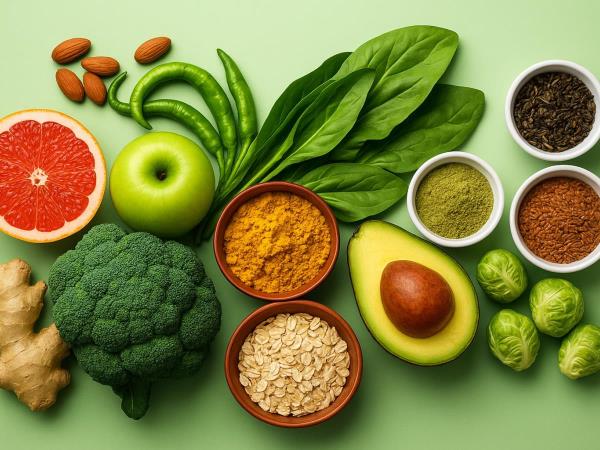
When you combine the evidence across individual foods {-15454}€” tomatoes, turmeric, green tea, olive oil, walnuts, cruciferous vegetables {-15454}€” a consistent theme emerges: specific dietary compounds interact with the body's inflammation pathways, antioxidant defenses, and immune surveillance in ways that appear to reduce cancer risk in human populations. None of this means food replaces medical treatment. But the gap between "food as risk factor" and "food as protective factor" is narrower than many people assume.
Research from Hong Kong published in 2025 showed that olive oil and walnuts strengthen special immune cells that recognize and destroy tumor cells even before they develop into cancer. In that research, a combination of medication and a diet rich in oleic acid increased therapy effectiveness by up to 25%. Foodwhisper explored this in Do olive oil and walnuts really protect the body against cancer?
The same logic applies to vegetables more broadly. Red onion contains powerful antioxidants such as quercetin, which has anti-inflammatory and anti-cancer properties, and studies have shown that extracts from red onion can inhibit the growth of cancer cells {-15454}€” at least in laboratory settings. And cabbage has been shown to have properties relevant to preventing the formation of cancer cells and blocking the development of metastases, a protective action attributed to sulforaphane, which protects cells from the invasion of carcinogens. See also Foodwhisper's round-up 7 types of vegetables that heal the body for a fuller look at how individual vegetables are being studied.
Theory versus practice {-15454}€” an honest summary
The original Slovenian observation {-15454}€” "in theory, food doesn't cure; in practice, the picture looks very different" {-15454}€” holds up reasonably well when you read the research carefully. No responsible scientist claims that eating tomatoes or drinking turmeric tea cures cancer. But the evidence that specific whole foods, eaten consistently, can meaningfully shift risk {-15454}€” and in some cases support treatment outcomes {-15454}€” is real, peer-reviewed, and growing.
Scientists predict that in the next decade, diet will become part of standard therapy for treating cancer and chronic diseases. The practical implication for now is simpler: if food can serve as a helper in treatment, there is good reason to pay attention to it {-15454}€” specifically choosing unprocessed, fermented, or minimally processed products and seeing food as part of a holistic approach.
What the evidence does not support is the idea that any single food, taken in isolation, is sufficient. What it does support {-15454}€” consistently, across multiple study designs and populations {-15454}€” is that the overall dietary pattern matters enormously, both as a source of risk and as a source of protection.
Information on this website is for educational purposes only and is not medical advice.
expert, nutritionist
 Would you like to be informed about news on the website?










|

