





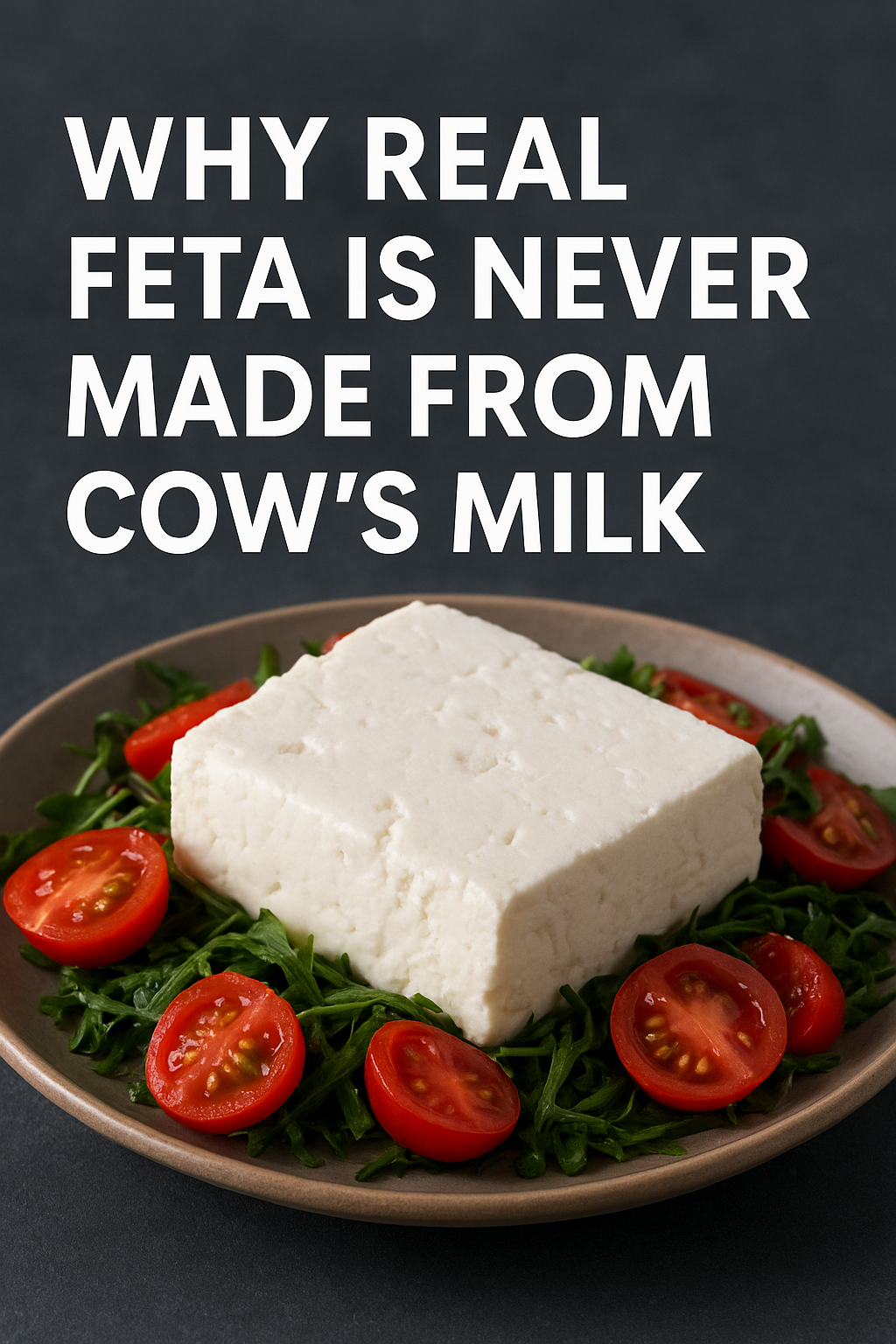


Why Real Feta Is Never Made from Cow's Milk and Why the Law Agrees
expert, nutritionist
Labeling a cow's-milk cheese "feta" isn't just misleading - inside the European Union, it's illegal. Since 2002, feta has held a Protected Designation of Origin (PDO) status in the EU, and legislation limits the name to cheeses produced in the traditional way in mainland Greece and Lesbos, made from sheep's milk or a mixture of sheep's and at most 30% goat's milk from the same region. Cow's milk is simply not part of the equation - and the reasons go far deeper than bureaucracy.
A Cheese Older Than European Cities
Feta is woven into Greek identity in a way few foods anywhere can claim. Archaeologists trace versions of the cheese back to roughly the 4th millennium BC, making it older than the first known urban settlements in Europe. Greeks therefore insist - in 2025 as fiercely as ever - that authentic feta can only be what it has always been.
The PDO "Feta" is used exclusively for cheese traditionally produced in a defined geographical area of Greece, from sheep's milk or a mixture with goat's milk (up to 30%), and has been protected in the EU since 2002 under Regulation (EC) No 1829/2002. The protection is not merely symbolic: the European Commission granted feta the same identity protection as French Champagne and Italian Parma ham. When Denmark continued exporting cow's-milk "feta" to non-EU markets, the European Court of Justice ruled in 2022 that the name may only be used for cheese that originates in the defined geographical area in Greece and conforms to the applicable product specification - even for exports. In the United States, by contrast, most cheese sold as feta is American and made from cow's milk, since US law does not define the term.
Why the Milk Matters: The Chemistry Behind the Flavour
The ban on cow's milk isn't arbitrary tradition - it reflects a genuine compositional difference that shapes flavour, texture, and nutrition from the very first step.
Sheep's milk contains nearly twice as much protein as goat and cow milk. Its high concentrations of protein, fat, and calcium per unit make it an ideal material for cheese-making, resulting in a higher cheese yield per litre of milk than cow's milk provides. The highest fat content among common dairy milks is found in sheep's milk (around 7.1 g/dL), which is statistically different from cow's milk (around 2.9 g/dL). According to the UN Food and Agriculture Organization, sheep's milk has higher fat and protein contents than goat and cow milk, and those high protein and overall solid contents make it particularly well suited for cheese and yoghurt-making.
Goat's milk adds its own character through caprylic acid (a medium-chain fatty acid), which gives feta its subtle peppery edge. Together, the two milks create a flavour and density that cow's milk simply cannot replicate. As one researcher's summary puts it, sheep's milk delivers roughly double the fat, protein, and calcium of cow's milk per 100 ml, enriched with conjugated linoleic acid and medium-chain fatty acids.
How Feta Is Actually Made
Greek cheesemakers describe the process almost poetically - and yet it is refreshingly straightforward, even if it takes more than two months from start to finish.
- Fresh milk rests for a day at low temperature to settle.
- It is pasteurised - a brief heat treatment that eliminates harmful bacteria while keeping the milk safe to consume.
- The milk is cooled to around 35 Ä‚{-15454}€š{-15230}‚{-15486}{-15696}C (roughly bath temperature).
- Rennet - a natural enzyme - is added to coagulate the milk into a solid mass.
- After about 55 minutes, the curd is cut into cubes.
- The cubes are placed in special moulds from which the whey (the liquid portion of milk) drains away.
A single batch yields roughly 6 kg of cheese - which makes sense when you consider that it takes 4Ä‚{-15477}{-15720}{-15230}{-13416}{-15454}€š{-15486}{-15700}{-15230}{-13416}{-15454}‚{-15700}›6 litres of milk to produce just one kilogram. The cheese yield expressed as kilograms per 100 litres of milk is approximately 18Ä‚{-15477}{-15720}{-15230}{-13416}{-15454}€š{-15486}{-15700}{-15230}{-13416}{-15454}‚{-15700}›20 kg for sheep's milk, compared to only 10 kg for cow's milk. Salting is done by hand, because experienced hands catch texture and moisture variations that machines miss. It is a habit shared by artisan cheesemakers the world over: tradition is often more precise than automation.
The Secret of Ageing: Why Sixty Days in Brine Changes Everything
Once the formed cheese is submerged in brine (salted water that protects it from spoilage), a quiet transformation begins. The brine gradually yellows - a visible sign that naturally occurring lactic acid bacteria are at work. Cheesemakers monitor elasticity throughout: press a piece gently, and if it springs back, it is ready.
The microflora of brines from commercial factories manufacturing traditional feta has been examined over the standard 60-day maturation period. Non-starter lactic acid bacteria are the dominant group, with Lactobacillus paracasei and Lactobacillus plantarum as the principal species identified. These organisms - along with the cheese's naturally acidic pH - are what give feta its signature tang and act as its first line of biological defence. Research published in Frontiers in Microbiology found that the population of Listeria showed a decreasing trend during ripening, with the pathogen undetected after enrichment by the 60th day in trials using protective bacterial cultures - underscoring why the minimum ageing period is not merely a tradition but a food-safety measure.
When the cheese is fully ripe it displays three main flavour notes:
- A gentle tartness from lactic fermentation (the natural process by which beneficial bacteria convert milk sugars into lactic acid)
- A faint peppery finish, contributed largely by the goat's-milk fraction
- A texture that is firm enough to slice yet creamy enough to crumble
What It Does for Your Health
Greek folk wisdom calls calcium "sun salt" - their old way of capturing the idea that it strengthens bones and keeps the body upright. Modern nutrition data backs the sentiment. Per 100 g, feta is richest in calcium at 493 mg (around 49% of the daily value). Calcium is crucial for maintaining healthy bones and teeth, and plays a role in muscle function, nerve transmission, and blood clotting.
Feta also qualifies as a fermented dairy product, and that matters for more than flavour. A body of research points to fermented dairy's potential to support gut and immune health. A 2021 review published in Advances in Nutrition found that interventions with fermented dairy foods lowered biomarkers of inflammation, while interventions with non-fermented dairy foods did not - part of an emerging body of evidence linking dairy foods to a decreased risk of inflammation. A separate meta-analysis on fermented dairy and inflammatory biomarkers found that intake of fermented dairy products reduced levels of CRP, an important inflammatory marker, especially in participants with metabolic diseases - though the authors caution that results should be interpreted carefully given the still-limited literature. These are promising associations in human studies, not proven cures; feta is food, not medicine.
Researchers at Stanford also found in a 2021 clinical trial that a diet rich in fermented foods enhances the diversity of gut microbes and decreases molecular signs of inflammation - based on 36 healthy adults randomly assigned to a 10-week fermented-food or high-fibre diet.
If you enjoy other fermented dairy products alongside feta, Foodwhisper has covered the broader benefits in Super healthy secret with Greek yogurt.
The Problem You Need to Know About: Imitations That Mislead Shoppers
Despite the EU PDO, outside the EU the name feta is often used generically, and for many consumers the word simply means a white, crumbly cheese aged in brine - regardless of origin or milk type. Even within markets that allow imitations, the nutritional gap is real.
Because sheep's milk is so much denser in protein, fat, and minerals than cow's milk, a cow's-milk imitation is compositionally a different product. The protein content of sheep's milk (4.52Ä‚{-15477}{-15720}{-15230}{-13416}{-15454}€š{-15486}{-15700}{-15230}{-13416}{-15454}‚{-15700}›5.50%) is significantly higher than that of buffalo, cow, and goat milk. A buyer who picks up a cow's-milk "feta" is therefore getting less protein and fewer minerals per gram - and may be more susceptible to digestive discomfort, since feta made with cow's milk tends to retain a higher lactose content than sheep's-milk varieties, given that the whey-drainage and ageing process affects the milks differently. Always check the label: PDO feta will state "sheep's milk" or "sheep's and goat's milk" and will carry the EU PDO logo.
A Quick Home Alternative: Greek-Style White Cheese (Asprotyri)
You cannot make authentic Greek feta at home - most of us don't have access to raw sheep's milk, and the PDO rules exist for good reason. What you can make is a very respectable home version that Greeks call asprotyri (literally "white cheese") or simply a homemade white curd. It is not feta, but it is delicious, inexpensive, and surprisingly simple.
You will need:
- 2 litres of whole (full-fat) cow's milk
- 3 tablespoons of lemon juice
- 1 teaspoon of salt
- A small pot of thick live yogurt (for the bacterial culture)
Warm the milk to 37Ä‚{-15477}{-15720}{-15230}{-13416}{-15454}€š{-15486}{-15700}{-15230}{-13416}{-15454}‚{-15700}›40 Ä‚{-15454}€š{-15230}‚{-15486}{-15696}C, stir in the yogurt, and leave the mixture in a warm spot for 12 hours. Then add the lemon juice - the acid causes the proteins to coagulate. Pour the mass through a piece of muslin or a clean tea towel, let the whey drain away, then salt the curd and press it lightly into shape. Place it in a mild brine solution (about 2% salt in water) and refrigerate. Within 3Ä‚{-15477}{-15720}{-15230}{-13416}{-15454}€š{-15486}{-15700}{-15230}{-13416}{-15454}‚{-15700}›5 days you will have a fresh, creamy, tangy cheese that works beautifully crumbled over salads, baked into pastries, or simply eaten with good bread and olive oil.
The result is lighter and milder than true PDO feta - but it costs a fraction of the price and contains no additives. Folk tradition in Greece also applies such fresh white cheese as a cool compress on minor skin irritations, crediting its mild, damp texture with a soothing effect. This is a folk practice, not a clinical recommendation.
Why Real Feta Remains in a Class of Its Own
Genuine feta is, in a very real sense, a living food. It is shaped by animals grazing on mountain pastures, transformed by naturally occurring bacteria, deepened by weeks of slow ageing in brine, respected by folk tradition, and increasingly supported by nutritional science. Officially recognised as a PDO by the EU in 2002, it enshrines an ancient Greek pastoral tradition centred on sheep and goat farming and a production model closely linked to the local area.
In an era when supermarket shelves offer products of questionable provenance at every turn, knowing what you are actually buying - and understanding the gap between a true PDO feta and its imitators - is knowledge worth having, both for your health and for your wallet.
Information on this website is for educational purposes only and is not medical advice.
expert, nutritionist
 Would you like to be informed about news on the website?









|

