


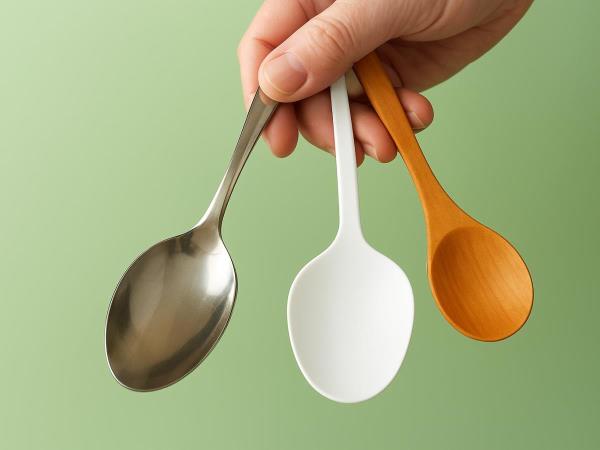

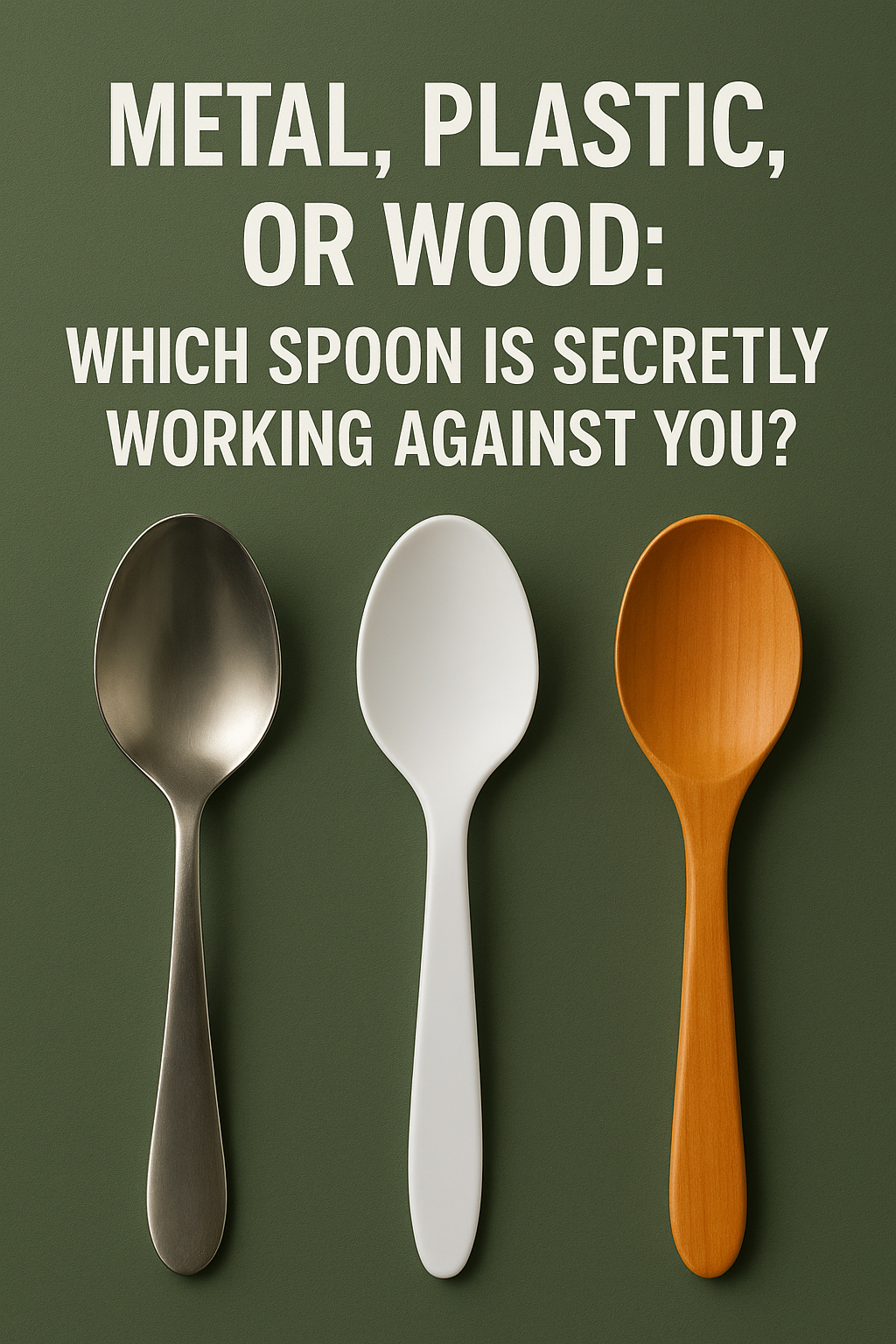


Metal, Plastic, or Wood: Which Spoon Is Secretly Working Against You?
expert, nutritionist
Imagine eating a bowl of rice and, simply by switching what you hold in your hand, lowering your blood sugar response by roughly 13 percent. That's not marketing copy {-15454}€” it's the finding of a study published in Physiology & Behavior by researchers at the National University of Singapore and the Clinical Nutrition Research Centre. The glycaemic response to white rice eaten with chopsticks was significantly lower than with a spoon, with the glycaemic index coming in at 68 for chopsticks versus 81 for a spoon. Chopstick users also took nearly double the time to finish each mouthful, because taking small bites with chopsticks means less chewing per piece. More chewing time, it turns out, matters. But we're getting ahead of ourselves {-15454}€” let's start at the beginning: the spoon drawer in your kitchen.
The Forgotten Logic: Match the Utensil to the Container
There is a simple, old-fashioned rule that most of us have abandoned entirely: use a utensil made of the same material as the container. Eat yogurt from a plastic cup with a plastic spoon. Scoop honey from a glass jar with a metal spoon {-15454}€” or better yet, a wooden one, since glass would shatter against crystallised honey. Serve food wrapped in paper or cardboard with a wooden utensil. The logic is partly practical and partly about avoiding unnecessary chemical or energetic interactions between materials. Metal can affect the energy charge of ingredients and may interact negatively with some natural substances, accelerating oxidation {-15454}€” something that experienced beekeepers and winemakers have long insisted on, many of them refusing to use any metal when producing honey or wine.
Foodwhisper's own recipe for a Salad Stronger Than a Doctor echoes exactly this principle: it is very important to prepare and eat that salad with non-metallic utensils, with a wooden spoon and wooden bowl being best, though glass and healthy plastic are also acceptable.
Metal Utensils: Not as Neutral as You Think
We use metal cutlery for almost everything today {-15454}€” and we do so largely because we inherited the assumption that it's safe from an era when fine cutlery was made of pure silver. That assumption deserves a closer look. Pure silver does have genuine antimicrobial properties: silver ions disrupt the membranes and enzyme systems of bacteria, a well-documented effect sometimes called the oligodynamic action of silver. But the stainless steel fork on your table is not silver. No reputable study has confirmed the healing effects of colloidal or dissolved silver when consumed, and health authorities warn that accumulation of silver in the body can damage internal organs, skin, and eyes. Modern cutlery delivers none of silver's antimicrobial benefit and potentially imparts a small electrical charge to food {-15454}€” an effect that is not yet fully studied.
This is why pharmacists and nutritionists have long advised against taking medicines with a metal spoon {-15454}€” the interaction between a metal surface and certain active compounds is a real concern, even if research on the specific magnitude of the effect is limited. The same caution applies when feeding babies and young children, and when using homemade cosmetic preparations such as clay face masks, where metal can destabilise the mixture. In all of these cases, wood or plastic is preferable.
Plastic Utensils: The Recycling Problem
If metal raises questions, surely plastic is the safe, neutral choice? Not necessarily. The growing concern with plastic is not primarily about virgin, food-grade plastic itself {-15454}€” it's about what happens to that plastic over time and through recycling. As more and more plastic is recycled, it becomes increasingly difficult to guarantee that the resulting material meets the same food-safety standards as the original. Recycled plastic can carry contaminants from its previous life that are not fully removed in standard processing. This is a known and ongoing challenge for regulators and manufacturers alike, and it means that the "safe plastic" you buy today may not remain safe once it has been through the recycling stream.
The practical upshot: plastic utensils that come into direct contact with food {-15454}€” especially hot food {-15454}€” should be verified as food-grade, and cheap or unknown-provenance recycled plastic items are worth treating with caution.
Wooden Utensils: Bacteria Myth vs. Reality
Wood has a reputation for harbouring germs, and the truth is more nuanced than either the scare stories or the reassurances suggest. The most-cited research on this comes from Dr. Dean Cliver, a food scientist at the University of California, Davis, whose work was published in the Journal of Food Protection. His team deliberately applied bacteria including Salmonella, Listeria and E. coli to wooden surfaces and returned to see what remained alive. On smooth, undamaged wood, the bacteria were drawn into the wood and died there {-15454}€” usually within minutes to a few hours {-15454}€” and live bacteria could not be recovered from the surface even without washing.
A 2011 study in the International Journal of Food Science & Technology comparing wooden and plastic cutting boards found that wood has natural antimicrobial properties, though its porosity can influence how long bacteria remain viable. The critical caveat is condition: when a wooden spoon becomes cracked, tiny hidden crevices form that are hard to clean thoroughly, and even regular washing may leave harmful microorganisms {-15454}€” including bacteria and mould {-15454}€” in those cracks, especially if the spoon is not properly dried.
Hardwoods such as maple and teak contain tannins, lignins, and other organic compounds that research has shown to suppress bacterial colonisation. Wood absorbs moisture and bacteria with it, which is why thorough drying matters. In the 1994 Wisconsin study, bacteria were recovered less from clean wood than from plastic. A spoon that is washed, dried, and stood upright is not a bacteria problem; one that sits damp in a closed drawer can be.
How to Actually Care for a Wooden Spoon
- Wash with hot running water rather than harsh chemical detergents, which can break down the wood's surface and push residues deeper into the grain.
- Dry immediately and stand upright in a spot with good airflow. Food safety researcher Ben Chapman notes that bacteria are best neutralised when wooden utensils are allowed to dry in a space with good air circulation for up to 24 hours.
- Dedicate spoons to specific tasks {-15454}€” one for salads, one for soups, one for desserts {-15454}€” to avoid cross-contamination of flavours and food particles.
- Retire cracked or darkened spoons. Once a spoon cracks, bacteria and food debris can lodge in the fissure in ways that soap and water cannot reach, and a cracked wooden spoon is not safe to continue using.
Chopsticks: The Answer Half the World Already Knows
The original Slovenian article ends with a tantalising question: does a solution exist, and does half the world already use it? The answer is chopsticks {-15454}€” and the evidence behind them is surprisingly solid.
Scientists at the National University of Singapore compared participants who used spoons, hands, and chopsticks to eat rice. Those who used chopsticks showed a significantly lower glycaemic response, meaning their blood sugar rose more slowly. Earlier studies have linked a lower glycaemic response to reduced risk for type 2 diabetes and related chronic diseases such as obesity and heart disease.
One underappreciated reason chopsticks remain popular is that they naturally limit how fast you eat. Research has found that eating rice with chopsticks is associated with a higher chewing rate and a lower overall eating rate compared to using a fork or spoon. Slower eating gives the body more time to register fullness, which can reduce overeating.
Research published in PLOS One notes that learning chopstick skills in early childhood activates the brain, enhances fine motor development, and builds hand coordination. In many East Asian households, children begin practising between ages three and five, and the skill is considered a developmental milestone.
It's worth being honest about the limits of the evidence. More research is needed to disentangle the effects of chopstick use itself from broader cultural dietary patterns, as nutrition researcher Jennie Brand-Miller of the University of Sydney has noted. And there is at least one downside worth knowing: a large study of over 2,500 adults in Beijing {-15454}€” the Beijing Osteoarthritis Study {-15454}€” found that decades of daily chopstick use is linked to higher rates of arthritis in specific hand joints. No utensil is perfect.
The Practical Takeaway
No single material wins outright. Metal cutlery is fine for most everyday eating but deserves more thought around medicines, infant feeding, and sensitive preparations. Plastic is convenient but scrutinise recycled or low-quality items. Wooden utensils, when made from a dense hardwood, kept smooth, washed with hot water and dried properly, are more hygienic than their reputation suggests {-15454}€” but replace them the moment they crack. And if you want to do something genuinely interesting for your metabolic health, pick up a pair of chopsticks. Half the world has been quietly ahead of the curve for thousands of years.
For more on food preparation choices that affect the quality of what you eat, see the Foodwhisper article Golden mixture against bacteria and viruses, which also highlights how the right ingredients and preparation methods work together.
Information on this website is for educational purposes only and is not medical advice.
expert, nutritionist
 Would you like to be informed about news on the website?















|

