


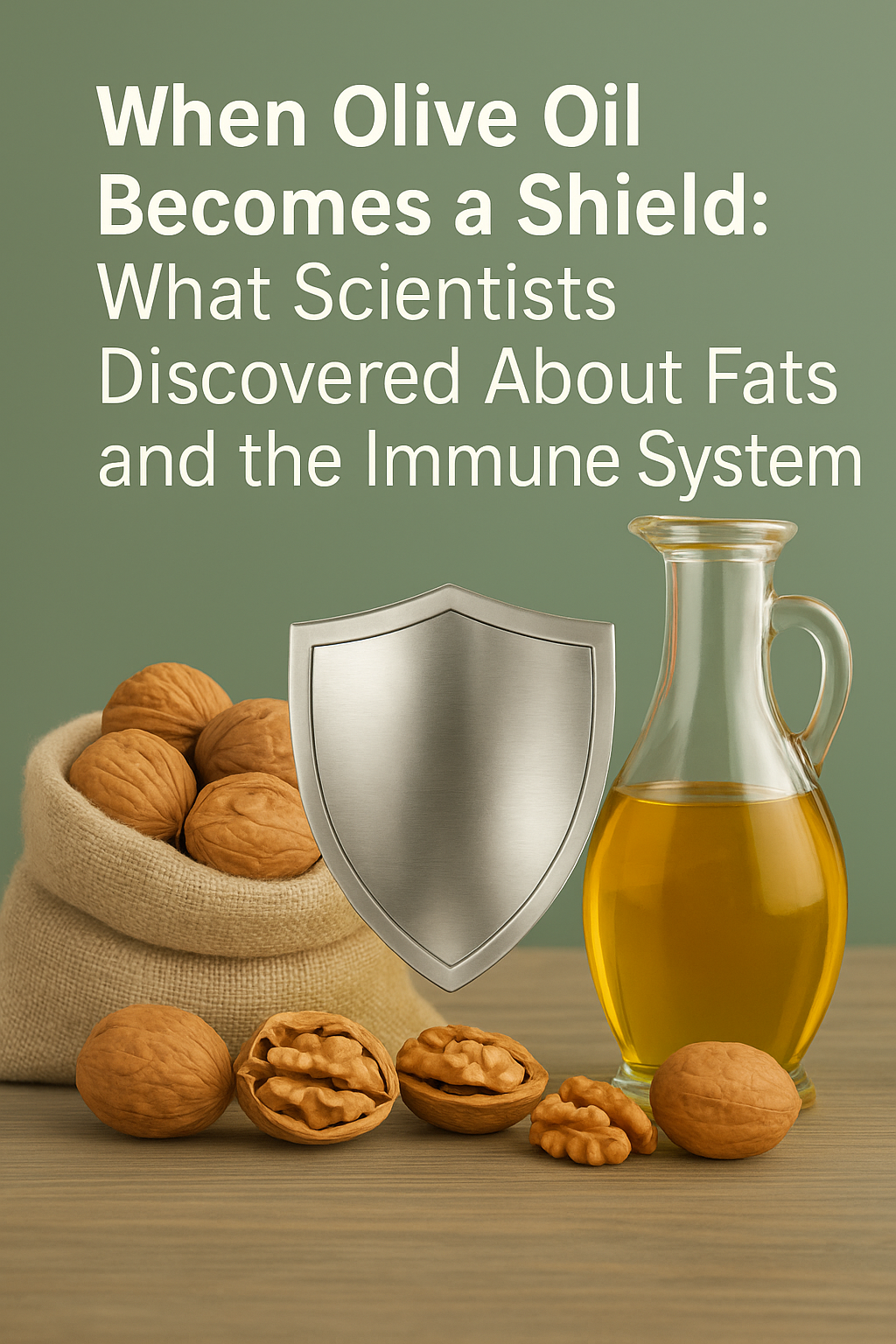


When Olive Oil Becomes a Shield: What Scientists Discovered About Fats and the Immune System
expert, nutritionist
Two kinds of fat, two very different outcomes. In a Hong Kong laboratory, immune cells exposed to the fat from olive oil stayed strong, energetic and ready for action. The very same cells exposed to the fat found in palm oil, butter and fatty meat ran out of energy, became inflamed and, in the end, destroyed themselves.
Research from the LKS Faculty of Medicine of the University of Hong Kong (HKUMed) has shown that oleic acid from olive oil and nuts strengthens immune cells that hunt down abnormal cells – at least under laboratory conditions.
Among these allies of the immune system, olive oil and walnuts stand out. But to understand why this combination is so special, we first need to look at the story of a fatty acid that sets off a true orchestration of defensive forces in the body.
The woman who lived to 122 – and poured olive oil on everything
Long before scientists in Hong Kong put immune cells under the microscope, one Frenchwoman had her own theory. Jeanne Calment, who according to Guinness World Records lived 122 years and 164 days – the longest fully authenticated human lifespan ever recorded – followed a diet rich in olive oil and even rubbed it into her skin. She remained remarkably active, still cycling at 100 and taking up fencing at 85.
Of course, her story proves nothing on its own. Calment also loved chocolate, enjoyed the occasional glass of port and smoked for most of her life, and her doctors believed genetics played a big part in her longevity. But her daily olive oil habit is a charming reminder of something Mediterranean grandmothers have always believed – and that modern science is now beginning to examine at the level of individual cells.
Many home cooks tell a similar, much more ordinary story: they did not change everything at once. They simply started frying their morning eggs in olive oil instead of butter, kept a jar of walnuts on the kitchen counter instead of a bag of crisps, and added half an avocado to their lunchtime salad. Weeks later, these small swaps had quietly become habits.
What exactly is oleic acid and why does the body love it?
Olive oil contains a substance called oleic acid. It is a fatty acid of a special kind. Don't let the word "acid" frighten you – in nature it doesn't mean anything dangerous. It is simply a name that describes the chemical structure of this fat. Oleic acid is a monounsaturated fat, which means it is soft, liquid at room temperature and generally considered a healthy choice, unlike saturated fats (butter, lard, fatty meat), which are harder and which the American Heart Association recommends limiting.
Extra virgin olive oil is one of the richest sources of oleic acid, and avocados come close behind – according to Harvard Health Publishing, half a medium avocado contains about 15 grams of fat, most of it oleic acid. Almonds and hazelnuts are also good sources. Walnuts contain some oleic acid too, but their real strength lies elsewhere – in plant-based omega-3 fats, which we will come back to shortly. If you want to get the most out of your bottle, it's worth reading Five Olive Oil Myths Most Chefs Will Never Tell You.
What did the Hong Kong researchers actually find?
A team led by Professor Tu Wenwei of HKUMed's Department of Paediatrics and Adolescent Medicine published the study in July 2025 in the journal Signal Transduction and Targeted Therapy, under the title "Oleic acid restores the impaired antitumor immunity of γδ-T cells induced by palmitic acid" (abstract on PubMed). The university presented the results to the public in October 2025.
The researchers found that oleic acid supports a special type of immune cell called gamma-delta T cells (γδ-T cells). If the name sounds complicated, think of them simply as special immune cells that patrol our body and search for suspicious cells. When they find an unwanted cell (for example, a cell that has started to grow abnormally), they move in to eliminate it.
In other words: imagine them as firefighters who arrive at the scene of a fire before anyone else even knows there is a problem.
In this Hong Kong study, gamma-delta T cells taken from human blood were grown in the laboratory and exposed to two different fats:
- oleic acid (found in olive oil, avocados, almonds and, in smaller amounts, walnuts),
- palmitic acid (found in palm oil, butter, fatty meat, full-fat dairy and many industrially processed foods).
The results were clear and surprising. When exposed to oleic acid, the gamma-delta T cells:
- remained strong and viable,
- kept their energy supply running smoothly,
- kept their signalling balanced,
- preserved their ability to attack dangerous cells.
The reason appears to lie in stable work of the mitochondria – the cell's power plants that produce energy. A mitochondrion works like a cell's battery: when the battery is full, the cell works well; when it's empty, the cell simply can't do its job. Because the mitochondria kept working properly, the immune cells were able to act decisively.
What happens when immune cells get palmitic acid?
Palmitic acid is a saturated fat. There is a lot of it in:
- butter,
- full-fat cheeses,
- fatty pork and processed meats,
- palm oil, which is widely used in biscuits, pastries, spreads, instant noodles and ready meals.
How widespread is palm oil? WWF has long said it is found in nearly half of the packaged products in supermarkets. However, a 2025 analysis of three Western supermarket chains, reported by OFI Magazine, found palm oil explicitly listed in only about 8% of products – though it could be hidden in many more under the generic term "vegetable oil." Either way, reading labels pays off, as our guide Read the Label Before You Buy Hot Dogs Again: The Codes on the Package Worth Knowing shows.
Gamma-delta T cells exposed to palmitic acid in the laboratory literally began to fall apart:
- their energy metabolism broke down,
- they released too much of a signalling protein called interferon-gamma (IFNγ),
- this triggered an inflammatory form of cell death known as pyroptosis,
- in the end, the cells destroyed themselves and lost their ability to attack abnormal cells.
In practice, palmitic acid created conditions in which immune cells could no longer do their job. It's as if firefighters had their hoses, water and equipment taken away. The encouraging part: the researchers found that adding oleic acid helped restore the weakened cells.
Food as a possible ally of cancer treatment?
What most fascinated the scientific community was the idea that the fats we eat might influence how well certain cancer therapies work. Gamma-delta T cells are already used in some experimental immunotherapies, and according to the University of Hong Kong, these cells have helped some lung and liver cancer patients live longer. Yet the therapy doesn't work equally well for everyone.
That is why the team also analysed blood samples from cancer patients receiving gamma-delta T cell therapy. They found that the levels of palmitic and oleic acid in the blood were associated with how well the therapy worked. Professor Tu described the work as the first to show that dietary fatty acids can directly affect how well our immune cells fight cancer, and suggested that eating more foods rich in oleic acid – such as olive oil, avocados and nuts – while cutting back on palmitic acid could be a simple step worth exploring.
An important caution: these are laboratory findings. As New Atlas pointed out in its coverage, the results have not yet been confirmed in clinical trials in which people simply changed their diet, so they are no reason to start drinking olive oil by the glass or buying supplements. Anyone undergoing cancer treatment should discuss any dietary changes with their oncology team.
Why are walnuts such a good friend of the immune system?
Walnuts contain:
- plant-based omega-3 fats (alpha-linolenic acid, ALA) – more than any other common nut,
- a smaller amount of oleic acid,
- vitamin E and B vitamins,
- minerals such as zinc, magnesium and selenium, which play a role in normal immune function.
Omega-3 fats are especially valuable because they are associated with a healthier inflammatory balance in the body. According to Cleveland Clinic, the healthy fats, polyphenols and vitamin E in walnuts may help reduce inflammation and oxidative damage.
A large Harvard study published in the Journal of the American College of Cardiology, which followed more than 210,000 people for up to 32 years, found that people who regularly ate nuts had a lower risk of cardiovascular disease. Eating walnuts once or more per week was associated with a 19% lower risk of cardiovascular disease and a 21% lower risk of coronary heart disease. As an observational study, it shows an association rather than proof of cause and effect – but the pattern is consistent. You can read more in One Handful of Walnuts a Day: The Small Snack Nutritionists Keep Coming Back To.
Walnuts are also one of Europe's most traditional "healing" nuts. For centuries, folk wisdom recommended them for the brain, for strength and for digestion. Today, nutrition science is gradually looking at what lies behind those old beliefs.
Olive oil and nuts together: the Mediterranean proof
The best evidence for this duo comes from Spain. In the well-known PREDIMED trial, published in the New England Journal of Medicine, more than 7,400 adults at high cardiovascular risk followed either a Mediterranean diet supplemented with extra virgin olive oil, a Mediterranean diet supplemented with mixed nuts (half of them walnuts), or a reduced-fat control diet. Both Mediterranean groups had fewer major cardiovascular events than the control group.
Similarly, a Harvard analysis reported by the American Heart Association found that people who consumed more than half a tablespoon of olive oil a day had a lower risk of heart disease than those who rarely used it – and that replacing butter, margarine or mayonnaise with olive oil was linked to additional benefit. It's no wonder that Why are nutritionists all over the world paying attention to the Mediterranean diet remains one of our most-read topics, while the opposite pattern is explored in Western diet causes inflammation, African traditional diet offers solutions that we do not want to see.
What does this mean for your kitchen?
There's no need to completely change your diet. It's enough to:
- replace butter with olive oil a few times a week,
- choose plant-based cooking fats more often,
- snack on walnuts instead of industrial crisps,
- add avocado to your salad,
- eat smaller portions of foods that contain palm oil.
Of course, we are talking about small steps, but these steps add up over time.
How to easily increase your oleic acid intake at home
Here are a few tried-and-tested, inexpensive and time-honoured ideas:
- A spoonful of olive oil in the morning
This is an old Mediterranean habit that many people enjoy as part of their morning routine. There is no strong scientific evidence that taking it on an empty stomach has special benefits – what matters most is that olive oil regularly replaces less healthy fats in your diet. If you prefer, simply drizzle it over your breakfast toast or vegetables. - A handful of walnuts a day
That's about 20–30 g of walnuts (in the PREDIMED trial, participants ate 30 g of mixed nuts a day). It's an easy way to add plant-based omega-3 fats to your diet. - A homemade salad with avocado
Avocado provides around 10 g of oleic acid per 100 g, along with fibre, potassium and vitamin E. It also makes a salad more filling. - Replace mayonnaise with an avocado spread
Mash a ripe avocado with a little lemon juice, salt and pepper. It's simple, natural and contains no industrial fats.
One more tip: how you use oil matters as much as which oil you choose. Overheating oil or reusing it for frying can undo much of the benefit – see 4 mistakes in the kitchen that make you lose nutrients.
What about warnings?
Nothing should be taken to excess. Many experts point out that too much fat, even healthy fat, can burden digestion and add up quickly in calories: one tablespoon of olive oil contains roughly 120 calories. Balance is key. For a healthy adult, 1–2 tablespoons of olive oil a day is a reasonable everyday amount within a balanced diet, in line with the World Health Organization's advice to favour unsaturated fats over saturated ones.
Tree nuts are also a common allergen, and people taking certain medications (for example, some thyroid medications) or managing a chronic condition should check with their doctor or pharmacist before making significant dietary changes.
Natural food can support your immune system
Research from recent years increasingly suggests that the food you choose can influence how your immune cells work. Oleic acid from olive oil, avocados and nuts appears to act as good fuel for some of our most important defenders, the gamma-delta T cells – at least in the laboratory.
It's not a miracle cure, but it is a promising direction in nutrition science, and it fits neatly with decades of research on the Mediterranean way of eating.
And the best part: the solution is homemade, inexpensive, simple and accessible. Olive oil, walnuts, avocados and seeds are foods you can include in your diet today as part of a varied, balanced menu.
Give it a try!
Information on this website is for educational purposes only and is not medical advice.
expert, nutritionist
 Would you like to be informed about news on the website?













|

