





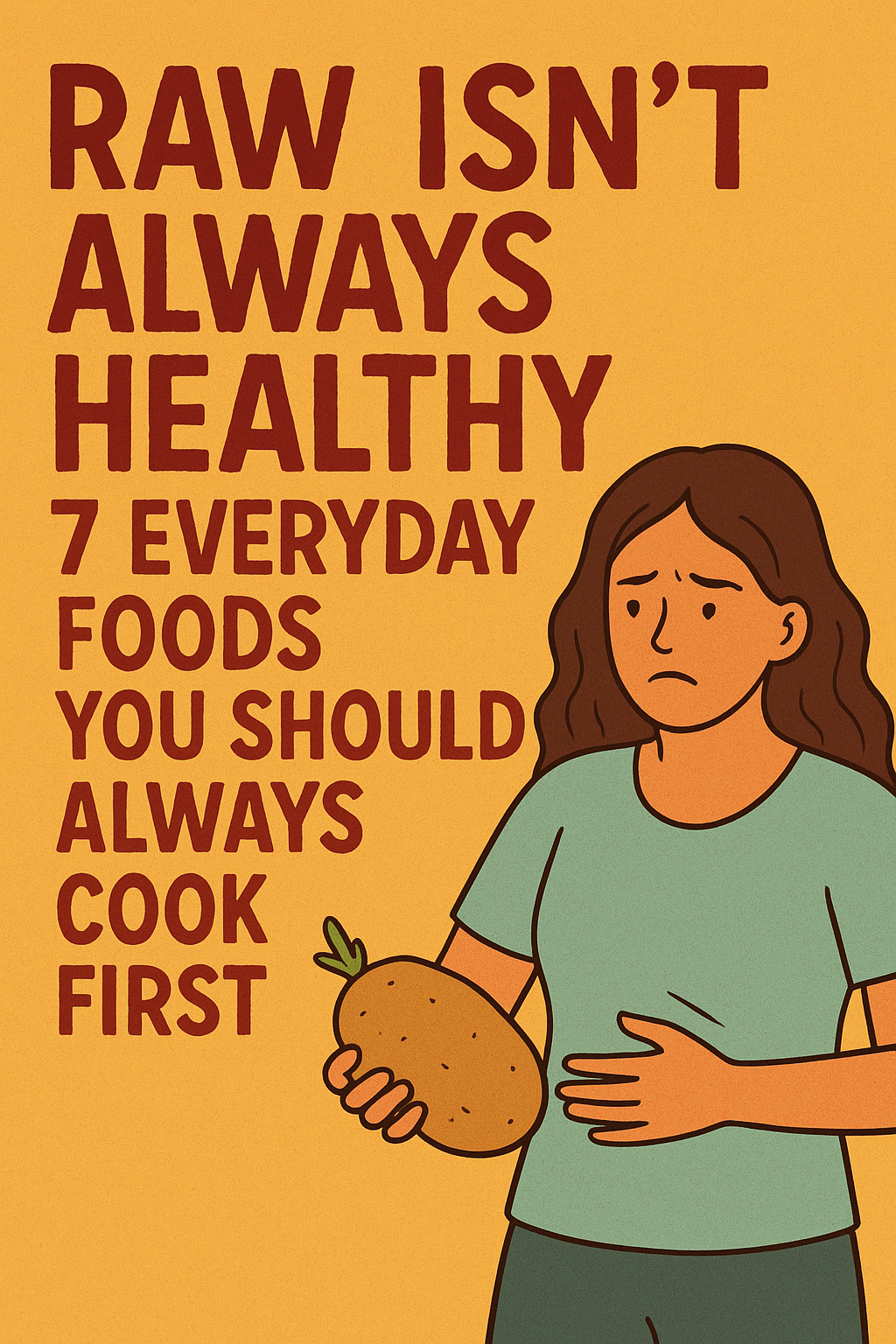
Raw Isn't Always Healthy: 7 Everyday Foods You Should Always Cook First
expert, nutritionist
Most people who sneak a spoonful of raw cookie dough worry about the eggs. Few think about the flour, yet that is where U.S. food safety agencies point first. Flour is a raw farm product, and grinding and bleaching don't kill the bacteria it can pick up in the field. Flour isn't the only kitchen staple that is better cooked. A freshly sliced potato for a salad, crunchy cassava, a glass of milk straight from the farm or a cold hot dog from the pack can all cause more than a disappointing meal. Here are seven foods where you should reach for the pot, not the salad knife.
One of our readers once told us about a friend who was making homemade pasta salad. Out of old habit, she kept tasting the raw dough for her noodles. A few hours later she had severe stomach cramps that only settled after a visit to the doctor. That was when she learned the likely culprit wasn't the eggs, as she had always assumed, but the flour. We have seen more stories like this in the comments under our articles than you might expect, and that is why we decided to look at the topic more closely.
Some foods do keep more of certain nutrients when eaten raw. Others, such as tomatoes and beetroot, change a little with heat and are healthy either way. We explored this balance in Boil the Tomato, Leave the Spinach Raw: What Heat Really Does to Your Food. Some foods, though, really should only be eaten cooked, or at least treated with extra care.
1. Flour
Remember the grandmothers who wouldn't let children eat raw dough? Most of us assumed the warning was about raw eggs, and few people knew the flour itself could be a problem. The FDA says most flour is a raw food that hasn't been treated to kill bacteria. Grain can pick up germs in the field or during milling, and harvesting, grinding and bleaching don't remove them. The CDC adds that it has investigated outbreaks linked to raw flour or cake mix in 2016, 2019, 2021 and 2023, caused by E. coli and Salmonella.
That means tasting raw dough for cookies, pancakes, pizza or bread isn't safe either. The same goes for homemade play dough. Both agencies advise against letting children play with raw-flour dough, because little hands end up in little mouths. Baking or cooking is the only step that kills these germs. If you love edible cookie dough, choose a product labelled as made with heat-treated flour.
2. Potatoes
Raw potatoes are hard on the stomach for many people and can cause bloating and painful indigestion. The same goes for potatoes that aren't cooked through. The bigger concern, though, is green patches. Potatoes, like other members of the nightshade family, produce glycoalkaloids, mainly solanine and chaconine, to protect themselves against pests and germs. Germany's Federal Institute for Risk Assessment (BfR) explains that green parts are a sign of higher glycoalkaloid levels, and that levels are especially high in the sprouts and "eyes". Potatoes stored in light or warmth, or for too long, are the most likely to be affected.
The tricky part is the timing. According to MedlinePlus, the U.S. National Library of Medicine's health site, symptoms are mostly digestive and are often delayed by 8 to 10 hours. By then, many people no longer connect them with the earlier meal. The BfR lists nausea, stomach ache, vomiting and diarrhoea, sometimes with fever. In rare, severe cases, consciousness can be affected.
One important point: cooking is not a fix for green potatoes. A toxicology review prepared for the U.S. National Institute of Environmental Health Sciences notes that boiling does not effectively break these compounds down. The BfR's advice is practical. Cut away green parts and eyes generously, don't reuse the cooking water, and skip any potato dish that tastes bitter. Small children in particular should only eat peeled potatoes.
Potatoes aren't the only familiar food with these natural defences. Unripe green tomatoes contain related glycoalkaloids, mainly tomatine. In healthy adults, the small amounts in well-stored potatoes are generally not considered a problem. Still, a little caution doesn't hurt, especially with children.
3. Cassava (Yuca)
First, a quick clarification, because the names are easy to mix up. Cassava, also called yuca or manioc, is a starchy root crop. It is not the same plant as yucca, the spiky ornamental often seen in gardens and offices. Cassava root is a staple food for hundreds of millions of people, but it naturally contains cyanogenic glycosides (linamarin and lotaustralin), which can release cyanide in the body.
The danger is real. The CDC published a report on an outbreak of cyanide poisoning caused by cassava flour in Kasese District, Uganda, in September 2017. Investigators identified 98 probable cases, including two deaths, after people ate a dish made from cassava flour. Tests of the flour found an average of 88 ppm of cyanide equivalent, more than eight times the recommended safe level of 10 ppm. The authors suspected bitter wild cassava varieties and stressed that traditional processing steps, including peeling, long soaking and drying or roasting, must be followed carefully.
So never eat cassava raw. Peeled, cleaned, soaked and thoroughly cooked, it has a pleasant, mildly nutty flavour. You just need to be careful in the kitchen.
4. Dried Beans and Other Legumes
Legumes are excellent sources of protein, fibre and antioxidants. Raw dried beans, however, contain phytohaemagglutinin, a lectin the plant makes to protect itself. According to the FDA, the high levels in raw or undercooked beans, especially red kidney beans, can cause nausea, severe vomiting and diarrhoea. The low levels left in canned and properly cooked beans are not a concern. The FDA's method is simple: soak the beans for at least five hours, discard the water, then boil them in fresh water for at least 30 minutes.
Fresh garden peas are a different story. Many people happily snack on a few straight from the pod. The foods that really need the full soak-and-boil treatment are dried beans, and red kidney beans most of all. A slow simmer on low heat that never reaches a proper boil isn't enough.
5. Unpasteurised (Raw) Milk
Milk straight from the cow may sound wholesome, but raw milk can carry Salmonella, E. coli, Listeria and Campylobacter. The FDA cites CDC data linking raw milk to 202 outbreaks between 1998 and 2018, with 2,645 illnesses and 228 hospitalisations, and notes that most foodborne illnesses are never part of a recognised outbreak. The FDA also addresses common myths. Pasteurisation does not reduce milk's nutritional value, and it does not cause lactose intolerance.
The CDC says children under five, adults over 65, pregnant women and people with weakened immune systems are at higher risk of serious illness. It also warns against drinking raw milk that may contain live H5N1 bird flu virus. The bottom line: skip fresh unpasteurised milk where you can, and enjoy dairy made from pasteurised milk.
6. Hot Dogs and Other Ready-to-Eat Meats
Hot dogs are already cooked when you buy them, so many people eat them cold straight from the pack. The catch is that ready-to-eat meats can be contaminated with Listeria after processing. Unlike many bacteria, Listeria can grow in the fridge. The CDC's guidance on preventing listeriosis recommends that anyone who is pregnant, 65 or older, or has a weakened immune system reheat hot dogs and deli meats until steaming hot, or to 74{-15230}‚{-15486}{-15696}C (165{-15230}‚{-15486}{-15696}F). Opened packs of hot dogs should be used within a week.
Most healthy adults who eat a cold hot dog won't get sick, but listeriosis is serious for vulnerable groups. It is also worth remembering that the World Health Organization's cancer agency classifies processed meat as carcinogenic to humans. That is another good reason to treat hot dogs as an occasional food. In short, buy from trusted producers, store them properly and heat them through.
7. Eggplant (Aubergine)
Eggplant is the least dangerous food on this list, and it is worth saying so plainly. Like potatoes and tomatoes, it belongs to the nightshade family and contains some solanine. However, the amounts in the fruit are low, and you would have to eat an unreasonable quantity of raw eggplant to be harmed. The real reasons most people cook it are that raw eggplant tends to be bitter and spongy and is hard on some stomachs.
A smaller group of people react to eggplant itself. A 2021 review of eggplant allergy describes reactions ranging from digestive to respiratory symptoms and identifies several possible triggering proteins. Most of the evidence comes from case series rather than large population studies. Some of these allergens are present in both raw and cooked eggplant, so cooking isn't a cure for a true allergy. Anyone who notices itching, a rash or mouth irritation after eating eggplant should talk to a doctor.
The good news is that a well-cooked eggplant, whether roasted, grilled or braised, is a low-calorie, fibre-rich vegetable that soaks up flavour beautifully. For more everyday foods whose benefits depend on how you prepare them, see Foods We Use Incorrectly.
It's natural to want as much as possible from our food, and that instinct often pushes us toward eating things raw. As we've seen, though, some plants have built-in defence systems, and some foods pick up germs long before they reach our kitchens. In many of these cases, proper cooking is what makes them safe. Once cooked, keep leftovers safe too. Our guide Leftovers Tonight? These Are the Foods You Should Never Reheat - and the Reason Will Surprise You covers the next step. The rule is simple: with these foods, safety comes before kitchen experiments.
Information on this website is for educational purposes only and is not medical advice.
expert, nutritionist
 Would you like to be informed about news on the website?











|

