




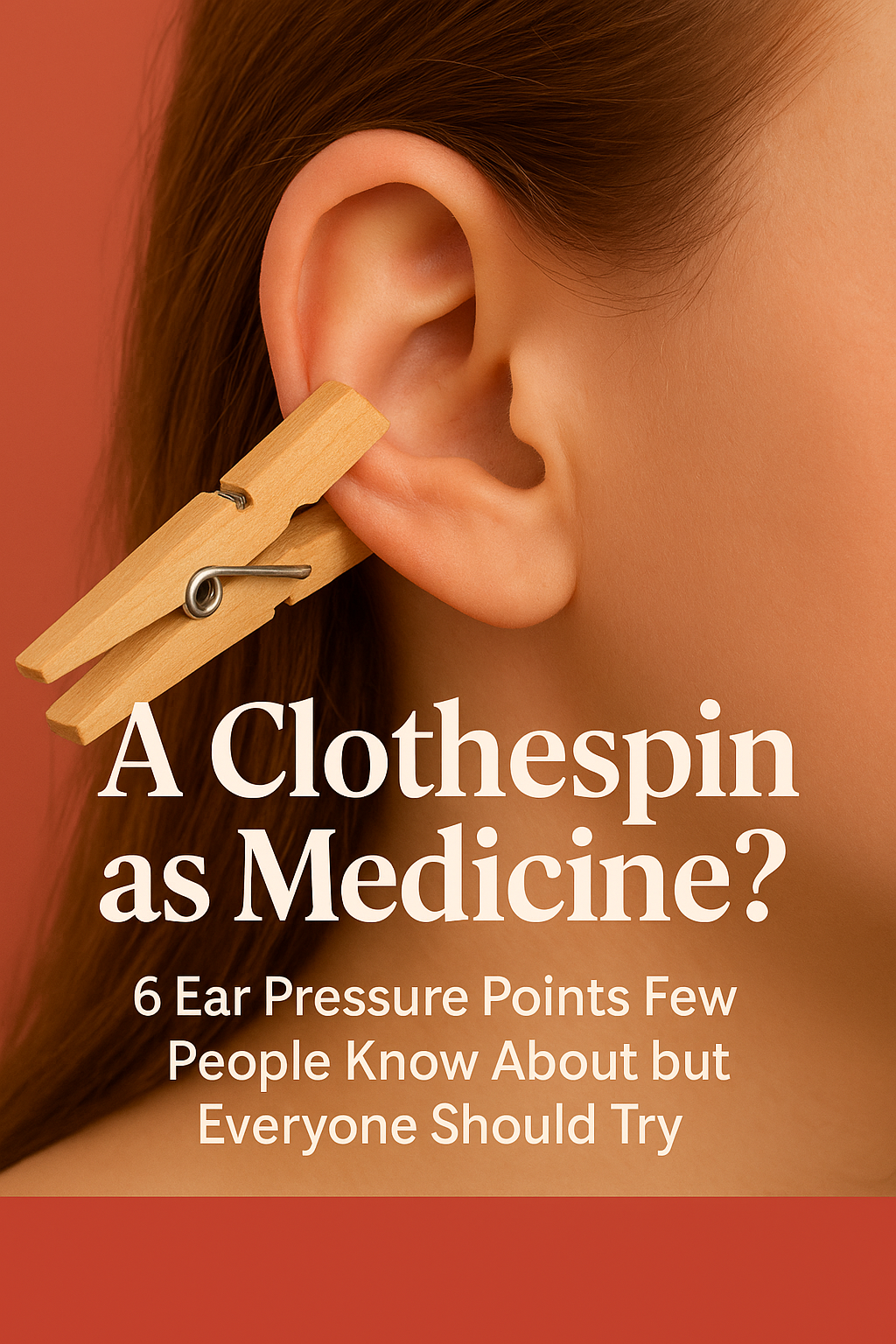

A Clothespin as Medicine? 6 Ear Pressure Points Few People Know About but Everyone Should Try
expert, nutritionist
Your outer ear isn't just cartilage and skin. A small hollow in the upper part of the ear's inner bowl, the cymba conchae, is of special interest to researchers because it is supplied only by a branch of the vagus nerve. The vagus nerve is the long "wandering" nerve that connects the brain with organs in the neck, chest and abdomen. Scientists are now testing gentle electrical stimulation of this ear branch, which sends input to the brainstem and may offer a non-invasive way to influence various brain functions. Traditional Chinese medicine reached a similar conclusion centuries ago: the ear is a doorway to the rest of the body.
The feet are said to have similar reflex zones, but the ears are much easier to reach, especially at a desk, on the sofa or in a waiting room. Massachusetts reflexologist Helen Chin Lui took the complex Chinese system of ear massage and simplified it for a fast-paced life. She describes each ear as holding a full reflex map of the body, rich in nerve endings. Her trick is to keep an ordinary clothespin handy and learn six key spots on your ear. She is a certified reflexologist who founded the Healing Place in Medfield.
What the research says before you reach for the clothespin
The clothespin method itself has never been tested in a clinical trial. The idea behind it, though, called auricular acupressure, has been studied in people. Practitioners usually apply small seeds or patches to ear points rather than clothespins.
- Pain in general: A 2014 meta-analysis of human trials compared ear therapy with sham treatment and found that ear therapy gave greater pain relief. Acupressure had the strongest evidence of the methods studied. The authors still called for larger trials.
- Chronic low back pain: A 2017 review of seven randomized trials reported large short-term improvements in pain. The authors said rigorous, larger trials are still needed for a precise estimate.
- Constipation: A 2023 meta-analysis of 34 trials with 2,465 adults called ear acupressure potentially safe and effective. It also rated the quality of the evidence as low to very low.
The traditional "map" that links each part of the ear to a specific organ is a different matter. It goes back to the French physician Paul Nogier, who mapped ear points as an upside-down fetus in the 1950s, and it has not been proven anatomically. As WebMD puts it, there is little proof that reflexology treats medical problems, though a relaxing massage can still help you de-stress. So treat the points below as a pleasant, low-cost way to relax and ease minor discomfort, not as a cure.
How to use the clothespin
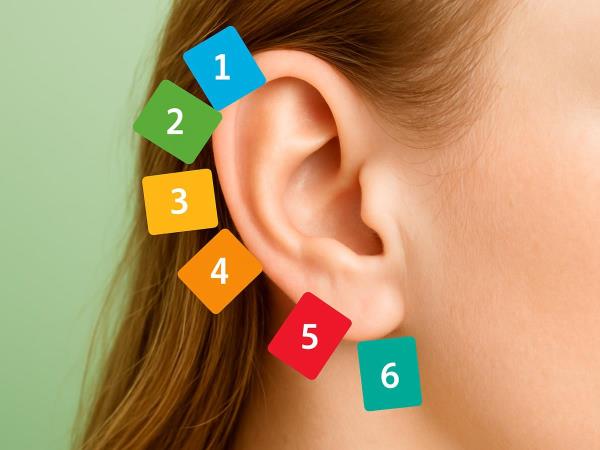
Choose a clothespin whose grip presses on roughly the same area of the ear as shown in the picture. Point it in the same direction as the square marked on the image. Placed this way, one clothespin presses on several neighbouring points at once.
The pressure should feel firm but never painful. Take it off at once if your ear starts to throb, goes numb or changes colour, and don't clip it onto broken or inflamed skin.
Point 1: Neck and spine
If your back or neck is aching, clip the clothespin to the very top of your ear for about 60 seconds. It helps to get comfortable or even lie down so your muscles can fully relax. That's fitting, since chronic low back pain is the area where ear acupressure has some of its more encouraging results.
Point 2: Internal organs
Just below the top of the ear, the traditional map places an important cluster of points linked to the internal organs. If you have a tummy ache, feel bloated or have caught a chill, Chin Lui's advice is to leave the clothespin on for up to three minutes or a little longer. Any pain that is new, severe or keeps coming back needs a doctor, not a clothespin.
Point 3: Joints
Pressing this part of the ear is meant to ease aching joints. Sometimes you need to keep up the pressure for several minutes, take a short break and then repeat. Reviews in people with chronic musculoskeletal pain are encouraging, but they used standard ear acupressure protocols rather than a clothespin.
Point 4: Nose, mouth and throat
The method recommends this spot for the moment you feel a cold or flu coming on, such as the first scratch in your throat. Many people find a few quiet minutes with the clothespin soothing. However, there is no evidence that it redirects your immune system to your throat or helps you wake up healthy the next morning, so we've left those promises out. Also, don't sleep with a clothespin on your ear, because hours of constant pressure can irritate the skin. For a stuffy head, try a kitchen remedy like Two Ingredients, a Thousand Years of Tradition: The Horseradish and Vinegar Remedy That Clears Sinuses and Eases Headaches, or for a nagging cough, More Than a Fruit: A Simple 3-Ingredient Banana Syrup That Soothes Coughs and Eases Bronchitis.
Point 5: Digestion
Maybe a meal is sitting heavily in your stomach, you've eaten something rich, or food has simply left you feeling off. Gas, rumbling and that uncomfortable fullness often follow. This is the point Chin Lui suggests for those moments, sometimes for 20 minutes or more depending on how slowly your digestion is moving. The original claim was that pressing here tells the body to skip a step of digestion. There is no evidence for that, but there is a more plausible reason ear stimulation might help. Researchers note that the vagus nerve helps regulate gut muscle contractions and secretions, and ear acupressure may act in a similar way to vagus nerve stimulation. Bear in mind that this is still a hypothesis.
Point 6: Head and heart
The lower part of the ear, around the lobe, is traditionally linked to the head, heart and blood vessels. Chin Lui recommends it for headaches and for that uncomfortable feeling of a pounding heartbeat, and some people use it as part of their routine for blood pressure. Some studies point in a hopeful direction here. A 2019 meta-analysis found that ear acupressure plus blood pressure medication lowered readings more than medication alone. The authors framed it as an add-on to drugs, not a replacement. A newer review of non-invasive ear stimulation says more studies are needed before it can be considered a real treatment for hypertension. So never stop or change your medication because of a clothespin. A racing heart, chest discomfort or sudden severe headache all need prompt medical attention. Our guide to 10 Body Signals You Should Never Ignore - and What They're Really Telling You explains which warning signs matter most.
The bottom line
A clothespin on the ear won't cure disease. It is still a cheap, quick and mostly harmless way to take a minute for yourself, relax tense muscles and perhaps take the edge off everyday aches. Human studies on ear acupressure for back pain, constipation and blood pressure are promising but mostly small and of modest quality. If you enjoy it, use it as a small extra alongside proper treatment, not instead of it.
Information on this website is for educational purposes only and is not medical advice.
expert, nutritionist
 Would you like to be informed about news on the website?













|

