





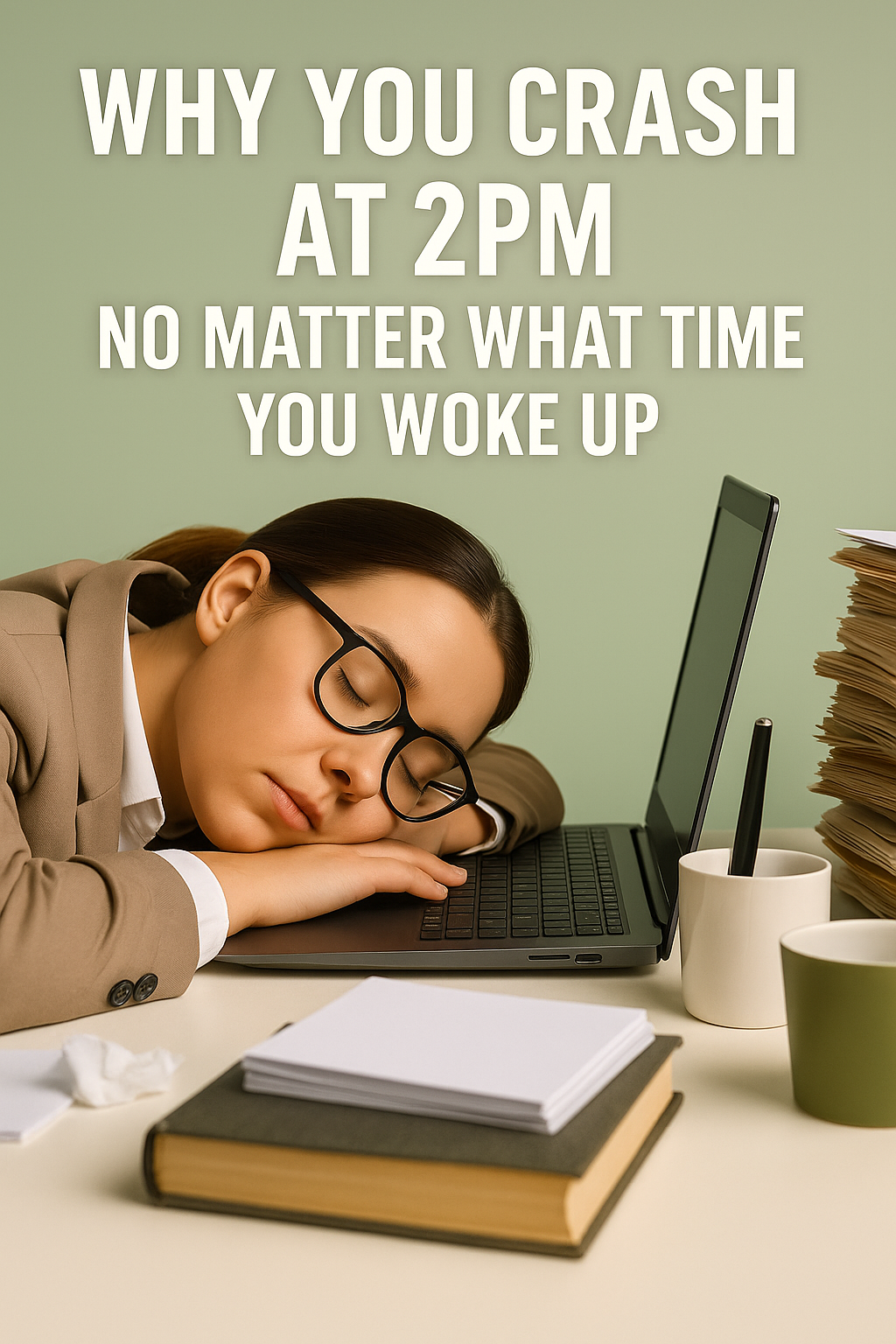


Why You Crash at 2PM, No Matter What Time You Woke Up
expert, nutritionist
Two o'clock hits, and suddenly the words on your screen start to blur. Your coffee has gone cold, your focus has gone with it, and no amount of willpower seems to bring it back. If this sounds familiar, you are in very good company — and, as it turns out, in very predictable company too.
Whether you're an early riser or a committed night owl, the timing of this slump barely changes. Somewhere in the early-to-mid afternoon, alertness quietly drops off a cliff, and it happens to almost everyone, on almost every day, regardless of how much sleep they got the night before.
Even the Experts Feel It
This isn't just internet folklore. Russell Foster, chair of circadian neuroscience at the University of Oxford, has described the cognitive fog of the 2PM slump as being roughly comparable to trying to work after having a couple of alcoholic drinks — a comparison that productivity coach Mackenzie Sweeney later shared with her audience after covering his research. It's a vivid reminder that this isn't a personal failing or a lack of discipline. It's biology, and it applies to brain scientists and office workers alike.
So This Is Not Just a "Fun Study"
It might sound like the kind of quirky headline that gets shared and forgotten, but chronobiology — the science of how our bodies run on internal timers — has become a serious field of medical research. Understanding these rhythms has real, practical stakes: timing certain medications to match the body's natural cycles can noticeably change how well they work, a principle known as chronotherapy that is being studied across several areas of medicine.
Some of our biological cycles are personal, shaped by when we go to bed, when we eat, and our individual chronotype. But others appear to be shared almost universally, as if a kind of collective internal clock is quietly running in the background for all of us.
We've touched on related natural cycles before — including why some people suddenly wake up in the middle of the night, and how sleep loss can quietly affect weight over time, and how the timing of meals can interact with the body's internal clock in our piece on what to avoid eating early in the morning or late at night.
What's Actually Happening in Your Body
Researchers have identified more than 100 biological processes that appear to follow a circadian — roughly 24-hour — rhythm. In medicine, these rhythms are increasingly relevant to when certain conditions tend to appear, how they're diagnosed, and how treatment is timed. Hormone levels rise and fall on a schedule, along with body temperature, blood pressure, and even heart rate. Hunger, too, tends to show up at strikingly consistent times of day.
These 24-hour patterns are called circadian rhythms, and the well-documented afternoon slump is closely tied to light exposure and the body's internal clock. According to the U.S. National Institute for Occupational Safety and Health (NIOSH), this is the point in the day when the circadian drive for wakefulness naturally dips while accumulated "sleep pressure" is still building — a combination that makes the early-to-mid afternoon one of the sleepiest windows of the entire day.
Sleep researchers sometimes describe this as part of a twice-daily, or "circasemidian," pattern layered on top of the main 24-hour cycle. As BBC Science Focus explains, the brain's suprachiasmatic nucleus — the body's master clock — drives a smaller, secondary dip roughly between 2pm and 4pm, separate from the bigger nightly drop in alertness. A large review of studies on attention and cognition, cited in peer-reviewed sleep research, similarly places the average post-lunch dip in performance between roughly 2pm and 4pm across the individuals studied.
During this window, certain brain hormone levels tend to fall, which lines up with the concentration lapses, memory slips, and slightly foggier judgment many people notice around this time. It may also be part of why minor kitchen mishaps, workplace slip-ups, and small errors in general seem to cluster in the afternoon — a pattern some safety researchers have linked to reduced alertness during this window, though of course tiredness is only one factor among many when things go wrong.
What You Can Actually Do About It
If your schedule allows it, this is a reasonable time to build in a short break rather than pushing through on willpower alone. Neuroscientist Mithu Storoni, quoted in BBC Science Focus, suggests saving low-stakes, low-effort tasks for the post-lunch dip and steering the more demanding, high-focus work toward the hours when your natural alertness is higher.
In other words: it may be more realistic to work with your body's rhythm than to fight it. Saving big decisions, tricky emails, and important meetings for a different part of the day — and treating the early afternoon as a natural, expected lull — is a simple, low-effort way to work with your biology instead of against it.
Information on this website is for educational purposes only and is not medical advice.
expert, nutritionist
 Would you like to be informed about news on the website?















|

