







Three Meals a Day: The Medieval Habit That Modern Science Has Quietly Moved Past
expert, nutritionist
Here's the surprising part: the tidy little rulebook of "breakfast, lunch, and dinner, always on time" isn't ancient wisdom at all. It's a leftover of medieval European table manners — and it may be quietly working against the very body it was meant to serve.
A Habit Born at the Dinner Table of the Nobility, Not in a Laboratory
In medieval Europe, eating outside of set hours was seen as something close to uncouth — a habit fit for animals, not "civilized" people. Well-to-do households prided themselves on structured mealtimes, and the three-meal pattern became a quiet marker of refinement and social status rather than a nutritional guideline. Historians note that this rigid schedule stood in sharp contrast to earlier and more flexible eating patterns; in fact, some accounts describe European settlers regarding the more fluid, hunger-driven eating habits of Native American communities as "uncivilized," a striking example of how much of this norm was cultural rather than biological (Fox News: The controversial history behind eating 3 meals a day).
When European colonists crossed the Atlantic, they brought this etiquette with them, and "three square meals" became a marker of a proper, respectable American household. The Industrial Revolution later cemented the habit further, since factory shifts and school schedules needed everyone eating — and working — on the same clock (Why eating three meals a day became the norm). Nobody at the time was asking the one question that actually mattered: is this pattern good for the human body, or just convenient for the household and the factory floor?
What a Landmark 2010 Study Actually Found
That question finally got a proper scientific look starting around 2010, when researchers began digging into large datasets connecting eating patterns to health outcomes. One frequently cited Swedish study published in the British Journal of Nutrition examined the eating habits of middle-aged adults and found that a higher eating frequency tended to go hand-in-hand with an overall healthier lifestyle — more physical activity, less smoking, and a diet richer in fiber — and, in men, a lower likelihood of general and abdominal obesity (Holmbäck et al., British Journal of Nutrition, 2010).
What surprised many nutrition researchers wasn't that one particular number of meals came out on top — it's that no single number did. Dietitians and physicians broadly agree today that total calories and diet quality matter far more than meal count. Some people thrive eating five or six smaller meals; others feel and function best with two well-planned ones. A major scientific statement from the American Heart Association reviewing meal timing and frequency research reached a similar conclusion: eating patterns affect cardiometabolic health, but rigid rules about meal number don't hold up as a one-size-fits-all recommendation (American Heart Association Scientific Statement, Circulation). Other cohort research has found modestly different associations depending on the population studied, which is itself a reminder that individual bodies respond differently and that no single pattern is universally "correct" (Journal of the Academy of Nutrition and Dietetics).
Where Occasional Fasting Fits In
The same wave of research also renewed interest in short periods of voluntary fasting. Some scientists argue that our modern habit of near-constant grazing — three meals plus snacks — is a fairly recent, historically unusual pattern, and that giving the body periodic breaks from digestion may support several markers of metabolic health (Meal frequency and timing in health and disease, PNAS). It's worth being careful here, though: this is still an evolving area of nutrition science, the effects vary a lot from person to person, and occasional fasting isn't a cure-all or a substitute for medical advice — especially for anyone with a health condition, who should check with a doctor or dietitian before changing their eating pattern significantly.
So How Do You Know When to Eat?
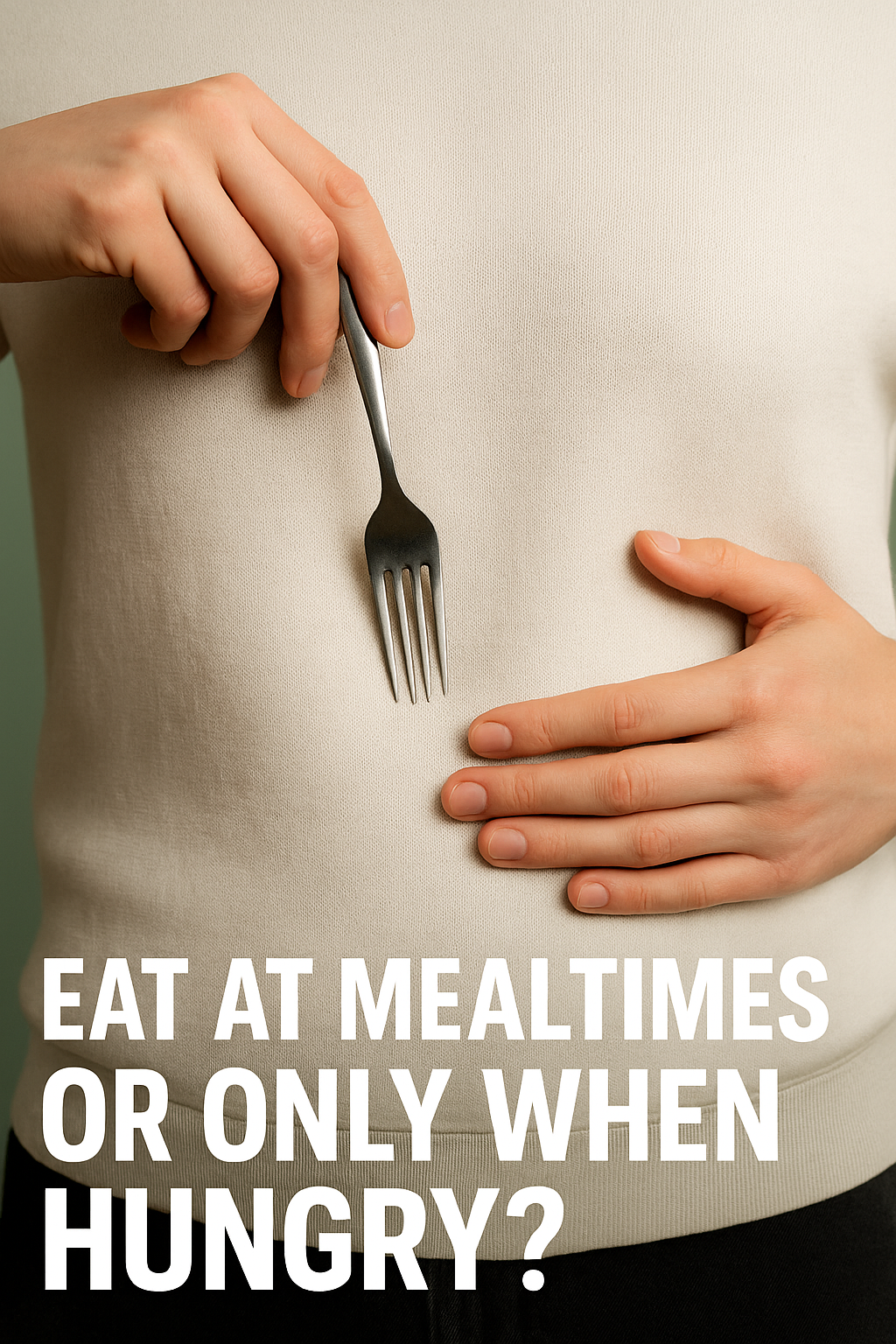
Most nutritionists today suggest a refreshingly simple approach: eat when you're genuinely hungry, not simply because the clock says so. If you're unsure whether it's real hunger or just habit, a small trick many dietitians recommend is drinking a glass of water and waiting about twenty minutes — if the "hunger" fades, it likely wasn't hunger at all. Beyond that, only you can gauge how many meals actually suit your energy levels, schedule, and appetite.
What ties all of this together isn't the number of meals on your plate — it's what's on it. Nutritionists consistently point to the same pattern: foods that pair fiber with protein and healthy fats keep you satisfied far longer than empty, low-fiber calories, which is exactly why a bowl of oats with nuts holds off hunger so much better than a slice of buttered white bread, even at similar calorie counts (Foodwhisper: Why don't empty calories satisfy us?). Building meals around naturally fiber-rich carbohydrates like oats, whole grains, and legumes is one of the simplest ways to extend that feeling of fullness between meals, whatever your personal meal count turns out to be (Foodwhisper: 7 healthy carbohydrates you can eat without worry, Foodwhisper: Legumes that melt fat and cleanse the blood).
It's also worth paying attention to timing choices beyond just frequency — for instance, some nutritionists caution against reaching for sugary foods first thing on an empty stomach, since it can leave some people feeling more fatigued rather than energized later in the morning (Foodwhisper: Sweets on an empty stomach). And if appetite control itself is the goal, there are a few surprisingly simple, evidence-informed tricks worth knowing about beyond meal counting altogether (Foodwhisper: 5 unusual weight loss tricks that work).
The Bottom Line
Three meals a day isn't a biological requirement — it's a social custom inherited from medieval dining halls and reinforced by factory whistles. Modern nutrition research points to a far more personal takeaway: pay attention to total calories, prioritize fiber- and protein-rich foods that keep you satisfied, and let genuine hunger — not the clock — guide when you eat.
Information on this website is for educational purposes only and is not medical advice.
expert, nutritionist
 Would you like to be informed about news on the website?















|

