




Persimmon: The Fruit of the Gods That Belongs on a Spoon – and the Reason Is All About Your Health
expert, nutritionist
Bite into an unripe persimmon just once and you will never forget it. Your mouth puckers, your tongue suddenly feels like it's wrapped in felt, and the fruit you expected to taste like honey tastes like chalk. That dry, gripping sensation comes from tannins – and the very same compounds that spoil the taste can, in rare cases, cause real trouble in the stomach. This is exactly why people who grew up with persimmon trees in the garden never bite into the fruit like an apple. They wait until it's soft as jelly, cut off the top, and eat it with a spoon.
A Poet Who Loved Persimmons So Much That Japan Gave Them a Holiday
Few people have loved this fruit as openly as Masaoka Shiki (1867–1902), one of the four great masters of Japanese haiku. In the autumn of 1895, still weak after a serious illness, Shiki stopped in Nara on his way back to Tokyo – at the very time of year he later described as the best season for persimmons in the region. He asked for a bowl of his favorite fruit and, resting at a tea house near Hōryū-ji temple, wrote a short poem about biting into a persimmon just as the temple bell began to ring. It became one of the most famous haiku ever written.
The bond between the poet and the fruit was so strong that, as Nippon.com explains, the Japan Fruit Growers Cooperative Association declared October 26 – the day the poem was written – national Persimmon Day in 2005. Shiki's experience captures something every persimmon lover knows: a perfectly ripe persimmon isn't just food, it's a small autumn ritual that asks you to slow down.
Why Ripeness Changes Everything
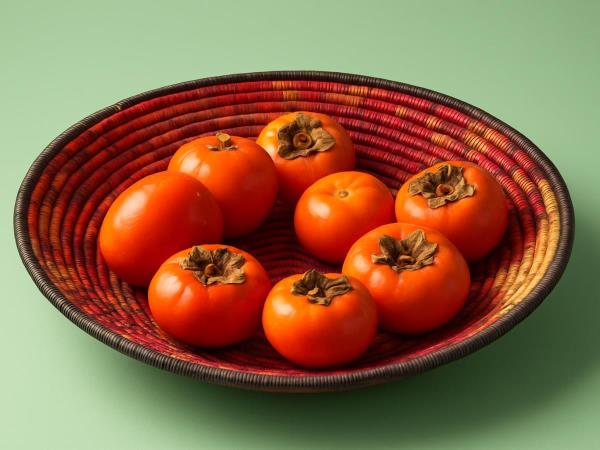
It's very important that the persimmon is fully ripe and isn't picked before it turns its characteristic orange-red color. A persimmon that ripens slowly on the tree develops the fullest flavor and the softest, silkiest texture. Fruit picked too early and left to soften on a store shelf will still become sweet – but it often loses some of its depth of flavor, and if it is eaten before it has fully softened, it keeps much of its astringent tannin.
There are two main types to know:
- Astringent varieties (such as Hachiya, the acorn-shaped kind) are only pleasant when they are completely soft – almost like a water balloon. Eaten earlier, they are mouth-puckeringly bitter.
- Non-astringent varieties (such as Fuyu and the "sharon fruit" types, round and flat like a tomato) can be eaten while still firm, although they too become sweeter as they soften.
If you're not sure which one you have, the rule is simple: wait until it's soft, then reach for a spoon.
What's Inside a Ripe Persimmon?
According to data from USDA FoodData Central, one medium Japanese persimmon (about 168 g) provides roughly 118 calories, 31 g of carbohydrates (about 21 g of natural sugars), around 6 g of dietary fiber, and almost no fat. It also delivers vitamin A (largely as beta-carotene and beta-cryptoxanthin), vitamin C, manganese, potassium and smaller amounts of magnesium, calcium and phosphorus.
A widely cited study in the Journal of Agricultural and Food Chemistry compared persimmons with apples and found that persimmons contained significantly more dietary fiber, phenolic antioxidants and several minerals, including potassium, magnesium, calcium, iron and manganese. As ScienceDaily reported, many persimmons in the study held about twice as much fiber as apples – and in both fruits, the peel was the richest part. (We'll come back to the peel – it's a double-edged sword.)
A Friend to Comfortable Digestion
In folk tradition, the persimmon has long been used for occasional constipation, upset stomachs, "stomach chills" after a cold, and a whole range of digestive complaints – from sluggish bowels to irritation further down the digestive tract, and even as gentle support for the liver and gallbladder. Modern science hasn't tested most of these traditional uses directly, but the fruit's fiber content gives some of them a sensible basis.
Fiber adds bulk, holds water and feeds beneficial gut bacteria, which is why a fiber-rich diet is linked to more regular bowel habits. A systematic review in Frontiers in Nutrition notes that eating fruit is one of the dietary strategies commonly recommended for functional constipation, although results vary from fruit to fruit. If you want to understand fiber better, read our articles Fiber is the express train to your happiness and What happens to your stool when you stop eating meat?. If you live with a sensitive or inflamed gut, our piece Should we avoid fiber if we suffer from intestinal inflammation? explains why fiber isn't one-size-fits-all.
One important nuance: while ripe persimmons tend to support regularity, unripe, tannin-rich fruit can have the opposite, binding effect. That's one more reason to wait for full ripeness – and to drink enough water when you increase your fiber intake.
Helpful When You're Watching Your Weight
Because of its high fiber content, many nutritionists suggest persimmons as a smart sweet treat for people trying to manage their weight. Fiber slows digestion, helps you feel full for longer, and may reduce the urge to snack between meals. The persimmon is virtually fat-free, while its natural sugars provide quick energy – which makes a ripe persimmon a pleasant snack after a workout, or a satisfying alternative to a cookie in the afternoon.
Still, persimmons are not "free" calories: one fruit contains about as much sugar as a small chocolate bar, just packaged with fiber, vitamins and water. One a day is a sensible portion. For more on this topic, see The Secret Weapon Against Stubborn Weight: Is Fiber the One Thing Missing From Your Diet? and Hello, and Fattening: Foods that Sabotage Your Diet.
That Bitter, Astringent Note – and Your Heart
Pay attention to the slightly bitter, in places astringent taste near the skin and stem. It comes from persimmon tannins, which researchers have been studying with growing interest. In a small randomized, double-blind trial published in Annals of Nutrition and Metabolism, adults with mildly elevated cholesterol who ate cookie bars containing tannin-rich fiber from young persimmons before meals for 12 weeks saw their total and LDL cholesterol levels decrease, compared with a placebo group. Important to note: this was a concentrated fiber preparation, not fresh fruit.
Folk wisdom also holds that the astringent taste helps "lower blood sugar." Animal studies, such as one in the Journal of Nutritional Science and Vitaminology, suggest that tannin-rich persimmon preparations may influence glucose and fat metabolism in mice, but this has not been confirmed in humans eating whole fruit. Ripe persimmons are sweet, so if you have diabetes or are monitoring your blood sugar, treat them like any other sweet fruit and talk to your doctor or dietitian about portions. For more on heart-friendly eating, read 10 Foods Nutritionists Swear By.
Vitamin A for Your Eyes, Vitamin C for Cold-Weather Months
The deep orange color of a persimmon is a clue to its carotenoids, which the body converts into vitamin A. Vitamin A is important for normal vision – especially seeing in low light – and for healthy skin and mucous membranes, as the NIH Office of Dietary Supplements explains. Older nutrition labels, which measured vitamin A in international units, credited one persimmon with as much as 55% of the daily value. Under today's measurement standard the figure is lower – roughly 15–20% – but that's still impressive for a single piece of fruit.
Persimmons also contain vitamin C, which contributes to normal immune function and helps the body absorb iron from plant foods. Our article Foods That Improve Nutrient Absorption explains this pairing, while When the Weather Turns: 5 Foods That May Help Your Body Handle the Swing From Summer Heat to Autumn Chill offers more seasonal ideas.
What About the Thyroid?
Persimmons are often praised online as a thyroid food, but it's worth being precise here. The thyroid relies mainly on iodine and selenium, and persimmons are not a significant source of either. As Harvard's Nutrition Source explains, iodine is a building block of thyroid hormones, while selenium helps convert them into their active form. Better sources are iodized salt, fish, seafood, dairy and eggs for iodine (see the NIH iodine fact sheet), and Brazil nuts, fish and eggs for selenium.
What persimmons do offer is potassium, magnesium, calcium and phosphorus, which fit nicely into the balanced, varied diet that supports overall wellbeing – including the thyroid. If you'd like to learn more, read The Small Gland That Can Quietly Turn Your Life Upside Down: What Happens When Your Thyroid Loses Its Rhythm and All enemies of the thyroid.
The Real Reason to Use a Spoon
Here's the health reason promised in the headline. The tannins in persimmons – concentrated in unripe fruit and, even in ripe fruit, just under the skin and around the stem – can react with stomach acid and form a sticky mass. In rare cases, this mass binds fibers together into a hard lump in the stomach called a persimmon bezoar (diospyrobezoar). A review in the World Journal of Gastrointestinal Endoscopy notes that such cases are reported mainly in regions where people eat a lot of fresh and dried persimmons, including Japan, South Korea, Israel, Spain and Turkey.
A case-control study from Ben-Gurion University of the Negev found that eating unpeeled persimmons raised the risk far more than eating peeled fruit – and most patients had previously had stomach surgery. A 2024 case report in Cureus describes a healthy 35-year-old man who developed the problem after eating a large quantity of unripe persimmons.
For most healthy people the risk is very low, but a few simple habits make it even lower:
- Eat only fully ripe, soft persimmons.
- Scoop out the flesh with a spoon and leave the skin and stem area behind.
- Enjoy one fruit at a time rather than several in a row, ideally not on a completely empty stomach.
- If you've had stomach surgery, have slow digestion or diabetes, ask your doctor how persimmons fit into your diet.
A Japanese Folk Tradition – With a Word of Caution
In some Japanese households, older generations prepared a homemade persimmon tincture by mixing pressed persimmon juice with strong alcohol, then took a spoonful before meals in the belief that it supported digestion and metabolism. It's a charming piece of folk tradition, but there is no scientific evidence behind it – and a daily dose of high-proof alcohol isn't something we can recommend. Alcohol is not suitable for many people, including those who are pregnant, take medications or have liver problems. If you'd like to honor the tradition, simply enjoy a ripe persimmon with a spoon before or after a meal.
How to Choose, Ripen and Enjoy Persimmons
- Choose: look for deep orange-red, glossy fruit with an intact green calyx and no bruises.
- Ripen: place firm astringent persimmons in a paper bag with a banana or apple at room temperature for a few days; the ethylene they release speeds up softening.
- Store: once soft, keep them in the fridge and eat within a day or two.
- Freeze: a frozen ripe persimmon, eaten half-thawed with a spoon, tastes like natural sorbet.
- Combine: spoon the flesh over plain yogurt or oatmeal, or blend it into a smoothie with kefir and cinnamon.
Small details often decide how much good a food really does – something we also explore in Foods We Use Incorrectly. And if you enjoy eating with the seasons, you'll like What If the Tastiest Tomato You'll Eat All Year Is Also the Cheapest?.
Give It a Try
Next time you see persimmons glowing at the market, buy a few, let them ripen patiently, and then do what Shiki did: sit down, slow down, and savor one – with a spoon.
Information on this website is for educational purposes only and is not medical advice.
expert, nutritionist
 Would you like to be informed about news on the website?















|

