




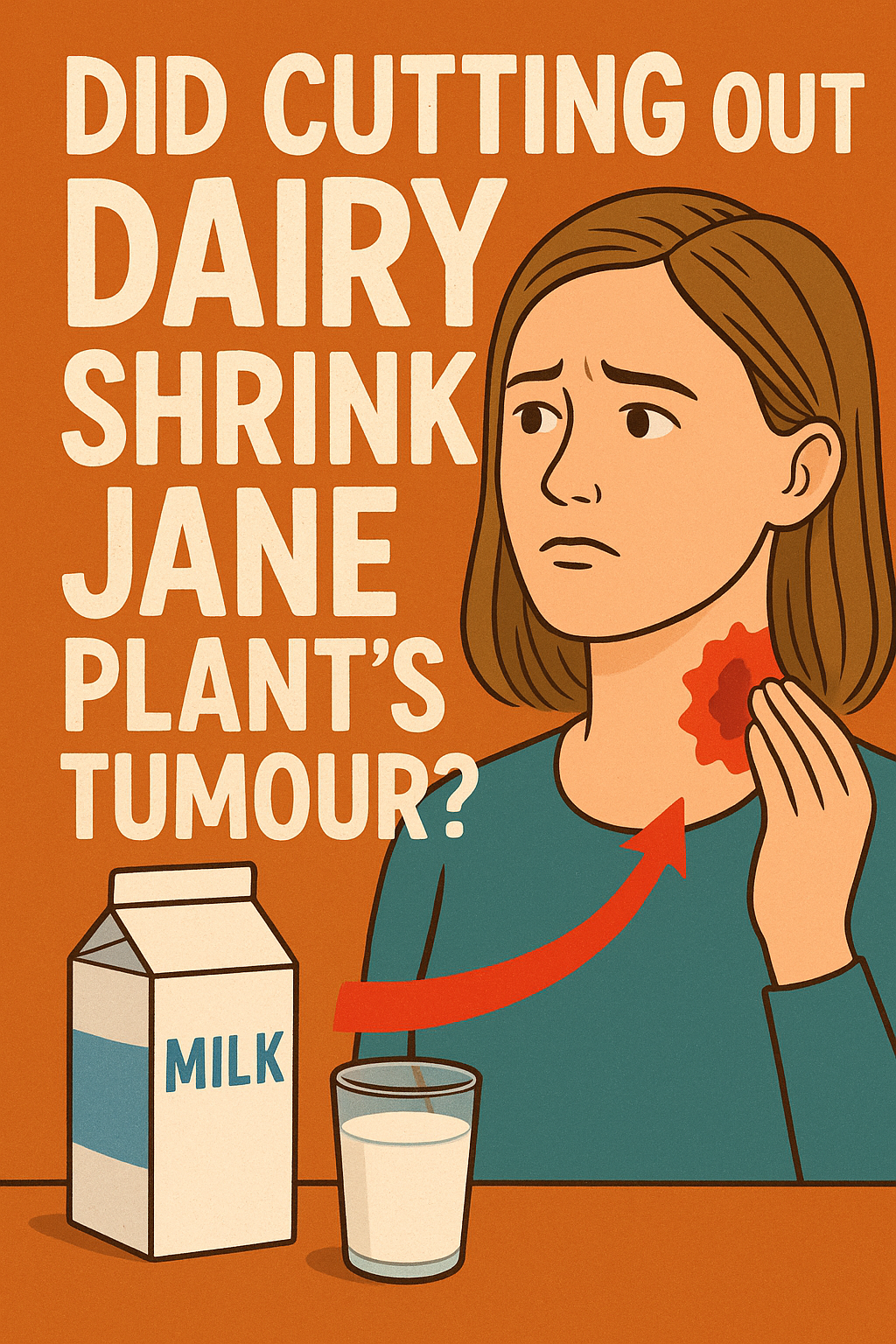
When Geochemist Jane Plant Cut Out Dairy, Her Tumour Began to Shrink – What Really Happened?
expert, nutritionist
Six weeks. That is how long it took, after one of Britain's leading scientists removed every trace of milk, cheese, butter and yogurt from her plate, before her doctors noticed that the lump in her neck had become soft and noticeably smaller. Her doctors credited the chemotherapy. She believed something else had played a part as well, and her story went on to spark one of the longest-running debates in modern nutrition.
Who was Jane Plant?
Jane Plant was not a writer of fad diets. She was one of the most accomplished geochemists of her generation: chief scientist of the British Geological Survey, later Emeritus Professor of Geochemistry at Imperial College London, and a holder of the CBE for her scientific work (biography).
She was first diagnosed with breast cancer in 1987, at the age of 42. She later recalled thinking that her career was over and that her health would only go downhill. Over the following years she had surgery, radiotherapy and chemotherapy, yet the disease came back again and again. By 1993, during her fifth recurrence, it had spread to a lymph node in her neck, and she was told her prognosis was poor. What happened next surprised her.
A clue from China
During those difficult months, her husband Peter, also a scientist, had been working in China. He and Jane had long noticed that breast cancer was historically far less common there than in Britain. At the time, rates in rural China were among the lowest in the world. According to the World Health Organization, breast cancer is now the most common cancer among women worldwide, and rates in China have risen considerably as diets and lifestyles have become more Western.
Did you know that, a few decades ago, breast cancer was several times less common in China than in Western Europe?
The couple put all their energy into studying Chinese eating habits. But the answer did not seem to lie in what people in China ate. It seemed to lie in what they didn't eat.
The turning point came when Peter remembered that his Chinese colleagues used to give him the powdered milk they received, because they rarely drank it themselves. The pattern was obvious: traditional Chinese cuisine contained almost no milk or dairy products.
In that tradition, most people stopped drinking milk after early childhood. Meals were also built on small, varied portions, with plenty of vegetables, legumes, soy, rice and modest amounts of meat or fish. Many people in East Asia still feel that the West overdoes it with dairy, and that a big bowl of sweetened yogurt every morning is not automatically "healthy".
Dairy and digestion: separating fact from myth
You may have read that "70 percent of people are allergic to milk". That is not accurate. A true milk allergy is far less common and mostly affects young children. What is common is reduced lactose digestion. According to the U.S. National Library of Medicine's MedlinePlus, roughly two-thirds of adults worldwide produce less of the enzyme lactase after infancy. This is especially common among people of East Asian, African and Indigenous American descent. For many of them, milk can cause bloating or discomfort, which partly explains why dairy never became a staple in traditional Chinese cooking.
It is worth noting, however, that Jane Plant's concern was not lactose. She focused on the natural hormones and growth factors in cow's milk, especially insulin-like growth factor 1 (IGF-1). She argued that these might encourage hormone-sensitive cancers. Modern dairy cows are often milked while pregnant, so their milk contains small amounts of reproductive hormones. That is why she removed all dairy, not just lactose.
Six weeks later
Shortly after this "discovery", while still receiving chemotherapy, Plant cut out milk and every dairy product, down to the butter in a biscuit. She replaced them with soy, vegetables, fruit, legumes and whole grains. After about six weeks her doctors repeated the examinations. The lump was still there, but it had become soft and noticeably smaller. Her doctors attributed this to the chemotherapy.
Plant was convinced that her new way of eating had also helped. She lived for more than two decades after that recurrence and wrote several bestselling books, including The No-Dairy Breast Cancer Prevention Program. She received thousands of letters from women with breast cancer who wanted to try her approach. She was disappointed, however, that the medical community never fully accepted her ideas. She died at home in 2016.
In the West we sometimes find it hard to understand the Asian philosophy of eating: modest portions, great variety, and food as nourishment rather than abundance. Perhaps that is because many of us still carry a cultural memory of hunger and scarcity, and we tend to measure success by how much we have.
What does science say today?
Plant's case is a single personal story, and a single case cannot prove cause and effect. She was also receiving conventional treatment at the same time. Researchers have been studying the dairy question ever since, and the results are genuinely mixed:
- Some studies point to a possible link. A 2020 analysis from the Adventist Health Study-2, following nearly 53,000 North American women, found that higher dairy milk intake was associated with a higher risk of breast cancer. Cheese and yogurt showed no important association (Fraser et al., International Journal of Epidemiology; summary from Loma Linda University Health). The authors stressed that the study was observational and that more research is needed.
- Other large reviews find no clear link. A major review in the New England Journal of Medicine by Walter Willett and David Ludwig of the Harvard T.H. Chan School of Public Health concluded that, in large prospective studies, milk intake overall was not linked to breast cancer risk. The authors also questioned whether adults really need three servings of dairy a day.
- Some evidence even suggests a modest protective effect. The World Cancer Research Fund has reported limited evidence that dairy may be linked to a slightly lower risk of some breast cancers.
- Critics point to digestion. Scientists at McGill University's Office for Science and Society note that IGF-1 is a protein that is largely broken down during digestion, so the IGF-1 in milk is unlikely to reach the bloodstream intact in significant amounts.
Overseas media have asked whether the Plants unknowingly found a "cure" for breast cancer. The honest answer is no: no single food or diet has been shown to cure cancer. But her story continues to inspire an important conversation about how diet, hormones and lifestyle may influence long-term health.
A nutritionist's perspective: what can you take from this story?
You don't need to follow an extreme elimination diet to borrow the best parts of the traditional Asian approach:
- Eat smaller, more varied portions. Fill half your plate with vegetables and add legumes, whole grains and fruit every day.
- Treat dairy as optional, not compulsory. If you enjoy it and tolerate it well, moderate amounts of fermented options such as natural yogurt and kefir fit well into a balanced diet. If you prefer to limit it, choose other calcium sources.
- Know your calcium alternatives. Calcium-set tofu, fortified soy drinks, leafy greens such as kale and bok choy, almonds, sesame seeds and canned sardines with bones are all useful sources.
- Mind the bigger risk factors. According to the WHO, limiting alcohol, staying physically active and maintaining a healthy weight are among the best-supported ways to lower breast cancer risk.
- Never change your diet in place of treatment. If you are living with cancer, talk to your oncologist or an oncology dietitian before making major dietary changes, so your nutrition supports your treatment rather than working against it.
Jane Plant's story is remarkable not because it offers a miracle, but because a scientist used her curiosity to ask a simple question: what are we eating that others are not? The answers are still being studied. Meanwhile, a varied, mostly plant-based plate with modest portions is a choice almost every nutrition expert can agree on.
Information on this website is for educational purposes only and is not medical advice.
expert, nutritionist
 Would you like to be informed about news on the website?



|

