



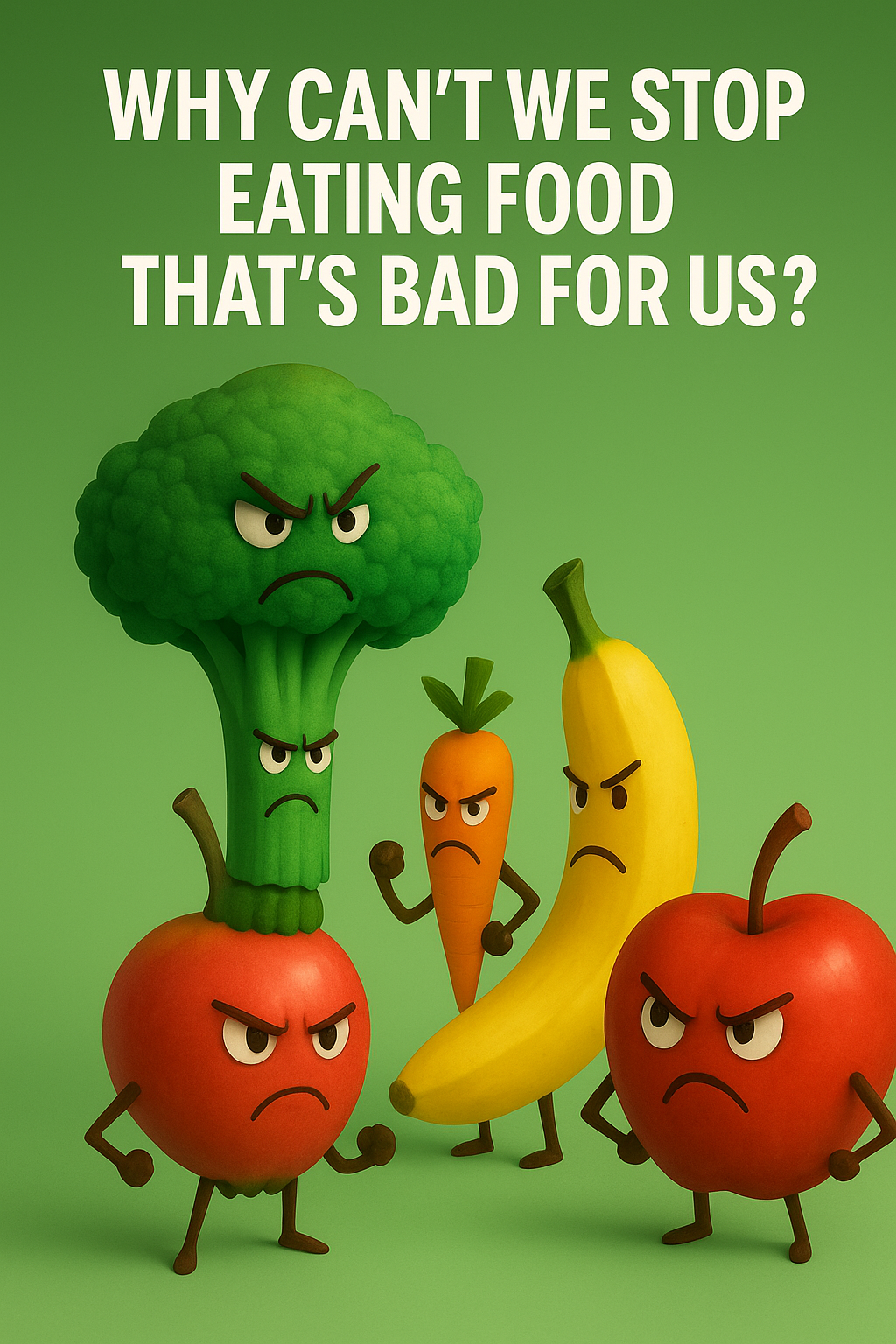


Why Can't We Stop Eating Food That's Bad for Us? Evolution, Laziness and an Industry That Knows Exactly How to Hook Us
expert, nutritionist
The food industry figured out how the human brain works decades ago, and that knowledge has become one of the biggest traps in our modern diet. Food scientists talk openly about the "bliss point," the precise amount of sugar, salt or fat that makes a product as appealing as possible without ever being quite satisfying. Investigative journalist Michael Moss described in detail in The New York Times Magazine how carefully engineered snack foods are, and how market researcher Howard Moskowitz helped shape this approach. Broccoli never stood a chance.
Few people demonstrated this pull as vividly as American filmmaker Morgan Spurlock. For his documentary Super Size Me (2004), he ate only fast food for 30 days. He described how quickly the meals began to dominate his mood: he felt sluggish and irritable when he hadn't eaten, and briefly better right after the next meal. He gained roughly 11 kilograms in a single month. Years later Spurlock acknowledged that other factors in his life at the time may also have played a role, so the film is not a scientific experiment. Even so, it captured something many people recognize from their own lives: the food that gives us the least seems to pull at us the hardest.
Where progress has taken us is perhaps most clearly visible in what we eat. We try to live healthily, and protecting nature and the planet matters more and more to us. We worry about the ozone hole and polluted cities. We worry about nuclear waste and the ballast water of oil tankers. That makes it all the more surprising how little thought we give to what ends up on our plates. More than that: we feed the same questionable food to our children, who are the future of the planet. Today's young people are among the first generations to grow up surrounded by fast food, pesticide residues, plastic packaging, heavily processed foods and countless other modern additives.
The effects are rarely visible right away. A young body is remarkably resilient and copes well with a lot. But as we age, metabolism gradually slows, and many people produce less stomach acid than they did when they were younger, a condition known as hypochlorhydria, which can affect how well we digest and absorb nutrients. The habits we build in our twenties often follow us into our fifties.
So the key question remains: why, despite countless arguments that vegetables can be tasty, healthy, varied and colorful, do we still reach for instant flavors? Wouldn't it be convenient if broccoli tasted like crispy roast potatoes?!
1. Laziness
Humans have leaned toward the path of least resistance since the dawn of time. Some even believe laziness is the engine of progress. If that's true, we have a problem, because we are among the first generations in human history to have more food than we need. Young people entering the world today were born into a society of abundance: television and computers, electricity, comfortable jobs and plenty of conveniences. Those are ideal conditions for laziness.
Food, and fast food above all, is available almost everywhere. Vending machines offer snacks, coffee and every kind of drink, and sugar is practically poured over us. The same goes for salt and refined carbohydrates. The way to a chocolate bar has never been easier...
Now think about where you can find a fresh carrot, a cucumber, peas or fruit. If your commute doesn't take you past a farmers' market, you're left with large retail chains, which aren't exactly known for putting quality above profit. We all know the cheapest supplier usually wins, not the best one. So why would a retailer insist on ultra-local, carefully grown produce when it can get similar-looking goods far more cheaply, pesticide residues included?
The numbers reflect this. According to the U.S. Centers for Disease Control and Prevention (CDC), only about one in ten American adults eats the recommended amount of fruit and vegetables. Meanwhile, a carefully controlled study at the U.S. National Institutes of Health, led by Kevin Hall and published in Cell Metabolism in 2019, found that participants on an ultra-processed diet ate around 500 more calories a day than on a minimally processed diet, even though the meals were matched for sugar, fat, fiber and salt. They ate faster, too. (NIH summary of the study)
Out of laziness, we buy whatever is closest and easiest to grab. If you want to know which everyday products deserve a second look, read Hello, and Fattening: Foods that Sabotage Your Diet.
2. Health Problems
An unbalanced diet can show up in many ways. Some people struggle with an upset stomach, others with blood sugar problems, still others with painful joints caused by gout, not to mention gallstones and kidney stones, which are often linked to lifestyle and eating habits. Many of these issues have become far more common in recent decades, a period that coincides with the rise of processed food rich in sugar and, until recently, in industrial trans fats. The World Health Organization has led a global campaign to remove them from the food supply.
A large umbrella review published in The BMJ in 2024, covering nearly ten million participants, found associations between high consumption of ultra-processed foods and a range of adverse health outcomes. The authors stressed that these are associations, not proof of cause and effect, but the direction of the findings was consistent. Many people also report that heavily processed meals leave them feeling tired, sluggish and unmotivated, which makes it even harder to get moving. Researchers are also looking at how certain foods may affect mood, a topic we explored in Does French fries really increase the risk of anxiety and depression?
And no, even health problems don't seem to be a strong enough motivator for most of us to change how we eat.
3. Evolution Is Working Against Us
Humans adapted to a world of abundance very quickly, and that is the heart of the problem. For hundreds of thousands of years, calories were scarce. Our ancestors survived by seeking out the most energy-dense foods they could find: ripe fruit, honey, fatty meat. A strong preference for sweetness and fat was a survival advantage. That instinct hasn't gone anywhere. We still don't choose food based on its real effects on our wellbeing, health and longevity. Instead, we crave simple food, simple fats, simple carbohydrates and simple sugars, because they give us an instant burst of energy.
Researchers even have a name for foods engineered to hit these instincts: "hyper-palatable foods." A study published in the journal Obesity in 2019 found that the majority of foods in the U.S. food supply met at least one criterion for hyper-palatability, specific combinations of fat with sugar, fat with salt, or carbohydrates with salt that rarely occur in nature.
The problem that seems to lie within us isn't really on the consumer's side at all.
In fact, it isn't even a problem.
It's simply that the food industry discovered half a century ago how the human brain works. After that it wasn't hard to create products that are light-years away from wholesome food nutritionally, yet are broken down in the gut extremely quickly into basic building blocks of energy. Sometimes even the foods we choose to start our day belong in this category, as we explained in Why is it dangerous to eat these foods for breakfast.
You could say evolution brought us to the peak of our strength, and now the same instincts are quietly working against us.
What Can You Do About It?
Understanding the mechanism is the first step. Once you know that the craving for chips is partly ancient biology and partly clever product design, it becomes easier not to take it so personally, and easier to outsmart. A few simple ideas that many readers find helpful:
- Make healthy food the easy option. Keep washed fruit and cut vegetables at eye level in the fridge and a bowl of fruit on the table. Laziness works both ways.
- Shop with a plan. Supermarkets are designed to tempt you. A list helps keep impulse purchases in check.
- Cook simple meals from whole ingredients as often as you can, even if it's just a few times a week.
- Read labels. A long ingredient list full of unfamiliar names is often a sign of heavy processing.
- Visit a local market when you get the chance. Seasonal produce often tastes noticeably better, and taste is the strongest argument there is.
The World Health Organization's healthy diet guidelines recommend plenty of fruit, vegetables, legumes and whole grains, and limiting free sugars, salt and industrial fats. Nothing revolutionary, but sometimes the simplest advice is the hardest to follow. For a closer look at which foods are worth limiting, see 5 Foods That Shorten Your Lifespan.
Information on this website is for educational purposes only and is not medical advice.
expert, nutritionist
 Would you like to be informed about news on the website?















|

