



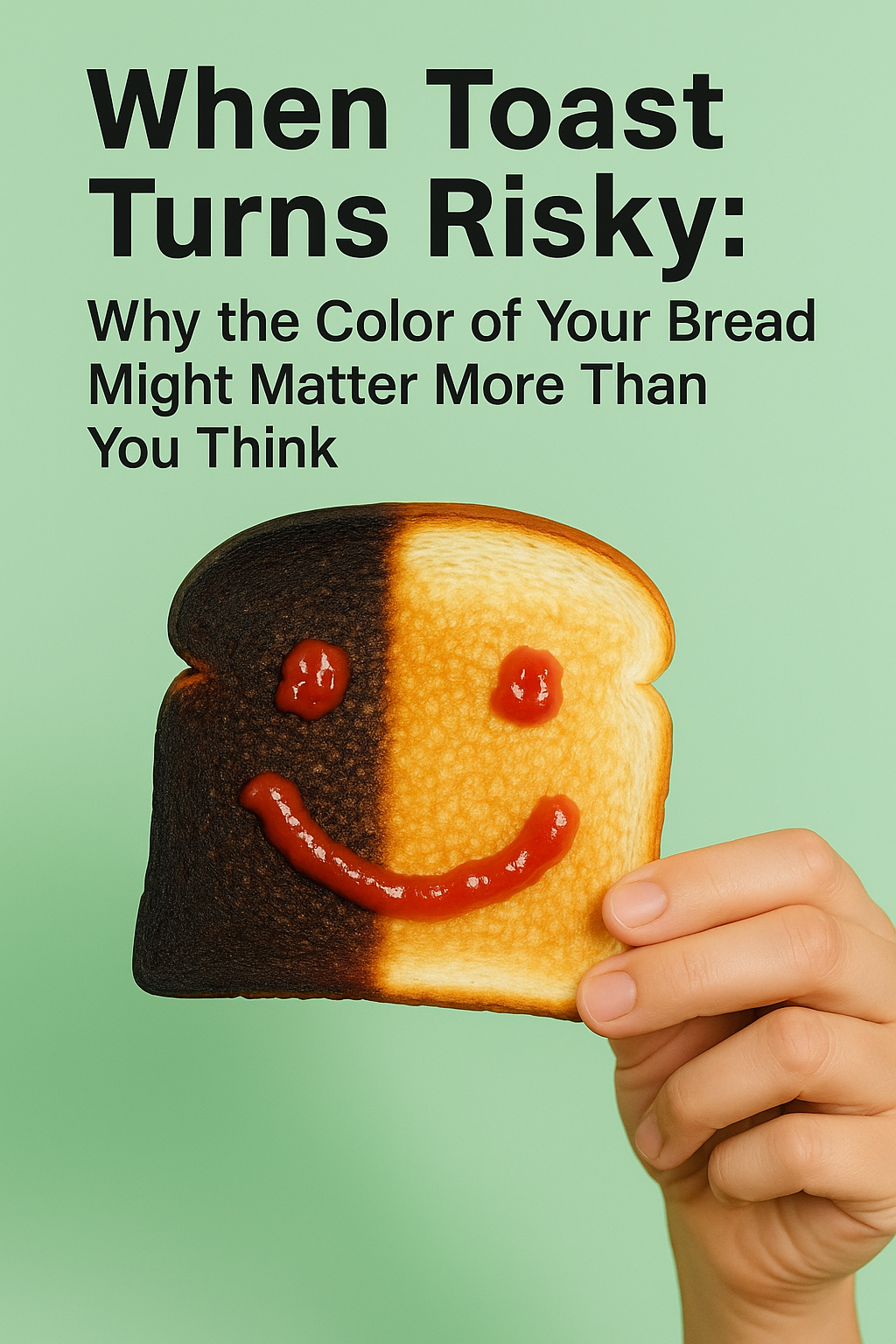


>When Toast Turns Risky: Why the Color of Your Bread Might Matter More Than You Think
expert, nutritionist
You probably don't think twice about the color of your toast. But according to some cancer researchers, a darker crust could mean more of a compound called acrylamide — and a few small changes to how you toast, spread, and brush might be worth considering.
One of our readers, a father of two from the outskirts of Chicago, told us he only started paying attention to this after his dentist mentioned it in passing during a routine cleaning. "I toasted my bread until it was almost black every single morning for years," he said. "Once I started aiming for a lighter, golden color instead — and swapped my chocolate spread for mashed avocado — breakfast honestly still felt just as satisfying, and I felt a bit more in control of a habit I'd never even questioned before." His experience isn't a medical result, just a small, relatable nudge — but it's a fair starting point for a conversation that's backed by a fair amount of science.
What Actually Happens When Bread Gets Burnt?
When bread — or other starchy foods like potatoes — is exposed to high heat, a chemical compound called acrylamide begins to form. This happens through the Maillard reaction, the same chemical process responsible for that appealing golden-brown color and toasty flavor, once temperatures climb above roughly 120{-15696}C (248{-15696}F).
Some background: Acrylamide was classified by the International Agency for Research on Cancer (IARC) back in 1994 as a Group 2A substance — meaning it is considered "probably carcinogenic to humans," a category based mainly on strong animal-study evidence. It's worth noting this classification describes a hazard under certain exposure conditions, not a guaranteed outcome for any individual eating toast for breakfast.
Professor Robert Thomas, a UK consultant oncologist at Addenbrooke's and Bedford Hospitals, has written that "the darker brown they are, the more acrylamides they contain" when it comes to starchy foods like bread and potatoes — in other words, a lightly toasted slice is likely to carry less acrylamide than one toasted nearly black.
A 2015 scientific opinion from the European Food Safety Authority (EFSA) reconfirmed that, based on animal studies, acrylamide and its metabolite glycidamide are genotoxic and carcinogenic — meaning they can damage DNA and cause cancer in those studies. EFSA was careful to add that evidence from human studies remains limited and inconclusive, which is an important caveat: most of what we know comes from lab-animal research at exposure levels far higher than a typical diet.
Is This Actually Something to Worry About Day-to-Day?
You might assume this barely applies to you if you don't eat much toast. But data cited in EFSA's review shows that bread, toast, potatoes, and biscuits are among the biggest everyday contributors to dietary acrylamide exposure across Europe — which is part of why UK food safety regulators eventually asked people to pay attention to it at all.
In fact, the UK Food Standards Agency's "Go for Gold" campaign, launched around 2015-2017, encouraged people to cook starchy foods to a golden-yellow color rather than dark brown or black, specifically to help reduce everyday acrylamide exposure at the population level.
Sugar on Toast: A Second Habit Worth a Second Look
Toast on its own isn't really the issue — it's often what we put on it. Jam, chocolate spread, and honey can add a substantial amount of sugar to what looks like a simple breakfast. According to World Health Organization guidance, adults are advised to keep free sugar intake under 10% of total daily energy, with additional benefit suggested below 5% — roughly 25 grams, or about six teaspoons, per day. In practice, many people exceed this fairly easily once spreads, drinks, and snacks are added up.
Separately, some epidemiological research has explored a possible link between high sugar intake and pancreatic cancer risk — for example, a case-control study published in Annals of Epidemiology found a positive association between consumption of sugar, candy, honey, and jam and pancreatic cancer risk in the population studied. It's worth stressing that findings like this vary between studies, associations are not the same as proof of cause, and diet is only one of many factors thought to influence pancreatic cancer risk.
Professor Thomas has suggested swapping sugary spreads for options like mashed avocado, which offers healthy fats, fiber, and a naturally creamy texture without the added sugar spike — a simple substitution rather than a guaranteed health fix.
The Toothbrush Connection
Interestingly, toast isn't the only breakfast-adjacent habit researchers have looked at. A growing body of research has examined the relationship between oral health and cancer risk. A systematic review and meta-analysis found that poor oral hygiene and periodontal disease were associated with higher odds of oral cancer compared with people who had good oral health — though, as with most nutrition and lifestyle research, an association isn't the same as a guaranteed cause-and-effect relationship, and other factors like smoking and alcohol use play a much larger role.
The practical takeaway researchers tend to agree on is straightforward: brushing thoroughly each evening, flossing, and keeping up with regular dental checkups is a low-cost habit that supports oral health regardless of any cancer-risk discussion.
Small, Manageable Changes to Consider
- Toast to golden, not black. The darker the crust, the more acrylamide it's likely to contain.
- Cut back on sugary spreads. Try avocado, a boiled egg, or a light layer of cheese instead of jam or chocolate spread.
- Don't skip the toothbrush. A consistent evening routine is one of the simplest habits in this whole list.
- Mix in whole-grain bread. It generally offers more fiber and nutrients than white bread, which may help with blood sugar management.
- Remember: consistency matters more than perfection. An occasional dark slice of toast is unlikely to be meaningful on its own — it's the everyday pattern that researchers focus on.
Toast Doesn't Have to Be the Enemy
Toast is quick, comforting, and for many people, a genuine part of the morning routine — there's no need to give it up. The point isn't to fear your breakfast; it's to make a few small, informed adjustments: toast to gold rather than black, reach for a spread with less added sugar, and don't forget the basics of oral hygiene at the end of the day.
None of this requires a dramatic diet overhaul. Small, sustainable swaps — repeated daily — are generally what nutrition researchers point to as most likely to add up over time.
Information on this website is for educational purposes only and is not medical advice.
expert, nutritionist
 Would you like to be informed about news on the website?














|

