


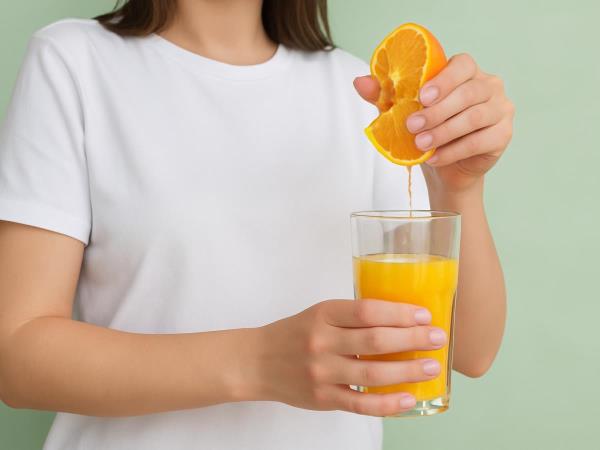



Half a Litre of Orange Juice a Day for 60 Days Shifted the Activity of Nearly 3,800 Genetic Signals in Immune Cells
expert, nutritionist
Twenty healthy adults drank two glasses of plain orange juice every day for two months. When researchers then looked inside their immune cells, they found 3,790 genetic transcripts behaving differently from before. Among them were genes that normally switch on during inflammation and genes tied to higher blood pressure, and many of these had gone quieter.
That is a striking result for a drink most of us pour without thinking. Orange juice sits on the breakfast table as routinely as bread and milk. Industry figures reported by ESM Magazine put it as the EU's favourite juice, at an average of about 7.4 litres per person a year. Few of us stop to ask what happens inside the body after the glass is empty.
Hesperidin: the citrus compound at the centre of the story
Much of the attention goes to hesperidin, a flavonoid that plants use as part of their natural defences. A 2022 review in Nutrients describes it as a bioflavonoid found in high concentrations in citrus fruit. Researchers are mainly interested in three of its possible roles:
- calming inflammation,
- reducing oxidative stress, the damage caused by harmful molecules called free radicals,
- and supporting healthier blood vessels.
Our grandmothers had their own way of putting it: an orange "chases out the inner devils." That was folk shorthand for what scientists now describe as less inflammation and better circulation.
How the researchers tested it
The study was led by the Food Research Center at the University of S{-15230}{-14975}o Paulo, working with North Carolina State University, and was published in Molecular Nutrition & Food Research in October 2025 (full text on PubMed Central). It involved 20 healthy adults, 10 men and 10 women aged 21 to 36. Each of them drank 500 ml of 100% pasteurised orange juice a day for 60 days, split into two portions: 250 ml in the morning and 250 ml later in the day.
Three days before the study began, participants had to cut out other citrus fruit, such as oranges, lemons and grapefruit, along with strawberries, passion fruit, coffee, chocolate, wine and teas. All of these contain flavonoids or similar plant compounds. Citrus stayed off the menu for the rest of the study, so the juice would be the main source of these compounds.
Blood was drawn at the start and again on day 60. The researchers isolated immune cells (peripheral blood mononuclear cells) and measured their gene expression, which is how "loud" or "quiet" each gene is. Think of it as the volume knob on a radio. A gene turned up is working harder, and a gene turned down is doing less.
What "3,790" actually means
The 3,790 figure counts every genetic transcript whose level changed. According to the paper, it includes 1,705 protein-coding genes, most of which became less active. The rest were regulatory RNA molecules: 66 microRNAs, 19 long non-coding RNAs and 67 small nucleolar RNAs. This is a large shift for a single food. It tells us the juice touched many biological pathways. It does not tell us that 3,790 separate health effects followed.
Blood pressure genes turned down
Several genes that are typically more active in people with high blood pressure, including NAMPT, NLRP3 and SGK1, were downregulated after 60 days. SGK1 affects how much sodium the kidneys hold on to, which is one reason it matters for blood pressure.
The finding fits earlier work by the same Brazilian group. In a 2021 study of 74 volunteers in Food & Function, people drank the same 500 ml a day for 60 days. Those whose bodies produced more of the flavanone breakdown products showed lower blood pressure and a lower body-fat percentage.
Controlled trials point the same way, though the effects are small. In a randomised crossover trial in the American Journal of Clinical Nutrition, 24 slightly overweight but healthy men drank 500 ml of orange juice a day for four weeks. Their diastolic blood pressure, the lower number, was lower than after a placebo drink. A control drink with added hesperidin produced a similar effect, which suggests hesperidin is one of the active ingredients. A 2022 meta-analysis of eight randomised trials in overweight and obese adults found that orange juice lowered systolic blood pressure by an average of about 1 mmHg compared with control drinks. That is modest. Still, small differences in blood pressure can add up over many years.
Folk medicine reached for citrus long before any of this. In China, flavonoid-rich parts of the citrus plant, especially the peel, have been used as seasonings and tea ingredients for centuries.
Inflammation: quieter genes, not yet proven outcomes
Inflammation runs quietly in the background, and you usually cannot feel it. When it becomes chronic, it is linked to type 2 diabetes, fatty liver disease, cardiovascular disease and faster ageing.
In this study, key inflammation genes, including IL6, IL1B and PTGS2 (the gene for the COX-2 enzyme), were less active after 60 days. In practical terms, the immune cells looked less "on alert" at the genetic level.
Body weight changed the picture. In normal-weight participants, the changes centred on inflammatory pathways. In overweight participants, they centred on fat metabolism, which is covered below.
The old saying is that citrus "cleanses the blood." This study does not quite show that. The researchers measured gene activity inside immune cells, not blood levels of inflammatory markers such as CRP. Fewer active IL6 genes is an encouraging sign, but it is not the same as a measured drop in inflammation.
This kind of finding has a history. A 2011 randomised, controlled crossover study in PLoS One found that four weeks of orange juice changed gene expression in white blood cells, and hesperidin explained part of that effect. Dragan Milenkovic, one of its authors, is also a co-author of the new study.
Fat storage and cholesterol: what the evidence really shows
In overweight participants, the juice mainly affected genes involved in storing and burning fat, including GSK3B and GRK6. These pathways help decide whether the body packs fat away or uses it for energy.
The new paper measured gene activity only, not blood cholesterol. For actual cholesterol numbers we have to look at other trials, where the picture is mixed:
- A 2021 meta-analysis of 15 randomised trials with 639 participants, published in Phytotherapy Research, found that orange juice lowered total cholesterol by about 7 mg/dL and slightly improved insulin resistance. Most other markers did not change.
- A 2023 meta-analysis in the Journal of Nutritional Science found no significant overall effect on triglycerides, total cholesterol or HDL. It did suggest that LDL ("bad") cholesterol may fall with daily intake, especially above 500 ml a day.
- The 2022 meta-analysis in overweight and obese adults found a small rise in HDL ("good") cholesterol, but no change in total cholesterol, LDL, triglycerides, blood sugar or CRP.
Put simply, orange juice may nudge some blood fats in the right direction, but the effects are small and inconsistent.
What about the sugar?
This is where honesty matters. According to USDA nutrient data, orange juice contains about 8.4 g of sugar per 100 g, so half a litre gives you roughly 40 to 45 grams of sugar. The same data show only about 0.2 g of fibre per 100 g. Juice does not come wrapped in the fibre of a whole orange, and much of that fibre is lost in the squeezing.
For this reason, health authorities treat the sugar in juice as "free sugar," the same category as added sugar, even when the juice is 100% pure. The NHS advises adults to keep free sugars under 30 g a day. It also recommends no more than 150 ml a day of fruit juice, vegetable juice and smoothies combined, ideally with a meal to protect your teeth. The 500 ml used in the study is more than three times that.
There is a reassuring side too. Across controlled trials, orange juice has not been shown to worsen blood sugar in healthy people. The 15-trial meta-analysis even found a slight improvement in insulin resistance. That does not make a litre or two a day a good idea, and these results do not apply automatically to people with diabetes.
If you want to try it sensibly
If you would like to copy the study set-up, or a gentler version of it:
- choose 100% orange juice with no added sugar, not "orange drinks" or nectars,
- split it into two smaller portions instead of drinking it all at once, as the volunteers did,
- drink it with meals, not as a between-meal sweet drink,
- and count it as a modest part of your diet, not your main source of sugar.
Folk wisdom says everything healthy is healthy in moderation. A few other simple ideas:
- Whole oranges. You get the same flavonoids plus the fibre that juice leaves behind.
- Tea from dried orange peel. The peel is among the most flavonoid-rich parts of the fruit. Use organic, unwaxed oranges, because conventional peel is often waxed.
- Water with a squeeze of lemon and some grated orange zest, a light drink that brings some of the peel's compounds with it.
- Juice diluted with water, an old home-kitchen trick that keeps the taste and cuts the sugar per glass.
Whole foods may also have an edge over pills. In a 2015 randomised trial in the American Journal of Clinical Nutrition, orange juice and a hesperidin supplement delivered the same dose. After the supplement, however, flavanone breakdown products in the blood were no different from the control. The authors suggested the juice itself changes how these compounds are absorbed.
So, is half a litre a day a good idea?
The honest answer is: interesting, but not proven. The new study shows that regular orange juice can shift the activity of many genes tied to blood pressure, inflammation and fat metabolism. But it was small, with only 20 people, and it had no control drink. The authors themselves say their results show associations, not cause and effect. Controlled trials do support small benefits for blood pressure and some cholesterol markers. Meanwhile, the amount used in the study goes well beyond what health authorities advise for juice because of its sugar.
Larger, longer and properly controlled studies, ideally following people for a year or more, will be needed to show whether these genetic changes lead to real health benefits. Until then, a small glass of 100% juice with breakfast, plus whole oranges during the day, is a sensible way to bring citrus flavonoids into your diet. Oranges have stood for good health for centuries, from ancient physicians to our grandmothers, and science is slowly starting to explain why.
Information on this website is for educational purposes only and is not medical advice.
expert, nutritionist
 Would you like to be informed about news on the website?















|

