




Sleep Yourself Slim: 4 Tricks That May Help Your Body Burn More While You Rest
expert, nutritionist
Here is a number that surprises most people: in one University of Chicago study, overweight adults who simply extended their nightly sleep by about an hour ended up eating roughly 270 fewer calories a day – without any diet plan at all. The results were published in JAMA Internal Medicine. The night, it turns out, is not "time off" for your metabolism. It is when much of the quiet work happens.
Few people know this better than Arianna Huffington. In 2007 the media entrepreneur collapsed from exhaustion at her desk, broke her cheekbone and woke up in a pool of blood. That moment made her rethink her life completely. She went on to write the bestseller The Sleep Revolution and to found Thrive Global. Today she describes a strict evening ritual: no phones in the bedroom, a cool and completely dark room, and a light dinner. She has often said that once she began sleeping properly, her cravings for sugary "energy fixes" during the day faded. Her story is a reminder that good sleep is not laziness. It is part of a healthy lifestyle.
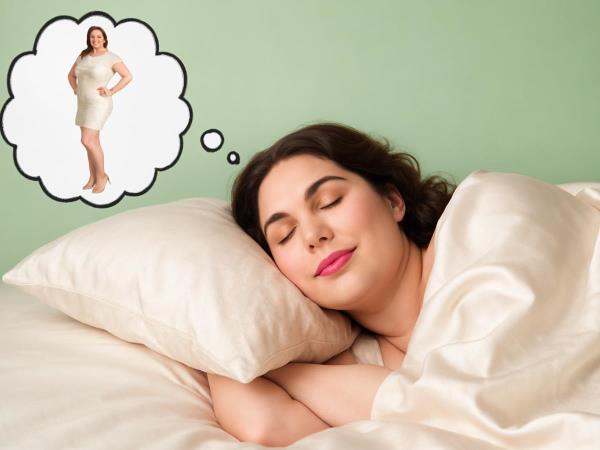
Men and women alike dream of the perfect figure. If you could get there overnight, that advice would be worth a million dollars. No such magic exists, of course. Still, these four simple steps may bring you a little closer to the ideal and help your body make the most of the hours you spend asleep.
1. Avoid high-sodium foods at dinner
Salty dishes can cause bloating and are often harder to digest. Salt also makes the body hold on to water, so the scale may show a higher number the next morning even though you have not gained any fat. The World Health Organization recommends that adults keep salt intake below 5 grams a day, which is about one teaspoon. Most people in Europe and North America eat almost twice that amount, much of it hidden in bread, cured meats, cheese, ready meals and snacks.
Instead of a salty dinner, try a bowl of simple vegetable soup. It is easy and quick to digest, light on calories and filling thanks to its water and fibre content. Season it with herbs, garlic, lemon juice or a little pepper instead of extra salt. If you often wake up feeling puffy, you may find practical tips in our article Get Rid of Bloating and Excess Water. It is also worth knowing which seemingly innocent foods can quietly work against you. We cover them in Hello, and Fattening: Foods that Sabotage Your Diet.
One of our readers, a 52-year-old office worker, told us that she replaced her usual evening sandwich with cold cuts with a vegetable and lentil soup. "The biggest change was not on the scale at first," she wrote. "It was that I stopped waking up with swollen fingers and a heavy stomach. The kilos started moving later."
2. Lower the temperature in your bedroom
Many sleep experts agree that a cooler bedroom supports better rest. The Sleep Foundation suggests roughly 16 to 19 {-15696}C (60 to 67 {-15696}F) for most adults. Popular articles often name about 17 {-15696}C as the sweet spot.
You may have come across a simple calculation online. It claims that for every degree above the optimum, your body uses about one percent fewer calories. By that logic, if you ate 2,000 calories today and sleep at 20 {-15696}C (3 degrees above 17 {-15696}C), around 2000 / 100 {-15465} 3 = 60 calories would stay "unused." That is not much, but over a month it would add up.
As a nutritionist, I would treat this maths as a rough illustration rather than a precise rule. The real effect varies from person to person and is probably smaller and less linear. Even so, there is a genuine scientific idea behind it. A cool environment can increase thermogenesis, the body's ability to produce heat, which also involves burning calories and fat. A key player here is brown adipose tissue ("brown fat"), a special type of fat that burns energy to keep us warm.
A small study led by researchers at the US National Institutes of Health looked at healthy men who slept for a month in a room kept at 19 {-15696}C. Their brown fat activity rose noticeably, and their insulin sensitivity after meals improved. The study was published in the journal Diabetes. When the room was warmed back up, those changes faded. This does not mean a cold bedroom will melt kilos away. It does suggest that a cooler room may be a small, pleasant ally for your metabolism and for deeper sleep.
Practical tip: Air the room before bed, choose a lighter duvet and breathable cotton or linen bedding, and avoid heavy pyjamas. If your feet get cold, wear socks. Warm feet help many people fall asleep faster, even in a cool room.
3. Sleep in a dark room
The hormone that promotes sleep is melatonin. The body releases more of it when we sleep in darkness, and even a small amount of light can reduce its production. Melatonin does more than send us to sleep. Researchers are also studying its role in regulating metabolism and body weight, although this research is still in its early stages.
What we know with more confidence is that light at night seems to matter. A large study of nearly 44,000 women, conducted by the National Institutes of Health, found that those who slept with a TV or light on in the room were more likely to gain weight over the following years. The results appeared in JAMA Internal Medicine. A later experiment at Northwestern University, published in PNAS, showed that even a single night with moderate room light raised heart rate and affected insulin response the next morning. These studies show associations and short-term effects, not proof that darkness alone causes weight loss. Still, they offer one more reason to switch off the lights and screens.
Darkness and sufficient sleep go hand in hand. When we sleep too little, hunger hormones get out of balance: ghrelin, which drives appetite, rises, and leptin, which signals fullness, falls. Read more about it in our article When you sleep too little, your belly grows.
You can also support your body's own melatonin production at dinner. Your body makes serotonin, and later melatonin, from tryptophan, an amino acid we get from food. Sleep researcher Marie-Pierre St-Onge of Columbia University explained this in an interview with NPR. Her advice is to eat tryptophan-rich foods regularly so the building blocks are available when the body needs them, rather than to treat them as a bedtime pill.
Foods rich in tryptophan include:
- turkey and chicken
- fish
- brown rice
- nuts and seeds
- milk and cheese
- eggs
- beans and peas
- pumpkin and pumpkin seeds
Pairing them with a small portion of complex carbohydrates, such as brown rice or wholegrain bread, may help tryptophan reach the brain more easily.
Practical tip: Use blackout curtains or a comfortable sleep mask. Cover or remove glowing standby lights, and leave your phone outside the bedroom. If you need a night light, choose a dim, warm-coloured one placed low near the floor.
4. The scent of mint
Smell and appetite are closely linked. Much of what we call "taste" is actually smell, and food aromas are one of the strongest triggers of cravings. Among plants, peppermint is the one most often mentioned for its potential to calm the appetite.
The best-known research comes from psychologist Bryan Raudenbush and colleagues at Wheeling Jesuit University in the USA. In their small study, participants sniffed peppermint oil every two hours for a week. They reported feeling less hungry and ate noticeably fewer calories than in the week without the scent. Related work by the team appeared in the journal Appetite. This was a small, short study. Claims that mint scent alone can make you lose more than 2.5 kilograms a month go far beyond what the evidence shows. A fresh mint aroma in the evening may simply help some people resist that late-night trip to the fridge, and that alone can make a difference over time.
A reader from Austria shared her ritual. After dinner she brushes her teeth, makes a cup of peppermint tea and puts a few drops of peppermint oil on a diffuser by the bed. "It works like a full stop for the day," she wrote. "Once the mint is in the air, my brain knows the kitchen is closed."
Practical tip: A pot of fresh mint on the windowsill, a cup of caffeine-free peppermint tea or a diffuser all work well. Essential oils should never be swallowed, and they should be kept away from small children and pets. Some people with acid reflux find that peppermint tea worsens their symptoms, so pay attention to how your body responds.
The bottom line
None of these four habits is a miracle cure, and no one burns off a heavy dinner simply by turning down the thermostat. Together, though, they create the conditions for deeper, more restful sleep, and good sleep makes everything else easier. That includes eating sensibly, moving more and saying no to cravings. If you are looking for a gentle overall approach, you may also enjoy Diet without dieting and 2 kg less per week.
Start tonight with just one change: a lighter dinner, a cooler room, real darkness or a hint of mint. Notice how you feel in the morning. Small habits, repeated night after night, are often what make the biggest difference.
Information on this website is for educational purposes only and is not medical advice.
expert, nutritionist
 Would you like to be informed about news on the website?















|

