





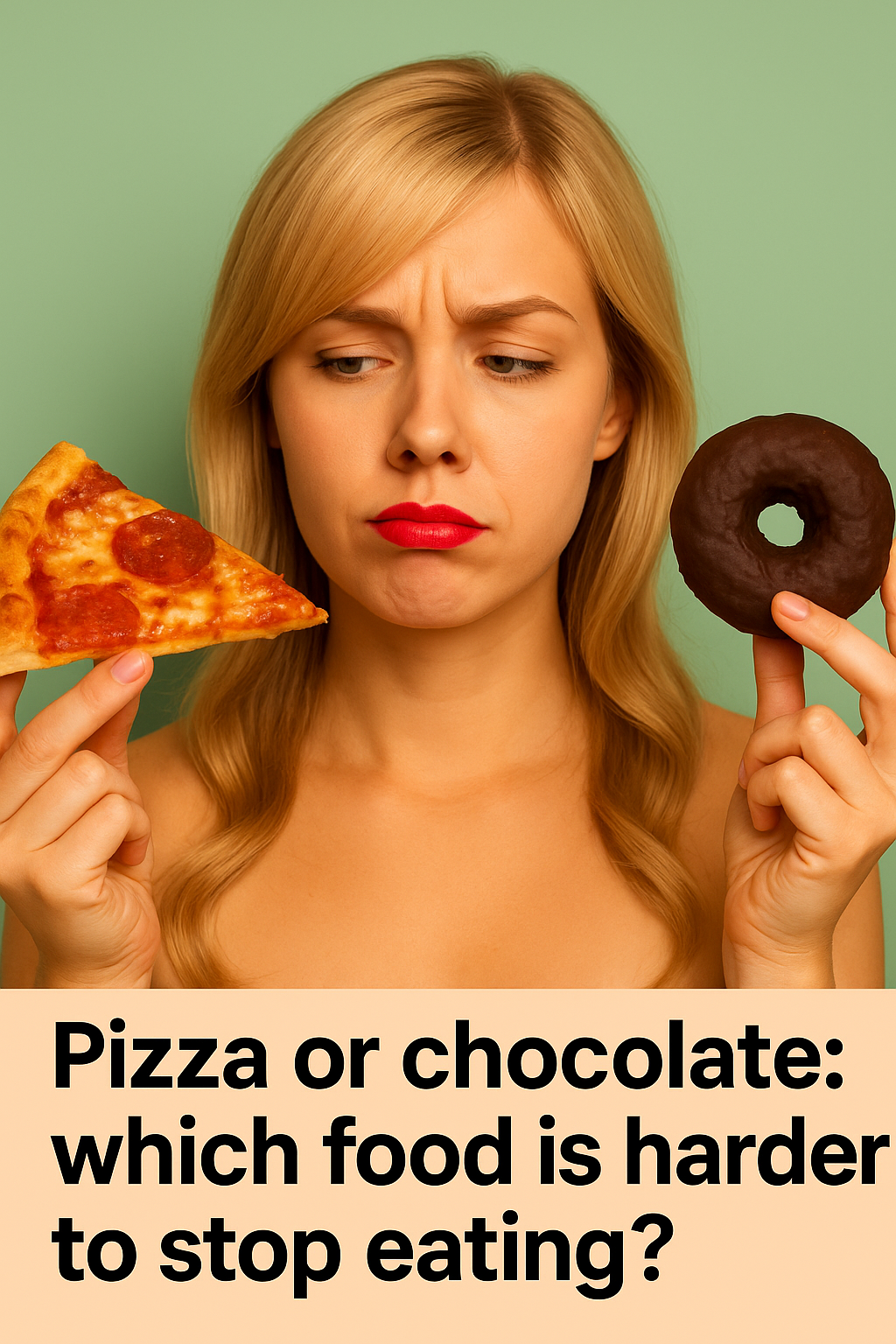


Pizza or Chocolate: Which Food Is Harder to Stop Eating, According to Science?
expert, nutritionist
Ask a room full of people to name the one food they can never stop eating, and most will say chocolate. Scientists at the University of Michigan asked a similar question, and the answer surprised even them. The food that came out on top was not chocolate. It was pizza.
If that sounds familiar, you are in good company. Actress Drew Barrymore, who has openly shared her healthy-eating efforts with fans, once posted a joke "in case of emergency" pizza box on Instagram, complete with a tiny glass-breaking pizza cutter, and admitted that this was exactly how she felt while dieting. Millions of people related to it, because pizza is the food that seems to whisper loudest when we try to cut back.
One of our readers, a mother of two from the Midwest, described it like this: "I could leave a box of chocolates untouched for a week. But if there was leftover pizza in the fridge, I would think about it all evening until it was gone." Her experience fits the research surprisingly well.
What does it mean when a food is "addictive"?
When we say a food "hooks" us, we usually mean more than "it tastes good." Researchers use the term addictive-like eating for a pattern in which people keep eating a food even when they are no longer hungry, eat more than they planned, and find it hard to cut back. Some scientists compare this pattern with the way the brain responds to other rewarding substances, although "food addiction" is still debated and is not an official medical diagnosis.
Many researchers point to highly processed foods (foods that industry modifies so they last longer, cost less and taste stronger) as the main suspects. These products often combine concentrated fats with refined carbohydrates, a pairing that appears to activate the brain's reward system strongly and stimulate the release of dopamine, a chemical messenger linked to pleasure and motivation.
Dopamine works like a natural reward: the body releases it when we do something useful for survival, such as eating, moving or falling in love. When a food delivers an unusually strong and fast reward, the brain may learn to seek it again and again. That is part of why highly processed food can feel so satisfying in the moment, while the satisfaction fades quickly and leaves us wanting more.
What science says and what the researchers found
The study, titled "Which Foods May Be Addictive? The Roles of Processing, Fat Content, and Glycemic Load", was published in the journal PLOS ONE in 2015 by psychologists Erica Schulte, Nicole Avena and Ashley Gearhardt. It included 504 participants in total. In the first part, 120 university students completed the Yale Food Addiction Scale and chose which of 35 foods they most associated with feeling they "could not stop eating." In the second part, 384 adults recruited online rated each food on a scale from 1 (not at all problematic) to 7 (extremely problematic).
The result?
First place did not go to chocolate, as many would expect, but to... pizza!
Yes, ordinary pizza. Its average score was 4.01 out of 7. It was followed by chocolate (3.73), potato chips (3.73), cookies and ice cream.
Interestingly, the bottom of the list was filled with foods we all know are good for us: cucumbers, carrots and beans. They scored below 2.0, which means participants almost never had trouble stopping when eating them.
The researchers concluded that the more processed a food was, and the more fat and fast-absorbing carbohydrates it contained, the more likely people were to link it with addictive-like eating. People who already showed more signs of problematic eating, or who had a higher body mass index, tended to report stronger difficulties with these foods.
Later research has built on this work. In 2023, Gearhardt and colleagues published an analysis in The BMJ estimating that roughly 14% of adults may show signs of addiction-like eating toward highly processed foods, while stressing that more research is needed.
Why pizza, chips and chocolate act like a "treat" for the brain
Highly processed food is designed to be hard to refuse. Industrial recipes often combine three key elements: sugar, fat and salt. Together, they create a powerful taste experience that may trigger a stronger reward response than any one of them alone.
To picture it more easily:
- A study from Yale University, published in Cell Metabolism in 2018, found that foods combining fat and carbohydrates were valued more by the brain's reward system than foods containing mostly fat or mostly carbohydrates with the same number of calories. Pizza, with its dough, cheese and oil, is a textbook example of that combination.
- Rare in nature, this fat-plus-carb pairing is very common in processed snacks such as chips, cookies and pastries. This may help explain why a bag of chips is easier to finish than a plate of boiled potatoes.
Some scientists suggest that when these rewards are repeated often, the brain may gradually adapt, so we may feel we need a bit more to get the same satisfaction.
That can create a vicious circle: the more we eat, the more we want. And because these foods are cheap, easy to get and delicious, they quietly become part of everyday life. If you notice your cravings peak at particular times, you may find our article The Three Moments Each Day When Your Willpower Is Weakest — and Your Cravings Are Strongest helpful.
What folk wisdom says
Although we like to trust laboratories and measurements today, our grandparents already knew a simple truth: food that is too salty, too greasy or too sweet does not bring lasting happiness. In the countryside, people who ate mostly homemade, seasonal food such as potatoes, cabbage, beans and apples were rarely described as people who overate.
Why? Because these foods are naturally balanced. They contain fiber, minerals and natural sugars that are released slowly, which helps people feel full for longer.
Traditional remedies such as sauerkraut, homemade soup, apple cider vinegar or a spoonful of flaxseed oil were used to help "settle" the stomach and appetite after heavy meals or festive overindulgence. Modern science has not confirmed every traditional claim, but many of these foods are nutritious, fiber-rich or fermented, which makes them a sensible part of a balanced diet.
What can you do yourself?
If you worry that pizza has gotten a little too comfortable in your routine, a few practical habits may help. This is not a diet, but a gentle return to balance.
- Eat at least one home-cooked meal every day.
Food you prepare yourself usually contains less hidden fat, salt and sugar. Researchers at the Johns Hopkins Bloomberg School of Public Health reported in the journal Public Health Nutrition that people who cooked dinner at home most days of the week tended to consume fewer calories, less sugar and less fat than those who rarely cooked, even when they did not try to lose weight. - Drink water before meals.
An old saying goes: first a sip of water, then a bite of bread. There may be something to it. A glass of water before a meal can help you feel fuller, and a small trial published in the journal Obesity found that adults who drank about half a liter of water before meals ate somewhat less during those meals. - Add bitter flavors.
Bitter foods such as radicchio, dandelion greens, arugula or a dash of apple cider vinegar in a salad dressing are a traditional way to "reset" the palate, and many people find they reduce the desire for something sweet or greasy afterward. Folk healers often recommended a "bitter cure" after the holidays, such as dandelion or wormwood tea. Note that wormwood is a strong herb and is not suitable for regular use, during pregnancy or alongside some medications, so it is best to ask a pharmacist or doctor first. - Eat slowly and pay attention to your food.
Fullness signals take time to reach the brain, often around 20 minutes. Several studies suggest that people who eat more slowly tend to eat less and feel satisfied sooner. Putting down your fork between bites, chewing well and avoiding screens during meals are easy places to start. - Get enough sleep!
In a well-known study published in the Annals of Internal Medicine, researchers at the University of Chicago found that after only two nights of short sleep, levels of the hunger hormone ghrelin rose by about 28%, while the fullness hormone leptin fell by about 18%. Participants also reported a stronger appetite for calorie-dense, carbohydrate-rich foods. More on this in our article When you sleep too little, your belly grows.
What happens when we eat less highly processed food
The most convincing evidence comes from a carefully controlled experiment at the U.S. National Institutes of Health (NIH), led by metabolism researcher Kevin Hall and published in Cell Metabolism in 2019. Twenty adults lived at the research center for four weeks and spent two weeks on a highly processed diet and two weeks on a minimally processed diet. Both diets offered the same amounts of sugar, fat, fiber and salt, and participants could eat as much as they wanted.
- On the highly processed diet, participants ate about 500 more calories per day and gained weight.
- On the minimally processed diet, they ate less without being told to, and tended to lose weight.
- Many people who cut back on highly processed snacks also report that their cravings gradually soften and that they feel more even energy through the day, although experiences vary from person to person.
Swapping pizza and chips for a home-cooked meal, such as boiled potatoes, vegetables and a source of protein, is a simple way to start. Not sure which everyday foods are working against you? See Hello, and Fattening: Foods that Sabotage Your Diet.
Why it is not just "in your head"
For a long time, overeating was seen purely as a question of willpower. Today we know that biology plays a large role. When we eat food rich in refined carbohydrates and sugar, blood sugar rises quickly and the body releases insulin to bring it back down. When this happens very often, especially alongside little physical activity and extra body weight, the body's cells can gradually respond less well to insulin. This is called insulin resistance, and it is associated with energy swings, tiredness and stronger cravings.
And so the circle closes: food, a dopamine reward, brief satisfaction, a drop in energy, and a new desire for food. Interestingly, what we eat may also affect how we feel emotionally, a topic we explored in 7 Everyday Foods That Quietly Feed Your Stress (Number 5 Might Surprise You) and Does French fries really increase the risk of anxiety and depression?
Old remedies that are still worth a try
People have always found natural ways to help settle the appetite:
- Soured milk or kefir were traditionally used to calm the stomach after a heavy meal. Today we know they are fermented foods that provide protein and live cultures.
- Warm root vegetable soup (parsley root, celery root, turnip) was considered a gentle "cleanser." It is light, filling and rich in water and fiber.
- Fennel or caraway tea was a classic choice when the stomach "wanted more than it could handle," and both are still popular for occasional bloating.
- A spoonful of apple cider vinegar diluted in water before a meal is a popular folk habit. A small study in the journal Diabetes Care suggested that vinegar taken with a carbohydrate-rich meal may modestly reduce the rise in blood sugar afterward, but the evidence is limited. Always dilute it, as undiluted vinegar can harm tooth enamel and irritate the throat, and talk to your doctor first if you take medication for diabetes.
People have used these methods for centuries, and some of them are now being studied by modern science.
How to tell if food has you in its grip
Although there is no official diagnosis of "food addiction," some signs may suggest your relationship with certain foods has become unbalanced. If you recognize yourself in more than one of the examples below, it may be a good time to cut back on highly processed food:
- you often tell yourself "just one more slice" and end up finishing the whole box or bag;
- you feel guilty or tired after eating;
- you reach for food when stressed, even though you are not hungry;
- you cannot stop eating a certain food, even though you know it does not make you feel good.
If eating feels out of your control most of the time or causes you distress, talking to your doctor, a registered dietitian or a mental health professional can make a real difference.
The way back to real food
Even though we live in a time when we can order almost anything in minutes, one simple rule is worth remembering: food without an ingredient label is almost always a good choice.
Natural, simple foods such as an apple, boiled potatoes, soup or a handful of nuts rarely have that "I can't stop" effect, because they nourish us rather than overwhelm us. For more on the everyday choices that matter most in the long run, see 5 Foods That Shorten Your Lifespan.
And if you occasionally treat yourself to pizza or chips, that is perfectly fine. The body is remarkably adaptable. Give it a little time, and your taste buds will start to appreciate real flavors again.
Information on this website is for educational purposes only and is not medical advice.
expert, nutritionist
 Would you like to be informed about news on the website?












|

