





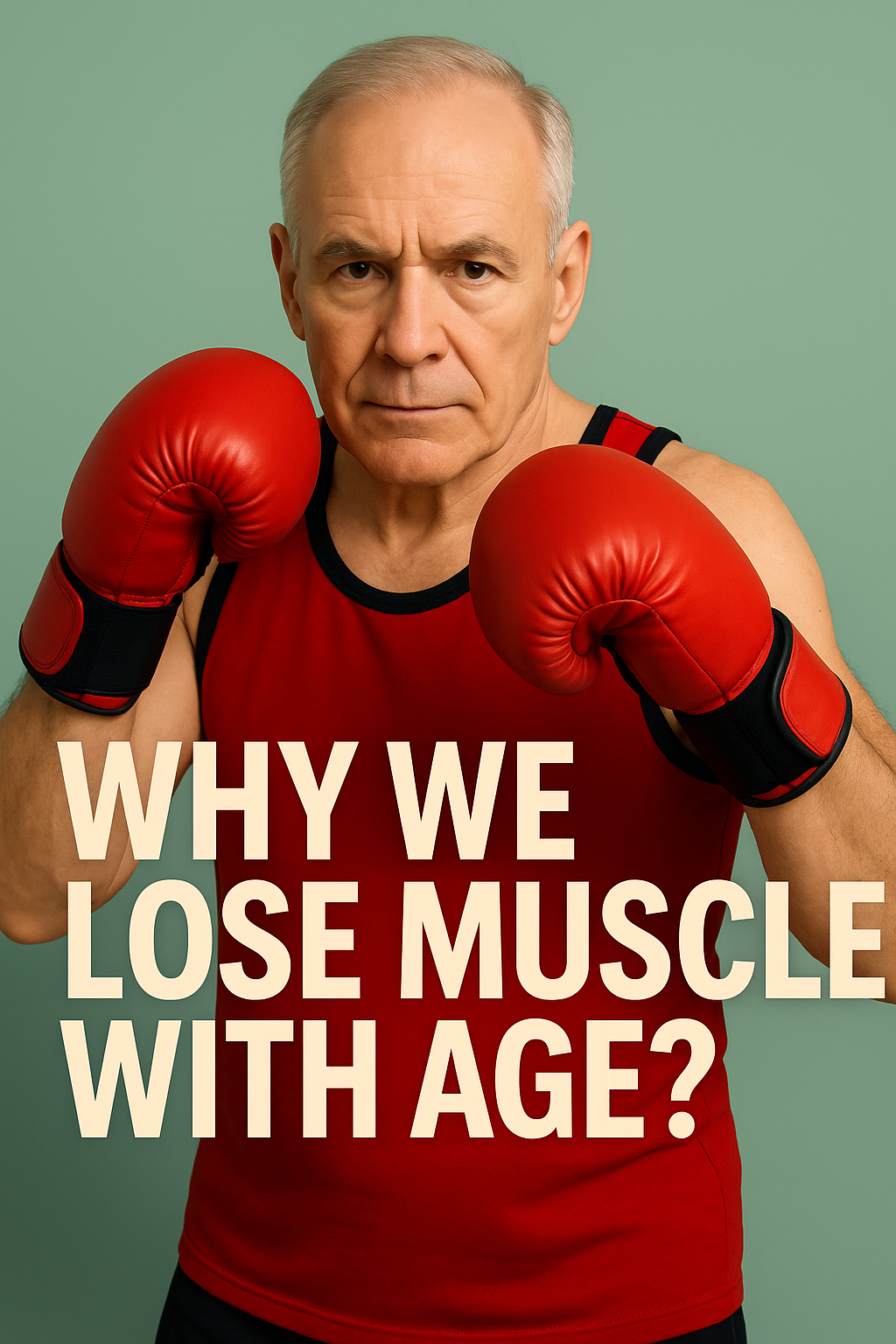

Why We Gain Weight With Age Even When We Don't Eat More: The Culprit Is a Process That Starts Around 40
expert, nutritionist
Here is a surprising fact: according to one of the largest studies ever done on human energy use, your metabolism does not mysteriously slow down in your 40s. An international team led by evolutionary anthropologist Herman Pontzer analysed data from more than 6,400 people aged 8 days to 95 years. They found that daily energy expenditure, adjusted for body size, stays remarkably stable from about age 20 to 60 (Pontzer et al., "Daily energy expenditure through the human life course", Science, 2021). So if your diet hasn't changed but your waistline has, something else is going on. That something is hiding in your muscles.
Even Arnold Schwarzenegger Trains to "Keep What He Has"
Few people have built more muscle than Arnold Schwarzenegger, seven-time Mr. Olympia. Yet even he has had to change his approach with age. In an interview with Insider shortly before his 75th birthday, he explained that he still works out every day for up to an hour and a half: 45 to 60 minutes of cycling and about 30 minutes of weights. His goal is no longer building a record-breaking physique. "Now I workout to maintain as much as I can as I get older," he said (Business Insider). The same article noted that muscle mass gradually starts to decrease from around age 40. If the most famous bodybuilder in history has to work to hold on to his muscle, the rest of us can't take it for granted either.
Many of our readers describe a very similar story. Picture someone in their mid-forties who eats exactly the same breakfast, lunch and dinner they ate ten years ago, yet notices their trousers getting tighter every year. Nothing on the plate has changed. What has changed, quietly and almost invisibly, is the body underneath.
Why Losing Weight (and Keeping It Off) Gets Harder
Everyone has learned firsthand how difficult it is to lose weight, and how even harder it is to keep the kilograms off. Without determination and willpower it can feel almost impossible. The most surprising part is that the weight gain is not caused by food alone. Food is still part of the equation, but a big piece of the puzzle is what happens to our muscles over time.
Muscle mass tends to grow until around age 30 and then slowly begins to decline. After 40, many people start to notice the change. According to Harvard Health Publishing, men may lose as much as 3% to 5% of their muscle mass per decade after age 30, and most men lose about 30% of their muscle mass over a lifetime. The good news from the same source: this decline is part of aging, but it is not inevitable.
What Is Sarcopenia?
This process is called sarcopenia: the gradual, age-related loss of muscle tissue and of its effectiveness. It shows up as reduced muscle strength, less power and poorer endurance. Research also shows that older muscles respond less strongly to the protein we eat. In one study, published in PLOS ONE (Wall et al., 2015), muscle protein synthesis after a protein-rich meal was about 16% lower in men in their seventies than in young men. Scientists call this "anabolic resistance." In practical terms, our muscles need a little more encouragement as we get older.
Fat Moves In Where Muscle Moves Out
As muscle declines, its place is often taken by fat, and fat is much harder to keep within the limits we would like. Muscle is metabolically active tissue. When there is less of it, the body tends to need somewhat fewer calories, so if portions stay the same, the surplus can gradually be stored. Other factors add to the effect:
- A sedentary lifestyle, which becomes more common with age: the older we get, the more we tend to sit.
- Stress, which can encourage cravings for sweet and fatty comfort foods.
- Lack of sleep. Read more in our article When you sleep too little, your belly grows.
- Hormonal changes, including the transition into menopause for women and a gradual decline in testosterone for men.
Tip 1: Move Your Muscles at Least Twice a Week
If we want to keep a reasonably slim figure, we can't avoid extra exercise at least twice a week. This matches public health advice: the U.S. Centers for Disease Control and Prevention (CDC) recommends that adults 65 and older do muscle-strengthening activities on at least 2 days per week, alongside about 150 minutes of moderate aerobic activity such as brisk walking. Strength exercise doesn't have to mean a gym. Squats or standing up from a chair, wall push-ups, step-ups on a stair and resistance-band exercises all count. Increase the effort gradually as you get stronger.
Tip 2: Give Your Body Time to Recover and Sleep Well
We also need to give the body enough time for the muscles to rebuild and regenerate. The older we are, the slower these processes become, and the more sleep and rest we may need. A sensible approach is to avoid working the same muscle groups on two consecutive days and to treat good sleep as part of your training plan, not an afterthought.
Tip 3: Choose Lean Protein and Spread It Through the Day
Eat foods rich in lean protein. Good sources include eggs, fish, poultry, legumes (lentils, beans, chickpeas), dairy, nuts and seeds. Leafy green vegetables don't contain much protein, but they belong on the plate for their fibre, vitamins and minerals.
Eggs deserve a special mention. A small study published in the American Journal of Clinical Nutrition (van Vliet et al., 2017) found that after strength exercise, eating whole eggs stimulated muscle protein synthesis more than an equal amount of protein from egg whites alone. The study was done in young men, so we shouldn't overgeneralise, but it suggests the yolk is worth keeping.
How much protein? Many people get by on the standard recommendation of roughly 0.8 g per kilogram of body weight. However, a review in the American Journal of Clinical Nutrition notes that some experts suggest 1.0 to 1.6 g per kilogram for better muscle health during aging. If you have kidney disease or another medical condition, check with your doctor before increasing your protein intake. Harvard Health also advises dividing protein fairly evenly across your daily meals instead of saving most of it for dinner.
It's just as useful to know what to limit. See our guide 6 foods you shouldn't eat after turning 40 – one everyday food hides an unexpected trap.
Don't Skip Meals to "Save" Calories for the Evening
Avoid skipping meals, especially with the idea that you'll be able to eat more calories in the evening to make up for it. This strategy often backfires: you arrive at dinner ravenous, eat quickly and usually eat more than you planned. It can also make it harder to spread your protein across the day.
It's a common belief that frequent small meals "speed up" metabolism and help burn fat. The research doesn't really support this. What matters more is the overall quality and amount of what you eat over the day. Still, regular, balanced, tasty meals rich in protein and fibre help many people keep hunger under control and avoid evening overeating. That makes them a practical tool rather than a magic trick.
Counting calories alone also rarely tells the whole story. Two meals with the same calories can affect fullness very differently: one built on vegetables, legumes and lean protein will usually keep you satisfied far longer than one built on refined snacks. For some sneaky diet traps, read Hello, and Fattening: Foods that Sabotage Your Diet.
The Bottom Line
Gaining weight with age is common, but it is not simply "bad luck" or a broken metabolism. Gradual muscle loss, less movement, stress, poor sleep and hormonal shifts all play a part. The encouraging message from research is that muscles keep responding to training and good nutrition at any age. Two strength sessions a week, enough protein spread across your meals, regular meals instead of skipped ones, and good sleep are simple habits that can help you feel stronger and keep your weight in check for years to come.
Information on this website is for educational purposes only and is not medical advice.
expert, nutritionist
 Would you like to be informed about news on the website?













|

