





Flour, Water and an Apple: How to Grow a Homemade Sourdough Starter That Will Change Your Bread Forever
expert, nutritionist
Did you know that what makes homemade bread truly different from store-bought isn't the flour or the water, but the starter? It's the living, fermented base that gives bread its soul. When you make it at home, you know exactly what's in it. No stabilizers, no preservatives, no mysterious chemical names on a label. Just flour, water, and nature doing its work.
Even Hollywood got hooked. During the 2020 lockdowns, actor Jake Gyllenhaal told Stephen Colbert on The Late Show that he had fallen in love with sourdough and asked a baker friend from The Mill in San Francisco to teach him how to make a starter. As Time Out reported, his first starter didn't really take off, until a little rye flour brought it back to life. It's a comforting reminder that even a movie star's starter can sulk at first, and that a bit of patience usually fixes it.
A friend who has been baking bread for years once told me that he made his first starter almost by accident. He left flour and water in a jar and forgot about it for three days. When he lifted the lid, he was greeted by a tangy smell and a cluster of bubbles. Today, he wouldn't trade that starter for any store-bought yeast in the world.
Why Bother With a Homemade Starter?
Store-bought yeast isn't dangerous, but many instant varieties contain added emulsifiers that extend shelf life and boost rising power. Industrially produced bread goes further still: its ingredient list can include several dough conditioners that simply aren't needed in a home kitchen, such as L-cysteine, potassium bromate and azodicarbonamide. Both of the latter are banned in the European Union, and azodicarbonamide has been linked to respiratory complaints among workers who handle it in powdered form.
A homemade starter is a living culture, an ecosystem of lactic acid bacteria and wild yeasts that ferment dough together. A study published through the NIH's PubMed Central reports that fermentation with such a culture can improve nutrient availability, increase the antioxidant properties of bread and support digestive comfort. A 2024 review (NIH/PMC) adds that natural fermentation may lower the glycemic response to bread and improve mineral bioavailability, partly because the long fermentation breaks down phytic acid, a compound in grain that binds minerals such as iron and zinc.
Of course, sourdough is still bread, and portion size matters. If you want to keep an eye on how bread fits into your daily menu, read Hello, and Fattening: Foods that Sabotage Your Diet, and for smart advice on which bread to pick in the evening, see The ideal time for dinner is 7 PM.
Recipe: Homemade Sourdough Starter With Apple
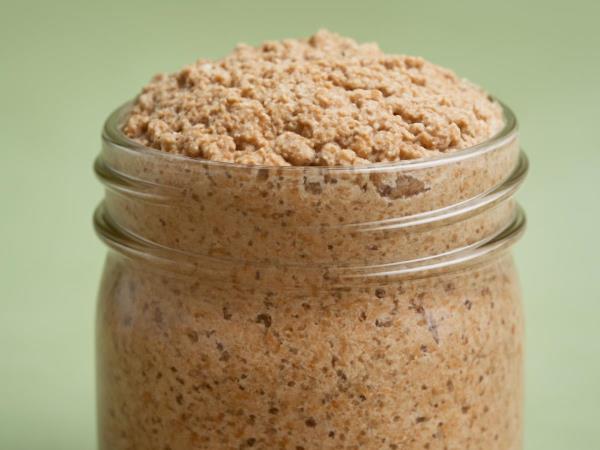
In principle, all you need for a starter is flour and water. Adding fruit, however, gives the wild yeasts an extra boost, speeds up fermentation and adds a pleasantly tangy note. Apples and grapes work best because their skins naturally carry wild yeasts. This time, we're using an apple.
What You Need:
- 1/2 organic apple (with the peel)
- 500 g strong white bread flour
- 350 ml lukewarm water
- A clean glass jar or container with a lid
Method – Stage 1 (Days 1–3):
- Use an organic apple, since you'll need the peel. If you're unsure how clean it is, soak it in apple cider vinegar for 10 minutes and rinse it well under running water.
- Grate half of the apple, peel and all.
- Add 500 g of strong flour and 350 ml of lukewarm water. Mix everything thoroughly.
- Transfer the mixture to a glass jar and cover it. During fermentation, keep the jar covered and undisturbed at room temperature (ideally 22–26 {-15696}C). Rest the lid on loosely, or remove the rubber seal from a clip-top jar, so the gases produced during fermentation can escape safely.
Method – Stage 2 (Days 4–6):
- After about three days, tiny bubbles will appear. This is the sign that fermentation has begun and the mixture is slowly growing.
- Remove half of the mixture, then add 250 g of strong flour and 170 ml of lukewarm water to the rest. Stir and leave at room temperature.
- When this mixture becomes bubbly too, and roughly doubles in size within a few hours of feeding, your starter is ready.
💡 Golden rule: Never take all of the mixture out of the jar. Always leave at least half, so fermentation doesn't stop. That way, your starter can live for weeks, months and even years. Some bakeries proudly use starters that are decades old.
Readers who have tried this method often say the first batch smells surprisingly fruity, almost like cider, and then settles into a milder, yogurt-like tang after the second feeding. That's perfectly normal: the balance of yeasts and bacteria is simply finding its rhythm.
Why Fermentation Is More Than Just "Rising"
Fermentation is a biological process in which yeasts and bacteria break down the sugars in flour, releasing CO₂ (which lifts the dough) and lactic acid (which gives the tangy flavor and acts as a natural preservative). This is also why well-fermented sourdough often stays fresh longer than ordinary bread. For another clever way to keep your loaf soft for days, try the trick in Celery in a bag with bread: a simple trick that only a few know, but it works surprisingly well.
Fermented foods in general are attracting a lot of scientific interest. A well-known Stanford University study published in the journal Cell found that people who ate more fermented foods over ten weeks showed greater gut microbiome diversity and lower levels of several inflammatory markers. Fermentation can also increase the content of certain B vitamins in food. Keep in mind that baking heat inactivates the live microbes in sourdough, so much of the benefit of bread comes from what fermentation does to the dough before it goes into the oven.
Interestingly, WebMD summarizes several studies suggesting that antioxidants in naturally fermented bread may contribute to overall well-being as part of a balanced diet.
One important note: sourdough fermentation reduces some gluten proteins, and many people find sourdough gentler on digestion, but regular wheat sourdough is not gluten-free and is not suitable for people with celiac disease.
Your Starter: More Than Just an Ingredient for Bread
A homemade starter isn't only for loaves. The portion you remove at each feeding, called "discard," is perfect for pancakes, waffles, crackers, pizza bases and flatbreads, and a spoonful can be stirred into soups or stews while they simmer to add body and a gentle tang.
Always cook or bake your starter before eating it. A starter is made from raw flour, and the U.S. Food and Drug Administration (FDA) warns that raw flour can carry harmful bacteria such as E. coli, which are only destroyed by heat. This is especially important for children, pregnant women and older adults.
In many European traditions, people once called natural yeast a "gift from God," mostly referring to brewer's yeast, a different product. The University of Rochester Medical Center notes that brewer's yeast is rich in protein and B-complex vitamins, but it is sold as a separate supplement and is not the same as a sourdough starter. If you're considering brewer's yeast, talk to your doctor or pharmacist first, as it isn't suitable for everyone.
⚠️ The content of this article is for informational purposes only and does not replace professional medical advice. Please consult your doctor or a registered dietitian before making significant changes to your diet.
Tips for Keeping Your Starter Happy
- Store it in the fridge when you're not baking regularly. Fermentation slows down in the cold, but the starter stays alive.
- Feed it once a week with a spoonful or two of flour and a little lukewarm water to keep it active. Before baking, take it out of the fridge and give it one or two feedings at room temperature.
- Glass is best. It doesn't absorb odors, it's easy to clean, and you can see the bubbles at work.
- Mark the level with a rubber band after feeding, so you can easily see how much it rises.
- A tangy, yogurt-like or mildly cheesy smell is normal. A grey liquid on top ("hooch") just means it's hungry: pour it off or stir it in, then feed. Pink, orange or fuzzy mold, however, means something went wrong, and the whole batch should be thrown away.
- Sluggish starter? Do what Jake Gyllenhaal did and add a little rye or whole-grain flour. It's richer in nutrients for the yeasts and often wakes a lazy starter right up.
Frequently Asked Questions
How long does a sourdough starter last?
With regular feeding, a starter can last indefinitely. Many bakers keep the same starter going for years.
Can I use all-purpose flour instead of bread flour?
Yes. It will work, although strong bread flour or a mix with some whole-grain flour usually gives a more vigorous, reliable starter.
Why isn't my starter bubbling?
The most common reasons are a cold kitchen, chlorinated tap water or not enough time. Move it somewhere warmer, try filtered or boiled-and-cooled water, and give it a few more days.
A homemade starter is a little bit of science, a little bit of patience and a lot of satisfaction. The first time you bake bread with a starter you raised yourself, you'll understand why it's all worth it. Real homemade bread truly is different, and it all begins right here.
Information on this website is for educational purposes only and is not medical advice.
expert, nutritionist
 Would you like to be informed about news on the website?










|

