





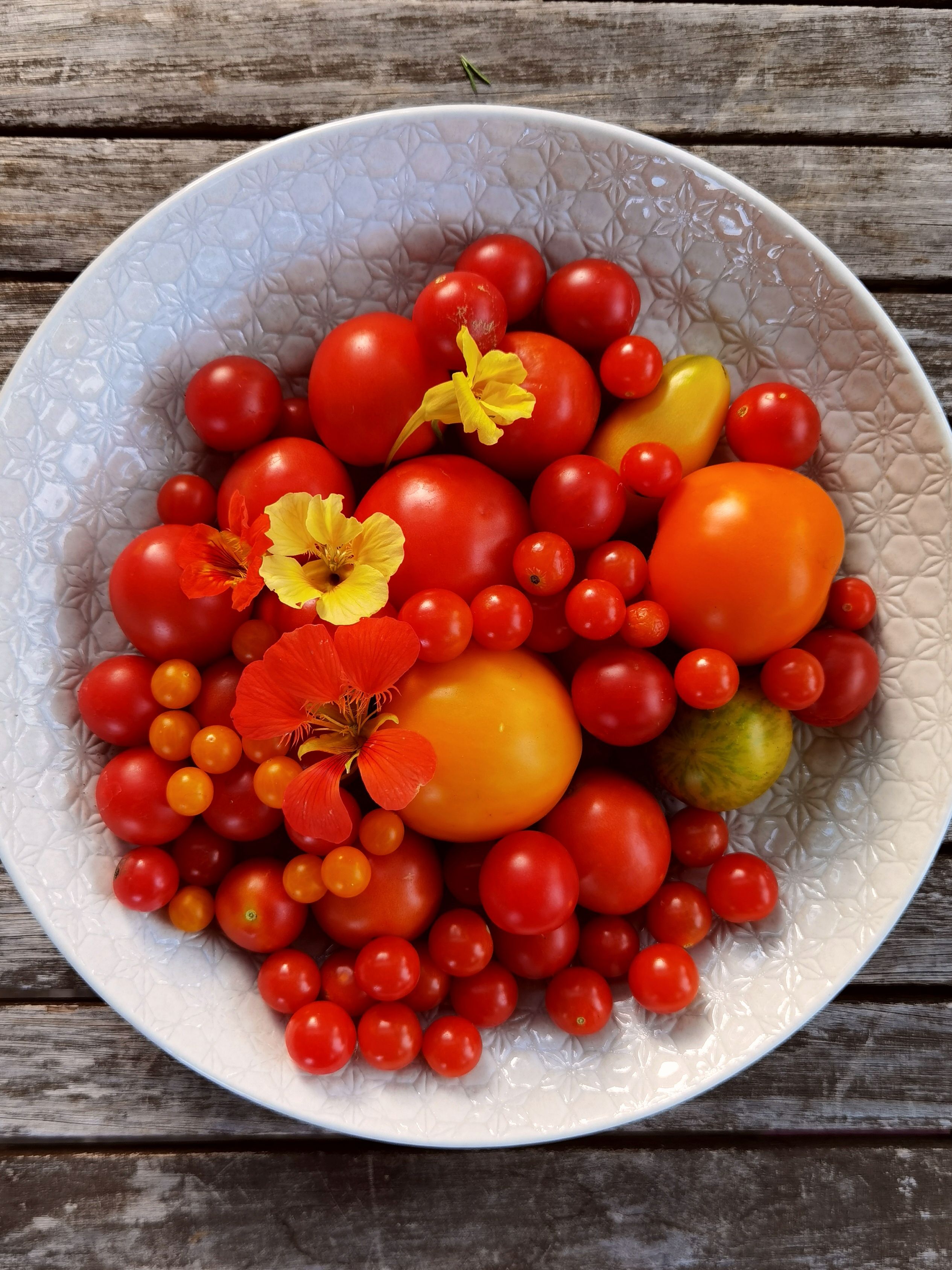

Summer Tomatoes: Why This Simple Fruit Deserves a Daily Spot on Your Plate
expert, nutritionist
Picture a fruit so distrusted that European aristocrats once displayed it only as a decoration, convinced that a single bite could kill. Now picture that same fruit sitting in nearly every refrigerator on the planet, starring in everything from a Neapolitan pizza to a chilled gazpacho. That's the strange, delicious story of the tomato — and summer, when the fruit is at its ripest and reddest, is exactly when it has the most to offer.
Few people did more to rehabilitate the tomato's reputation in the English-speaking world than Thomas Jefferson. The third President of the United States was, among his many pursuits, a dedicated gardener, and his meticulous garden journals show him planting tomatoes at his Monticello estate every year from 1809 until his death in 1826 (Thomas Jefferson's Monticello). At a time when most of his neighbors still considered the "wolf peach" a poisonous curiosity, Jefferson was quietly eating it, growing dozens of varieties, and serving it to guests — helping turn a feared nightshade into an American kitchen staple.
A Fruit With a Suspicious Past
The tomato's botanical name, Solanum lycopersicum (formerly classified as Lycopersicon lycopersicum), translates loosely to "wolf peach." It belongs to the nightshade family, Solanaceae, alongside potatoes and eggplants — and that unflattering nickname wasn't entirely paranoid.
The leaves and stems of the tomato plant do contain bitter, naturally occurring compounds called alkaloids, which the plant produces as a defense against pests. The fruit itself, however, is both safe and, as it turns out, remarkably nutritious.
Names for the tomato vary charmingly across cultures. The French once called it pomme d'amour ("love apple"), believing it worked as an aphrodisiac, while the Italians named it pomodoro ("golden apple"), a nod to the yellow color of the first varieties Europeans encountered.
Today there are more than 10,000 recognized tomato varieties — from cherry tomatoes weighing under 20 grams to giant beefsteak types topping 500 grams — and colors that go well beyond red, including white, green, black, purple, orange, and striped fruits.
From the Andes to the World's Kitchens
It's hard to imagine Italian cuisine without tomatoes, yet the plant is originally native to western South America and the Gal{-15455}pagos Islands. Long before Europeans arrived, Indigenous peoples in Mesoamerica were already cultivating it, likely drawn to its resemblance to the tomatillo, a small, tart, papery-husked fruit still used in Mexican cooking today.
Spanish colonizers brought tomato seeds back to Europe in the 16th century. For roughly two hundred years, most Europeans grew the plant purely as an ornamental curiosity, wary of its nightshade relatives. It wasn't until the 18th century that the tomato became a genuine kitchen ingredient across the continent — a slow-burn success story if there ever was one.
What's Actually Inside a Tomato
A medium tomato contains roughly 22 calories, and because about 95% of its weight is water, it doubles as a genuinely hydrating summer food. The remaining 5% is made up of fiber and carbohydrates, alongside a notable spread of vitamins and minerals.
Standout nutrients include:
- Vitamin C: one tomato provides roughly 40% of the recommended daily intake, an antioxidant vitamin whose role in immune function is documented by the U.S. National Institutes of Health.
- Vitamin K1: important for bone health, since it activates osteocalcin, a protein that helps bind calcium into bone tissue.
- Folate: essential for healthy cell division and studied for its possible role in colon health.
- Biotin (vitamin B7): supports normal metabolism and skin function.
- Riboflavin (vitamin B2): a randomized controlled trial published in the journal Neurology found that high-dose riboflavin supplementation (400 mg/day) reduced migraine attack frequency compared with placebo in adults with migraine (Schoenen et al., Neurology, 1998). It's worth noting this research used concentrated supplement doses far beyond what any amount of tomatoes could provide, so think of this as interesting context rather than a reason to self-treat migraines with diet alone — always check with a doctor about persistent headaches.
- Chromium: plays a role in blood sugar regulation, which is relevant for people managing type 2 diabetes.
- Lycopene: the pigment responsible for the tomato's red color, and a member of the carotenoid family. It's considered one of the more potent dietary antioxidants, helping to neutralize free radicals that can damage cells over time.
One of the most frequently cited pieces of research on tomatoes and health comes from the Harvard-affiliated Health Professionals Follow-up Study, led by Dr. Edward Giovannucci. Tracking the diets of tens of thousands of men over several years, the researchers found that those who ate the most tomato-based foods had a meaningfully lower incidence of prostate cancer compared to those who ate the least (Giovannucci et al., Journal of the National Cancer Institute, 1995; follow-up analysis: Giovannucci et al., 2002). It's an association, not proof of cause and effect, but it's one of the more consistent findings in nutrition research and a big part of why tomatoes have such a strong reputation.
Interestingly, the body appears to absorb lycopene more efficiently from cooked tomatoes, especially when a little oil is involved, than from raw ones — something Foodwhisper has explored in more detail here. Tomato sauce, soup, and even ketchup (provided it isn't loaded with added sugar) can offer more bioavailable lycopene than a fresh, raw tomato. Pairing tomatoes with a source of healthy fat, such as olive oil or avocado, appears to boost absorption even further — a pairing Foodwhisper has written about in its piece on foods that improve nutrient absorption.
Lycopene has also been studied in relation to breast, lung, and stomach health, and there's some early evidence it may help protect skin against sun damage from the inside out. A German study published in the Journal of Nutrition found that volunteers who consumed roughly 16 mg of lycopene a day from tomato paste (about the amount in two large tomatoes) for ten weeks showed measurably less UV-induced skin redness than a control group (Stahl et al., Journal of Nutrition, 2001). That's a promising finding, though it's no substitute for sunscreen and sensible sun habits.
Tomatoes and Heart Health
Beyond lycopene, tomatoes contain potassium, which supports healthy blood pressure regulation, along with niacin and vitamin B6, both involved in fat metabolism and in keeping homocysteine — an amino acid linked to cardiovascular risk when elevated — in check.
The Kuopio Ischaemic Heart Disease Risk Factor Study, a long-running Finnish cohort study, found that men with the lowest blood levels of lycopene had a substantially higher risk of coronary events and stroke compared with men with the highest levels (Karppi et al., published via the American Academy of Neurology). A separate Finnish trial found that a high-tomato diet measurably reduced total and LDL cholesterol over just a few weeks (Silaste et al., British Journal of Nutrition, 2007). Foodwhisper has previously looked at how tomato juice specifically may support healthy cholesterol levels in this related article.
Fiber for Gut Health and Beyond
Tomatoes contain around 1.5 grams of dietary fiber per 100 grams. Fiber does more than support regularity — it also plays a role in blood sugar regulation and feeds beneficial gut bacteria. The large-scale European EPIC study, which followed hundreds of thousands of participants, found that people with the highest fiber intake had a notably lower incidence of colorectal cancer than those with the lowest intake (Bingham et al., The Lancet, 2003).
Folk Wisdom Meets Modern Science
Tomatoes have shown up in home remedies for centuries. In parts of the Balkans, they were once rubbed on insect bites to soothe itching. In India, warm tomato juice has traditionally been used to ease joint discomfort. Neither practice has been rigorously confirmed by clinical trials, but tomatoes do contain compounds with mild anti-inflammatory properties, which may explain why these traditions persisted.
In Russia, tomato juice was once recommended to pregnant women as a way to "cleanse the blood." Today, we understand this folk wisdom a little differently: tomato juice's vitamin C content can help the body absorb iron from food more efficiently, which may be genuinely useful for preventing iron-deficiency anemia.
Foodwhisper readers have shared their own tomato traditions over the years too — from grandmothers who swore by a spoonful of olive oil in every tomato salad, to home cooks who freeze bags of tomato sauce every August so a taste of summer survives the winter. If you have a favorite way of using summer tomatoes, we'd love to hear it in the comments.
When and How to Eat Tomatoes
For the best nutritional payoff, eat tomatoes when they're fully ripe — which, conveniently, is exactly what summer delivers. A deep red color signals peak lycopene content. If you've bought tomatoes that aren't quite ripe, let them finish ripening at room temperature; refrigeration tends to dull both flavor and some of the nutrient content.
Cooking tomatoes with a small amount of oil — olive oil is the classic choice — appears to boost lycopene absorption, which is one reason olive-oil-dressed salads, tomato sauces, and minestrone-style soups are such solid choices. Tomato paste and sauce also freeze well, retaining most of their nutritional value.
The Bottom Line
A ripe tomato is more than a bright spot on the plate. Between its hydration content, its fiber, and compounds like lycopene and vitamin C that researchers continue to study for their possible role in heart and cell health, it's a food with a genuinely interesting nutritional profile. Summer, when tomatoes are at their ripest and most flavorful, is simply the best time to make the most of it — as part of a varied diet that includes plenty of other fruits and vegetables. As always, this article is for general information purposes and isn't a substitute for personalized medical or dietary advice.
Information on this website is for educational purposes only and is not medical advice.
expert, nutritionist
 Would you like to be informed about news on the website?















|

