





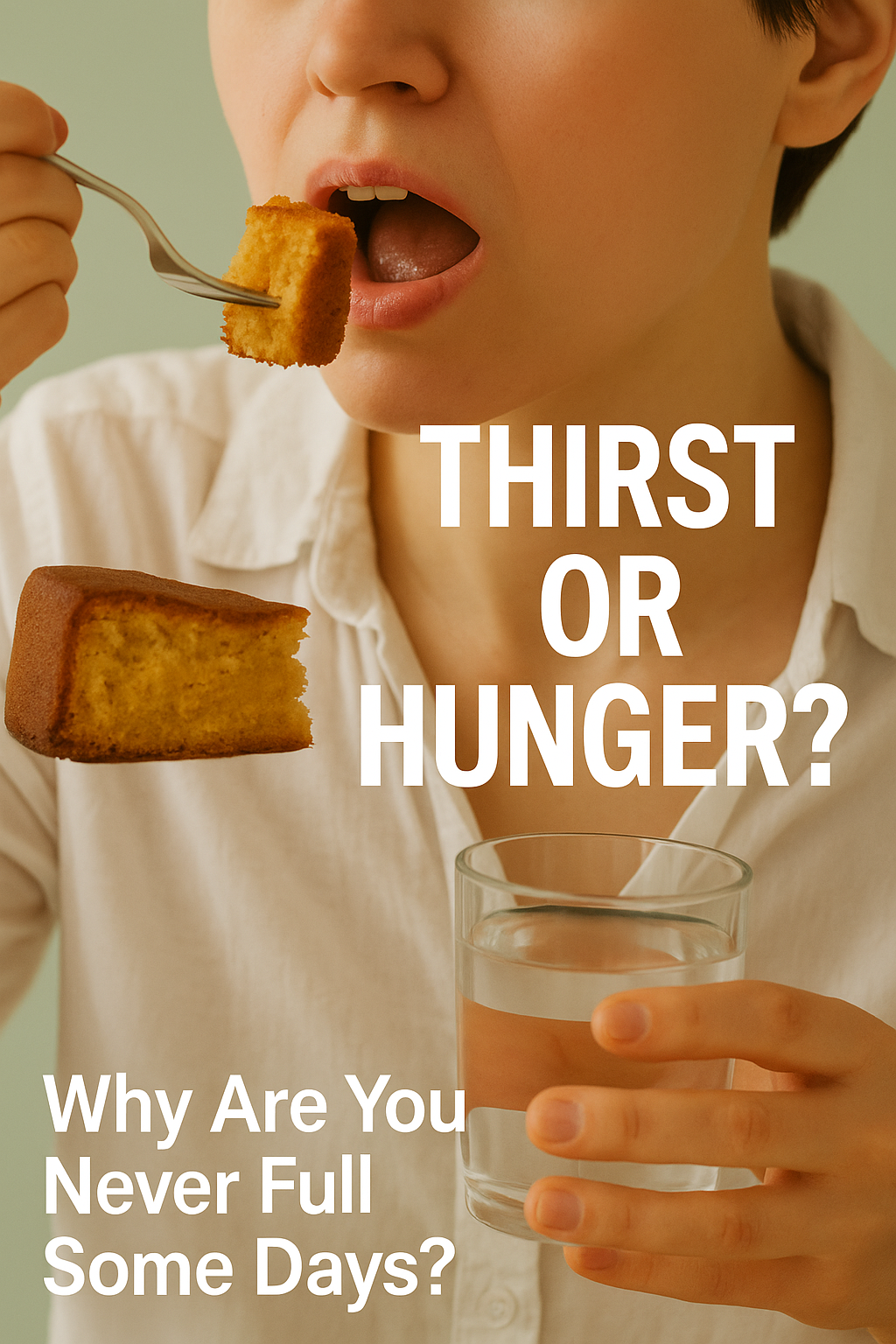


Why Are You Never Full Some Days? 7 Hidden Signals Your Body Might Be Sending You
expert, nutritionist
It's 3 p.m., you've already had lunch and a snack, and you're standing in front of the open fridge like it owes you an explanation. Sound familiar? Almost everyone has days like this, and readers of this site describe the exact same thing over and over in their messages: a wave of hunger that shows up out of nowhere and doesn't seem to care how much you just ate. The good news is that this kind of hunger usually isn't random. It tends to follow a short list of everyday triggers — and once you can name the trigger, it's much easier to deal with it instead of quietly overeating and feeling frustrated afterward.
Below are seven of the most common reasons your appetite might be working overtime, along with what current research says about each one.
1. You Might Be Dehydrated
The line between thirst and hunger is thinner than most people think. Thirst signals and hunger signals travel through overlapping pathways in the brain, which is part of why it's so easy to reach for a snack when what your body actually needed was a glass of water. Nutrition counselors who work on weight management routinely point out that staying ahead of thirst helps keep appetite signals clearer, and that the brain frequently misreads thirst as hunger, which can lead to eating more than the body actually needs.
A simple way to check your own hydration is the skin-pinch test: gently pinch the skin on the back of your hand. If it snaps back instantly, you're likely fine; if it stays tented for a moment, your skin has lost some elasticity and a glass of water is probably overdue. It's not a medical test, just a quick, low-effort habit check — try it a few times over a week and you'll start to get a feel for your own baseline. Our related piece on 10 reasons why every weight loss diet fails makes a similar point: many people confuse hunger and thirst constantly, and it quietly derails their eating patterns.
2. You Might Not Be Sleeping Enough
Ravenous days often follow short, restless nights, and there's real biology behind that pattern. A frequently cited clinical study from the University of Chicago, published in Annals of Internal Medicine, found that just two nights of shortened sleep in healthy young men was associated with a drop in leptin (a hormone that helps signal fullness) and a rise in ghrelin (a hormone that stimulates appetite), alongside self-reported increases in hunger and appetite. Not every study agrees on the exact hormonal mechanism — some more recent reviews report mixed results — but the practical, lived experience lines up: Stanford's Lifestyle Medicine program notes that consistent sleep deprivation is linked with a general pattern of feeling hungrier and craving more food.
A weekend nap won't undo this the way a full night's sleep will, because the goal isn't just "more rest" in general — it's restoring the hormonal rhythm that regulates appetite day to day. If this sounds familiar, our deeper dive on what happens to your body when you sleep too little walks through exactly how sleep debt and appetite are connected.
3. You're Eating a Lot of Simple Carbohydrates
Simple carbohydrates — white bread, pastries, sweets, and refined starches like white rice and potatoes — are broken down quickly and can send blood sugar up in a hurry. What goes up quickly tends to come back down quickly too, and that crash is often experienced as sudden, urgent hunger rather than as "low blood sugar." According to research referenced by the American Heart Association, people who regularly eat sugar first thing in the morning can experience a sharp drop in glucose within about two hours of breakfast, which shows up as drowsiness, irritability, and a false sense of hunger.
You don't necessarily need to cut these foods out entirely — but pairing them with fiber, protein, or healthy fat slows down digestion and tends to smooth out that spike-and-crash pattern. Our article on why sweets on an empty stomach leave your body unsatisfied goes into more detail on how this works and what a more balanced first meal of the day can look like.
4. You're Under Stress
Short bursts of stress usually suppress appetite — think of the "too nervous to eat" feeling before a big presentation. But when stress lingers for days or weeks, the picture flips. Harvard Health Publishing explains that ongoing stress keeps cortisol elevated, and cortisol tends to increase appetite and steer cravings toward foods that are high in fat and sugar. It's a big enough phenomenon that researchers now talk about generational shifts in stress exposure — chronic, daily stress simply wasn't as common a few decades ago, and today it affects a large share of young people, driven by demanding jobs but also, increasingly, by school and academic pressure.
A warm bath, breathing exercises, gentle yoga, or just a hobby that fully occupies your attention won't make a stressful week disappear, but they can take the edge off the cortisol response — and, over time, off the cravings that come with it. Our piece on 10 reasons why every weight loss diet fails lists stress as one of the most underrated obstacles people run into.
5. Your Protein and Fat Intake Might Be Out of Balance
Greek yogurt, eggs, chicken, avocado, nuts, and fatty fish all share one thing in common: they tend to extend the feeling of fullness longer than refined carbohydrates do. That's not just folk wisdom — one commonly cited 2020 finding, described in our article on whether yogurt really works wonders, found that people who ate more protein-rich meals went on to eat notably fewer calories at their next meal. The catch is balance: this effect seems to depend on having both adequate protein and adequate healthy fat in your diet, not just piling on one or the other. As long as your body is running short on either, you may keep feeling hungry no matter how much you eat.
If you're looking for easy ways to build more of this balance into your day, our article on peas and stable blood sugar is a good, budget-friendly starting point.
6. You're Not Eating Often Enough
If you go the entire day without eating much, it's completely normal to arrive home starving. That kind of hunger isn't a signal that something is biologically wrong — it's your body telling you that your eating pattern needs adjusting. A commonly recommended rhythm is a substantial meal roughly every 4–5 hours, with a lighter snack in between, which in practice often works out to eating something small every couple of hours. Our guide to 10 mandatory eating rules covers this kind of spacing in more detail, including why it also matters to leave enough time between your last meal at night and breakfast.
Skipping meals tends to backfire in a very specific way, too: our article on why it's worth not skipping breakfast even after a big dinner notes that people who skip a meal because they "aren't hungry" often end up eating considerably more later in the day to compensate.
7. You're Eating Too Quickly
There's no direct nerve line from your stomach to your brain that fires the instant you've had enough — the fullness signal actually depends on hormones like leptin and cholecystokinin traveling through your bloodstream, which takes time. Live Science reports that this delay is, on average, around 20 minutes. If you eat quickly, a lot can happen in that window: you can easily eat past the point of comfortable fullness before your brain has caught up, taking in more food, and food you might not have chosen if you'd paused to notice.
A practical target is to make each meal last at least 20–30 minutes, phones and screens put away, so you're actually paying attention to what you're eating and how it tastes. Distractions during meals don't just make eating less enjoyable — they seem to stretch out that gap between your stomach and your brain even further. Our article on what happens when you eat pears mindfully touches on this same idea of slowing down and paying attention to how food actually makes you feel.
The Bottom Line
Persistent, hard-to-satisfy hunger is usually your body pointing at something specific — not enough water, not enough sleep, a diet leaning too heavily on refined carbs, ongoing stress, an imbalance between protein and fat, too much time between meals, or simply eating too fast to notice you're full. None of these are character flaws, and most of them respond well to small, unglamorous adjustments rather than a complete overhaul. If unusually intense hunger is new for you, doesn't improve with these kinds of changes, or comes with other symptoms that concern you, it's worth mentioning to a doctor or registered dietitian, since they can rule out other causes and tailor advice to your situation.
Information on this website is for educational purposes only and is not medical advice.
expert, nutritionist
 Would you like to be informed about news on the website?















|

